
Check whether your RV appliances fit a 50 amp hookup and whether one hot side could trip first.
Table of contents
How to use our RV 50 Amp Load Calculator
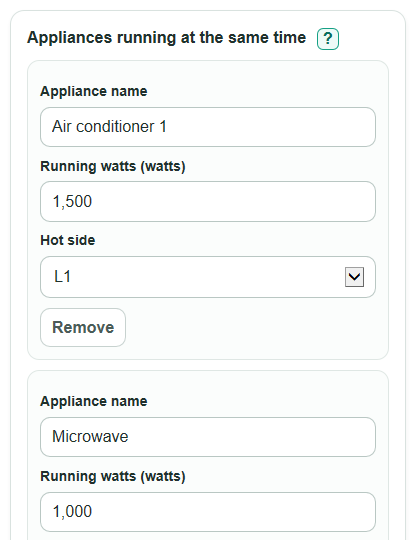
- In Appliances running at the same time, enter only items that may run together, using running watts from the label, manual, or a watt meter.
- Mark each row as L1, L2, or Not sure; choose Not sure when you do not know which hot side feeds that appliance.
- Open Advanced options if needed to change Voltage on each hot side, Advisory running limit, or Extra cushion for surprise loads.
- Click Calculate, then read Highest possible hot-side load first and check whether Room before the 50 A breaker is positive or negative.
- Sanity-check the result by comparing Total running load with the appliance watts you entered and by making sure any unknown or small loads are included in Loads marked Not sure plus cushion.
Definitions
Running watts: The steady power an appliance uses after it is already on, measured in watts.
Hot side: One 120 V side of a 50 amp RV hookup. A 50 amp RV service has two hot sides for load checking.
L1 and L2: The two 120 V hot sides. Each side is checked against 50 A.
Not sure: A load whose hot side is unknown. The calculator puts these watts on the heavier side for the main safety check.
Headroom: The amount left before a limit. Positive headroom means room left; negative headroom means the load is over that limit.
Advisory running limit: A planning target below or equal to 50 A, shown as a percent of one 50 A side.
Extra cushion for surprise loads: Added watts for small or missed loads, such as a converter, battery charger, or devices left plugged in.
Common mistakes and quick fixes
Mistake: Putting every RV appliance into Appliances running at the same time , even items that will not run together.
Fix: Enter the realistic worst-case group, such as air conditioner plus microwave plus converter, then run a second check for a different group.
Mistake: Using starting watts instead of running watts in Appliances running at the same time .
Fix: Use steady running watts for this load check; motor startup surges need a separate startup check.
Mistake: Marking all loads as L1 or L2 without knowing the real hot side.
Fix: Use Not sure in Appliances running at the same time when you do not know, because the calculator then checks the safer worst case.
Mistake: Leaving Voltage on each hot side at 120 when your pedestal is much lower.
Fix: Enter the measured voltage, because lower voltage makes the same watt load use more amps.
Mistake: Reading Total running load only and ignoring Highest possible hot-side load .
Fix: Use Room before the 50 A breaker to check the busiest one side, since one side can be overloaded before the total hookup is full.
Mistake: Treating a negative Room before your advisory limit as the same thing as a breaker trip.
Fix: Use it as a planning warning; the actual breaker check is Room before the 50 A breaker .
Limitations & Key Assumptions / Boundary Conditions
- This calculator checks steady running load, not short motor startup surge.
- It assumes a 50 amp RV hookup with two 120 V hot sides, each checked against 50 A.
- The hot-side result is conservative when rows are marked Not sure; real wiring may place those loads on either side.
- The result depends on the voltage you enter. If campground voltage drops, amps rise for the same watt load.
- Appliance watt ratings can vary by model, setting, temperature, and duty cycle. Use measured watts when accuracy matters.
- The advisory limit is only a planning target. It does not change the 50 A breaker rating.
- This tool does not inspect your RV wiring, pedestal condition, breaker condition, plug heat, extension cord rating, or code compliance.
Methodology
How the load check works
The calculator separates listed appliance watts by the hot-side choice in Appliances running at the same time. Rows marked L1 go into L1 watts, rows marked L2 go into L2 watts, and rows marked Not sure are held as unknown watts.
l1_watts = sum of watts for rows marked L1
l2_watts = sum of watts for rows marked L2
unknown_watts = sum of watts for rows marked Not sure + reserve_watts
For the main safety check, the calculator adds unknown watts to the already-heavier known hot side. This gives the Highest possible hot-side load, which is the primary answer because either hot side can reach its 50 A breaker before the total hookup is full.
max_hot_side_watts = max(l1_watts, l2_watts) + unknown_watts
max_hot_side_amps = max_hot_side_watts / voltage
Headroom and percent used
The calculator keeps signed headroom. A positive value means room left. A negative value means the load is over that limit.
breaker_headroom_amps = 50 - max_hot_side_amps
advisory_limit_amps = 50 * advisory_limit_percent / 100
advisory_headroom_amps = advisory_limit_amps - max_hot_side_amps
max_hot_side_percent = max_hot_side_amps / 50 * 100
Total watts
Total running load adds all known and unknown watts, including the cushion. Total 50 amp hookup capacity uses two hot sides, 50 A per side, and the entered voltage.
total_running_watts = l1_watts + l2_watts + unknown_watts
total_capacity_watts = 2 * 50 * voltage
Mini-example
Suppose L1 has 1,500 W, L2 has 1,000 W, Not sure has 600 W, reserve is 0 W, and voltage is 120 V. The heavier known side is L1, so the worst-case hot side is 1,500 W + 600 W = 2,100 W.
max_hot_side_amps = 2100 / 120 = 17.5 A
breaker_headroom_amps = 50 - 17.5 = 32.5 A
total_running_watts = 1500 + 1000 + 600 = 3100 W
That example has plenty of breaker room. If the highest possible hot-side load rises above 50 A, the result can show an overload even when total running watts are below the combined capacity.