
Estimate the generator size your RV needs from appliance watts, startup surge, safety buffer, altitude, and RV service size.
Table of contents
How to use our RV Generator Size Calculator
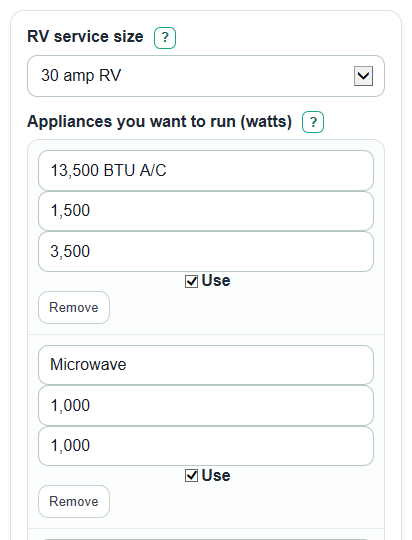
- Choose your RV service size, such as a 20 amp outlet, 30 amp RV, or 50 amp RV.
- Fill in Appliances you want to run with running watts and starting watts for each item you expect to use at the same time.
- Set Safety buffer and choose Round answer to based on whether you want a shopping-size answer or the exact minimum rounded to the next 100 watts.
- Open Advanced options only if you need to change How to count startup bursts, Camping altitude, or Output loss per 1,000 feet.
- Sanity-check the result by comparing Power used after everything is on with Approximate RV service limit; if the running room is negative, reduce loads before trusting the generator size.
Definitions
Running watts: The power an appliance uses after it is already on. In the calculator, this feeds Power used after everything is on.
Starting watts: A short burst of power some motors need when they start. Air conditioners, refrigerators, and pumps often need more starting watts than running watts.
Startup burst: The extra part of starting watts above running watts for one appliance. The calculator avoids counting the same running watts twice.
Safety buffer: Extra percent added after the load check. It gives room for small missed loads, hot-weather strain, and normal power dips.
Generator nameplate: The watt rating printed or listed for the generator. Use the running or rated watt value for sizing, not the higher surge-only rating.
RV service limit: The approximate watts your RV inlet or cord can carry, based on volts times amps. This is separate from how large the generator is.
Altitude output factor: The estimated share of sea-level generator output kept at the entered altitude. A factor of 0.79 means about 79 percent is kept.
Common mistakes and quick fixes
Mistake: Using peak generator watts for Recommended generator size .
Fix: Shop by the generator's running or rated watts, then use peak watts only as a short startup check.
Mistake: Leaving motor loads out of Appliances you want to run , especially an air conditioner or refrigerator.
Fix: Add each item you may run at the same time, with both running watts and starting watts.
Mistake: Entering a starting watt value below running watts in Appliances you want to run because the label lists only one number.
Fix: If the item has no startup burst or you only know one value, use the same value for running watts and starting watts.
Mistake: Treating RV service size as the same thing as generator size.
Fix: Check Approximate RV service limit and Running room left on RV service ; a larger generator cannot push 50 amp power through a 30 amp RV cord.
Mistake: Leaving Camping altitude at zero when you usually camp in the mountains.
Fix: Enter the highest normal camping elevation so Estimated output kept at altitude can raise the generator nameplate estimate.
Limitations & Key Assumptions / Boundary Conditions
- The appliance list is only as accurate as the watts you enter. Nameplate labels, manuals, and watt meters can differ from real use.
- The 50 amp RV service estimate assumes a 120/240 V split service and that loads can be shared across both legs. It does not check leg-by-leg balance.
- Altitude loss is a planning estimate. A specific generator manual may use a different derate rate or have fuel, carburetor, temperature, or maintenance limits.
- The startup setting is simplified. Real appliances may start seconds apart, overlap, or use soft-start devices that reduce the surge.
- The common generator size list is a shopping guide, not a standard. Actual models may have different rated watts, surge watts, outlets, noise, and fuel limits.
- This calculator checks watts, not plug shape, breaker coordination, transfer switch safety, grounding, neutral bonding, or code compliance.
Methodology
How the calculator totals the load
The calculator includes only the appliance rows marked as used at the same time. Running watts are added first. Then the calculator adds either the single largest startup burst or all startup bursts, depending on How to count startup bursts. This follows the practical RV sizing idea that the generator must cover normal running load plus startup surge, often from the largest motor load [2].
running_watts = sum(running_watts_i)
extra_start_i = max(0, starting_watts_i - running_watts_i)
if start_policy = largest_one: starting_peak_watts = running_watts + max(extra_start_i)
if start_policy = all_at_once: starting_peak_watts = running_watts + sum(extra_start_i)
How buffer and altitude change the generator size
The calculator uses the larger of running watts and the startup peak, then adds the selected safety buffer. It then divides by the altitude output factor, because a fuel-powered generator may deliver less usable output at higher elevation.
needed_watts_before_altitude = max(running_watts, starting_peak_watts) * (1 + safety_buffer_pct / 100)
altitude_output_factor = max(0.5, 1 - (altitude_ft / 1000) * (altitude_derate_pct_per_1000 / 100))
minimum_nameplate_watts = needed_watts_before_altitude / altitude_output_factor
If Round answer to is common generator size, the calculator picks the first size at or above the minimum from this list: 2000, 2500, 3000, 3500, 4000, 4500, 5000, 5500, 6500, 7500, 9500, 12000, or 15000 watts. If the exact minimum mode is selected, it rounds up to the next 100 watts.
recommended_generator_watts = first common size >= minimum_nameplate_watts
exact_mode_recommended_watts = ceil(minimum_nameplate_watts / 100) * 100
How the RV service check works
The RV service check is separate from generator sizing. It estimates the simple watt limit for the selected cord or inlet, then compares that limit with the running load and startup peak.
rv_service_max_watts = amps * volts
running_headroom_watts = rv_service_max_watts - running_watts
starting_peak_over_service_watts = starting_peak_watts - rv_service_max_watts
For this calculator, 20 amp service uses 20 * 120 = 2400 watts, 30 amp RV service uses 30 * 120 = 3600 watts, and 50 amp RV service uses 50 * 240 = 12000 watts. The 50 amp value is a total split-service estimate and does not prove that each leg is balanced.
Mini-example
Suppose a 30 amp RV runs a 1500 W air conditioner with 3500 W starting watts, a 1000 W microwave, a 150 W refrigerator with 600 W starting watts, and 100 W of lights. Running watts are 2750 W. The largest extra startup burst is 2000 W, so the highest short startup load is 4750 W. With a 20 percent buffer at sea level, the minimum generator nameplate is 5700 W. In common-size mode, the recommendation rounds up to 6500 W. The 30 amp RV service limit is about 3600 W, so running room is 850 W, but the startup peak is 1150 W over the simple service limit.
Sources
- What Wattage Generator Do I Need? | Honda Power Equipment - Honda
- What Size Generator For RV? A Practical Sizing Guide - RV Repair Help, Upgrade Guides, and Real Parts Advice - Rvupgradestore
- Cummins RV Generators | Quiet, Power for Your Next Adventure - Cummins
- Home Generator Sizing Guide | Size My Generator - Sizemygenerator