
Estimate a practical RV charger amp size that covers 12V loads, battery limits, recharge time, and any wiring limit.
Table of contents
How to use our RV Charger Size Calculator
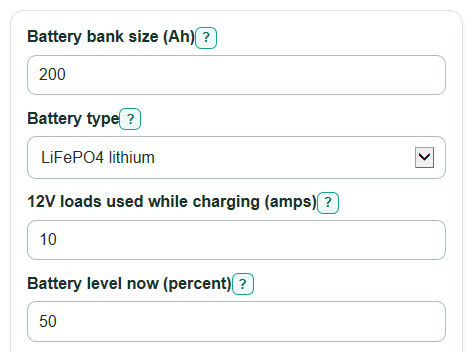
- Enter Battery bank size (Ah) for the total 12V house battery capacity you want to charge.
- Choose Battery type, then enter 12V loads used while charging (amps), Battery level now (percent), and Wanted recharge time (hours).
- Open Advanced options if you want to change Target battery level (percent), Extra headroom (percent), converter efficiency, charge voltage, a battery manual charge limit, or a wiring limit.
- Click Calculate and read Recommended converter charger size first, then check Charging amps left after 12V loads and Target time check.
- Sanity-check the result: if Estimated recharge time is much longer than Wanted recharge time (hours), look for an Important note about battery charge limits, 12V loads, or Current wiring or converter limit (amps, optional).
Definitions
Battery bank size (Ah): The usable rating you enter for the 12V house battery bank. Ah means amp-hours, a measure of stored electric charge.
Battery type: The battery chemistry choice used to set a starter charging-current limit: flooded lead-acid, AGM lead-acid, or LiFePO4 lithium.
12V loads used while charging (amps): The DC current used by RV items that may be on while the converter is also charging the battery.
Battery level now (percent): The estimated state of charge, meaning how full the battery is before charging starts.
Target battery level (percent): The battery level you want to reach, such as 100 percent for full or 80 percent for a shorter stop.
Extra headroom (percent): Added room for small 12V loads that turn on after you sized the charger. It is applied to loads, not to the battery charge limit.
Battery charge current limit used: The maximum battery charging amps allowed by the selected battery type or by Battery max charge rate (percent of Ah, optional).
Charging amps left after 12V loads: The converter amps that remain for battery charging after the entered 12V loads are running.
Estimated 120V AC draw: The rough shore power or generator current used by the converter charger only. Shore power supplies 120V AC that an RV converter changes to 12V DC for the batteries [1].
Common mistakes and quick fixes
Mistake: Entering one battery's rating in Battery bank size (Ah) when several 12V batteries are wired in parallel.
Fix: Add the Ah ratings of parallel batteries and enter the total Battery bank size (Ah).
Mistake: Adding microwave, air conditioner, or outlet loads to 12V loads used while charging (amps).
Fix: Enter only 12V DC loads, such as lights, pump, fans, and control boards, in 12V loads used while charging (amps).
Mistake: Setting Wanted recharge time (hours) very low and assuming a bigger converter will always make charging faster.
Fix: Check Battery charge current limit used and Target time check before shopping for the Recommended converter charger size.
Mistake: Leaving Battery type at LiFePO4 lithium for a flooded or AGM battery bank.
Fix: Pick the correct Battery type, or enter Battery max charge rate (percent of Ah, optional) from the battery manual.
Mistake: Ignoring Current wiring or converter limit (amps, optional) when replacing a smaller factory unit.
Fix: Enter the known wiring, fuse, panel, or existing converter limit so Recommended converter charger size does not exceed it.
Mistake: Comparing Estimated 120V AC draw to the full RV power draw.
Fix: Treat Estimated 120V AC draw as the converter charger draw only, not the microwave, water heater, or air conditioner.
Limitations & Key Assumptions / Boundary Conditions
- The recharge time is a simple bulk-charge estimate. Real chargers often slow down near full charge, so the last part can take longer than shown.
- The default battery charge-rate limits are planning values. Use Battery max charge rate (percent of Ah, optional) if your battery manual gives a different maximum.
- The calculator does not verify wire gauge, fuse size, converter compartment cooling, battery temperature limits, or charger profile settings.
- Current wiring or converter limit (amps, optional) is treated as a hard cap when entered. Do not upgrade past the rated wiring, fuses, and panel without checking the RV electrical design.
- Estimated 120V AC draw uses 120V AC, Charging voltage (V), and Converter efficiency (percent). Low campground voltage, generator limits, and other 120V appliances can change real input current.
- Standard converter sizes are shopping buckets, not a complete product catalog. If the raw need is above 150 amps, use multiple charging sources or get a custom RV electrical design.
- The calculator assumes a 12V house battery bank. It is not meant for 24V or 48V RV electrical systems.
Methodology
Calculation steps
The calculator first finds how many amp-hours need to be replaced between Battery level now (percent) and Target battery level (percent).
needed_ah = battery_ah * (target_soc_pct - current_soc_pct) / 100
It sets a battery charging-current limit from Battery type, unless Battery max charge rate (percent of Ah, optional) is entered. The default charge-rate decimals are 0.13 for flooded lead-acid, 0.20 for AGM lead-acid, and 0.50 for LiFePO4 lithium.
auto_max_charge_amps = battery_ah * charge_rate_decimal
The charger current requested by your time goal is the amp-hours to replace divided by Wanted recharge time (hours).
requested_charge_amps = needed_ah / recharge_hours
The sizing charge current is capped at the battery charging-current limit. If the requested current is higher than the limit, the Target time check explains that the time goal is too fast for the selected battery limit.
sizing_charge_amps = min(requested_charge_amps, max_charge_amps)
Next, the calculator adds the entered 12V loads and applies Extra headroom (percent) to those loads only.
raw_converter_amps = dc_load_amps * (1 + safety_buffer_pct / 100) + sizing_charge_amps
The raw need is rounded up to the first standard size in this list: 15, 20, 30, 35, 45, 55, 60, 70, 75, 80, 100, 120, and 150 amps.
unconstrained_converter_amps = first standard_size >= raw_converter_amps
If Current wiring or converter limit (amps, optional) is entered and is lower than the unconstrained size, the recommendation is reduced to the largest standard size that does not exceed that limit.
recommended_converter_amps = constrained standard converter size after optional existing_limit_amps
The actual charging amps left after loads are based on the final recommended size. The safety buffer is not subtracted here because it is reserve room, not a load that is always on.
charge_current_after_loads = min(max(recommended_converter_amps - dc_load_amps, 0), max_charge_amps)
Estimated recharge time divides the needed amp-hours by the charging amps left. If no charging current is left after loads, the result is N/A instead of a divide-by-zero value.
estimated_recharge_hours = needed_ah / charge_current_after_loads
Estimated 120V AC draw uses the final converter size, Charging voltage (V), nominal 120V AC input, and Converter efficiency (percent). The result is for the converter charger only.
ac_input_amps = recommended_converter_amps * charge_voltage_v / (120 * converter_efficiency_pct / 100)
Worked example
For a 200 Ah LiFePO4 bank going from 50 percent to 100 percent, needed amp-hours are 100 Ah. If Wanted recharge time (hours) is 3, requested charging current is 33.3 amps. The LiFePO4 default limit is 100 amps, so the battery limit does not reduce the request. With 10 amps of 12V loads and 10 percent Extra headroom, the raw converter need is 10 * 1.10 + 33.3 = 44.3 amps, which rounds to a 45 amp standard converter. Charging amps left after loads are 45 - 10 = 35 amps, so Estimated recharge time is 100 / 35 = 2.86 hours. Estimated 120V AC draw is 45 * 13.6 / (120 * 0.85) = 6.0 amps.
How to read the result
Recommended converter charger size is the size to compare with products. Target time check tells you whether the size can meet your time goal after battery and wiring limits. Size needed without the wiring limit helps show when Current wiring or converter limit (amps, optional) is the reason the final recommendation is smaller.