
Estimate your RV battery bank size, usable energy, and battery count for camping without recharging.
Table of contents
How to use our RV Battery Bank Calculator
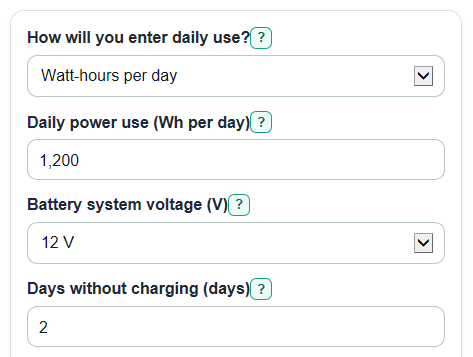
- Choose How will you enter daily use?, then enter either Daily power use or Daily battery use.
- Select Battery system voltage, Days without charging, and Battery type so the calculator can size the bank at your RV voltage.
- Open Advanced options if you want to change Size of one battery, Extra reserve, inverter settings, or cold-weather capacity.
- Click Calculate and read Recommended rated bank size first, then compare Usable energy with that many batteries to the Daily battery energy used.
- Sanity-check the result: if Estimated days covered is barely above your target, increase Extra reserve or choose a larger battery count.
Definitions
Watt-hour (Wh): A measure of energy. Watts times hours gives watt-hours, so it is the clearest way to compare RV loads and battery banks.
Amp-hour (Ah): A battery capacity rating based on electric current over time. Amp-hours only tell you energy when Battery system voltage is also known.
Battery system voltage (V): The DC voltage of the RV house battery bank, such as 12 V, 24 V, or 48 V.
Depth of discharge: The percent of a battery's rated capacity that has been used [1]. The calculator uses planned usable shares to avoid sizing from 100 percent of the label rating.
Usable share used for sizing: The battery type usable share after the Capacity left in cold weather setting is applied.
Inverter efficiency: The share of battery energy that reaches 120 V AC appliances after the inverter changes DC battery power into AC power.
Extra reserve: A cushion added to the target energy for imperfect load estimates, battery aging, and unexpected use.
Common mistakes and quick fixes
Mistake: Entering appliance amp-hours in Daily power use.
Fix: Put watt-hours in Daily power use, or switch How will you enter daily use? to Amp-hours per day and use Daily battery use.
Mistake: Forgetting that Daily battery use depends on Battery system voltage.
Fix: Check How will you enter daily use? and then recalculate. Recheck Battery system voltage before using an Ah per day number, because 100 Ah at 12 V is not the same energy as 100 Ah at 24 V.
Mistake: Setting Share of daily Wh that uses an inverter to 100 percent when only a few loads are 120 V AC.
Fix: Use Share of daily Wh that uses an inverter only for the part of Daily power use that goes through the inverter.
Mistake: Leaving Inverter efficiency at 90 percent when the inverter manual gives a different number.
Fix: Enter the real Inverter efficiency if you know it, especially for heavy AC loads.
Mistake: Treating Batteries needed as the only design requirement.
Fix: Use Batteries needed as an energy estimate, then check wiring, fuses, charger limits, battery weight, and available space.
Mistake: Ignoring Capacity left in cold weather for batteries stored in a cold compartment.
Fix: Lower Capacity left in cold weather if your battery maker gives a cold-temperature capacity rating.
Limitations & Key Assumptions / Boundary Conditions
- This is an energy-sizing tool. It does not check wire size, fuse size, surge current, charger current, battery weight, ventilation, or whether batteries can be wired safely in series or parallel.
- The built-in usable shares are planning defaults: 90 percent for LiFePO4 and 50 percent for AGM, flooded lead-acid, and gel. Follow your battery manual if it gives a stricter limit.
- Battery system voltage is treated as nominal DC voltage. Real battery voltage changes while charging and discharging, so measured watt-hours can differ.
- Inverter loss is added only in Watt-hours per day mode and only to Share of daily Wh that uses an inverter. In Amp-hours per day mode, inverter inputs are ignored.
- Capacity left in cold weather changes available energy, but it does not model low-temperature charging protection. Many LiFePO4 batteries need protection before charging near freezing.
- Batteries needed is rounded up from energy only. Large banks should be reviewed for current limits, cable length, fusing, mounting, and charging equipment.
Methodology
How the calculation works
The calculator first turns the daily load into watt-hours, because watt-hours compare stored energy across 12 V, 24 V, and 48 V systems. If you enter amp-hours, the selected Battery system voltage is needed.
daily_input_wh = daily_wh
daily_input_wh = daily_ah * system_voltage
In Watt-hours per day mode, inverter loss is added only to the AC share of the load. If the inverter share is 0 percent, adjusted daily use stays the same.
ac_share = ac_load_share_percent / 100
inverter_efficiency = inverter_efficiency_percent / 100
adjusted_daily_wh = daily_wh * ((1 - ac_share) + (ac_share / inverter_efficiency))
The target usable energy is the daily battery energy multiplied by Days without charging, then increased by Extra reserve.
target_usable_wh = adjusted_daily_wh * days_no_charge * (1 + reserve_percent / 100)
The calculator then applies the planned usable share for the selected Battery type. It uses 0.90 for LiFePO4 and 0.50 for AGM, flooded lead-acid, and gel, then multiplies that by Capacity left in cold weather.
usable_fraction = dod_fraction_by_type * (cold_capacity_percent / 100)
Rated bank energy is larger than usable energy when the usable fraction is below 1. Amp-hours are then found from watt-hours and Battery system voltage.
recommended_bank_wh = target_usable_wh / usable_fraction
recommended_bank_ah = recommended_bank_wh / system_voltage
If Size of one battery is entered, the calculator rounds up to a whole battery count, then uses that rounded count to estimate installed usable energy and supported days.
batteries_needed = ceil(recommended_bank_ah / single_battery_ah)
installed_bank_ah = batteries_needed * single_battery_ah
installed_usable_wh = installed_bank_ah * system_voltage * usable_fraction
estimated_supported_days = installed_usable_wh / adjusted_daily_wh
Mini-example
Suppose an RV uses 1200 Wh per day, needs 2 days without charging, uses a 12 V LiFePO4 bank, has 15 percent Extra reserve, and uses 100 Ah batteries. With no inverter share and normal temperature, target usable energy is 1200 * 2 * 1.15 = 2760 Wh. The rated energy needed is 2760 / 0.90 = 3066.7 Wh, which is 3066.7 / 12 = 255.6 Ah. With 100 Ah batteries, the count rounds up to 3 batteries. That installed bank has 3 * 100 * 12 * 0.90 = 3240 Wh usable, or about 3240 / 1200 = 2.7 days covered.