
Find the total speaker load for series, parallel, or custom speaker wiring and check it against your amp's minimum ohms.
Advanced options
Table of contents
How to use our Series Parallel Speaker Impedance Calculator
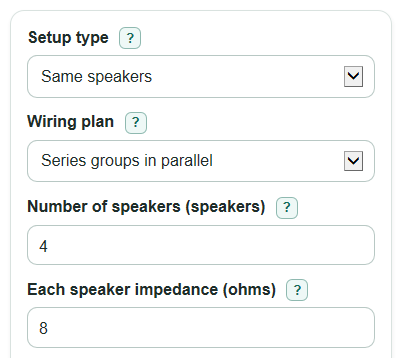
- Choose Setup type. Pick Same speakers for matching speakers, or Custom groups for mixed speaker values or uneven wiring.
- Choose Wiring plan, then enter Number of speakers, Each speaker impedance, and Speakers in each series group when those fields are shown.
- For Custom groups, type one series chain with commas, and separate parallel chains with semicolons, such as 8,8; 8,8.
- Optional: enter Amp minimum load, Amp rated power, and Load for that power rating if you want a safety check and rough power estimates.
- Check the Total speaker load first. If Space above amp minimum is negative or the Important note warns about uneven power, change the wiring before using the setup.
Definitions
Total speaker load: The combined nominal impedance, in ohms, that the amplifier sees from the speaker wiring.
Impedance: A speaker's opposition to electrical current, shown in ohms on the speaker label. This calculator uses that label value as a planning number.
Series: Speakers connected end-to-end, so their ohm values add together.
Parallel: Speaker paths connected side-by-side, which lowers the combined load compared with one matching speaker.
Series group: One chain of speakers wired in series before that chain is joined with other chains in parallel.
Amp minimum load: The lowest speaker load, in ohms, that the amplifier maker says the amp can drive.
Space above amp minimum: Total speaker load minus Amp minimum load. A negative value means the calculated load is below the entered minimum.
Load compared with amp minimum: Total speaker load divided by Amp minimum load. A value under 1 means the load is below the entered minimum.
Common mistakes and quick fixes
Mistake: Entering the speaker's watt rating in Each speaker impedance.
Fix: Use the ohm value printed on the speaker, such as 4, 8, or 16 ohms.
Mistake: Choosing Same speakers when Custom groups has mixed values like 4,8; 8.
Fix: Set Setup type to Custom groups and enter the exact group pattern.
Mistake: Using a Speakers in each series group value that does not divide evenly into Number of speakers.
Fix: Change Speakers in each series group or Number of speakers so every parallel group has the same size.
Mistake: Reading Space above amp minimum backward.
Fix: Positive is above the Amp minimum load. Negative is below the Amp minimum load and may be unsafe.
Mistake: Filling Amp rated power but leaving Load for that power rating blank.
Fix: Enter both Amp rated power and Load for that power rating, or leave both blank to skip power estimates.
Mistake: Rounding too hard with Decimal places and missing a borderline Total speaker load.
Fix: Use more Decimal places when the load is close to the Amp minimum load.
Limitations & Key Assumptions / Boundary Conditions
- The calculator uses nominal speaker impedance, which is the labeled ohm value. Real speaker impedance changes with frequency.
- The amp safety check only compares Total speaker load with the Amp minimum load you enter. It does not know your amp's full manual, switch settings, bridge mode, or speaker jack wiring.
- Power estimates use a simplified voltage-based model from Amp rated power and Load for that power rating. Real output can differ because amps have limits, distortion, protection circuits, and music is not a steady test tone.
- For Same speakers with Series groups in parallel, the calculator assumes every series group has the same number of matching speakers.
- For Custom groups, commas mean speakers in one series chain, and semicolons mean those chains are in parallel. Other wiring layouts are not modeled.
- Mixed speaker impedances can share power unevenly. Use Highest estimated speaker power and Lowest estimated speaker power as rough checks, not exact speaker safety ratings.
Methodology
How the load is found
The calculator treats each speaker's labeled impedance as a resistance-like value in ohms, then uses standard series and parallel combining rules for the wiring pattern [1].
Series same-speaker load: Z_total = N * Z_speaker
Parallel same-speaker load: Z_total = Z_speaker / N
Same-speaker series-parallel: G = N / S; Z_group = S * Z_speaker; Z_total = Z_group / G
In these formulas, N is Number of speakers, S is Speakers in each series group, G is Number of parallel groups, and Z means impedance in ohms. Series wiring adds the speaker ohms, while parallel wiring combines paths using reciprocals [1]. Speaker wiring can also use series, parallel, or series-parallel layouts [2].
Custom group load: Z_group_j = sum(Z_j1, Z_j2, ...); Z_total = 1 / sum(1 / Z_group_j)
For Custom groups, each comma-separated group is first added as one series chain. The semicolon-separated chains are then combined in parallel.
Amp check and power estimates
If Amp minimum load is entered, the calculator compares it with Total speaker load.
Space above amp minimum = Z_total - Z_amp_min
Load compared with amp minimum = Z_total / Z_amp_min
If Amp rated power and Load for that power rating are both entered, the calculator estimates amp voltage first, then estimates power at the calculated load.
V_amp = sqrt(P_rated * Z_rated)
P_total_est = V_amp^2 / Z_total
For Same speakers, Estimated power per speaker is Estimated total amp power at this load divided by Number of speakers. For Custom groups, each parallel group gets the same estimated voltage, and speaker power inside each series group is found from that group's current.
I_group_j = V_amp / Z_group_j
P_speaker_jk = I_group_j^2 * Z_speaker_jk
Mini-example
With four 8 ohm speakers and two speakers in each series group, each group is 2 * 8 = 16 ohms. There are 4 / 2 = 2 parallel groups, so the total load is 16 / 2 = 8 ohms. If the amp minimum is 4 ohms, Space above amp minimum is 8 - 4 = 4 ohms, and Load compared with amp minimum is 8 / 4 = 2 times.