
List appliances and tools that will run together to find the running and starting watt ratings your generator must meet.
The continuous running-watt rating should be at least this high.
The starting or surge rating should be at least this high.
This is the running demand before extra capacity and rounding.
This adds the single largest startup event to the running load.
This is extra startup demand, not an item's total starting watts.
Table of contents
How to use our Generator Sizing Calculator
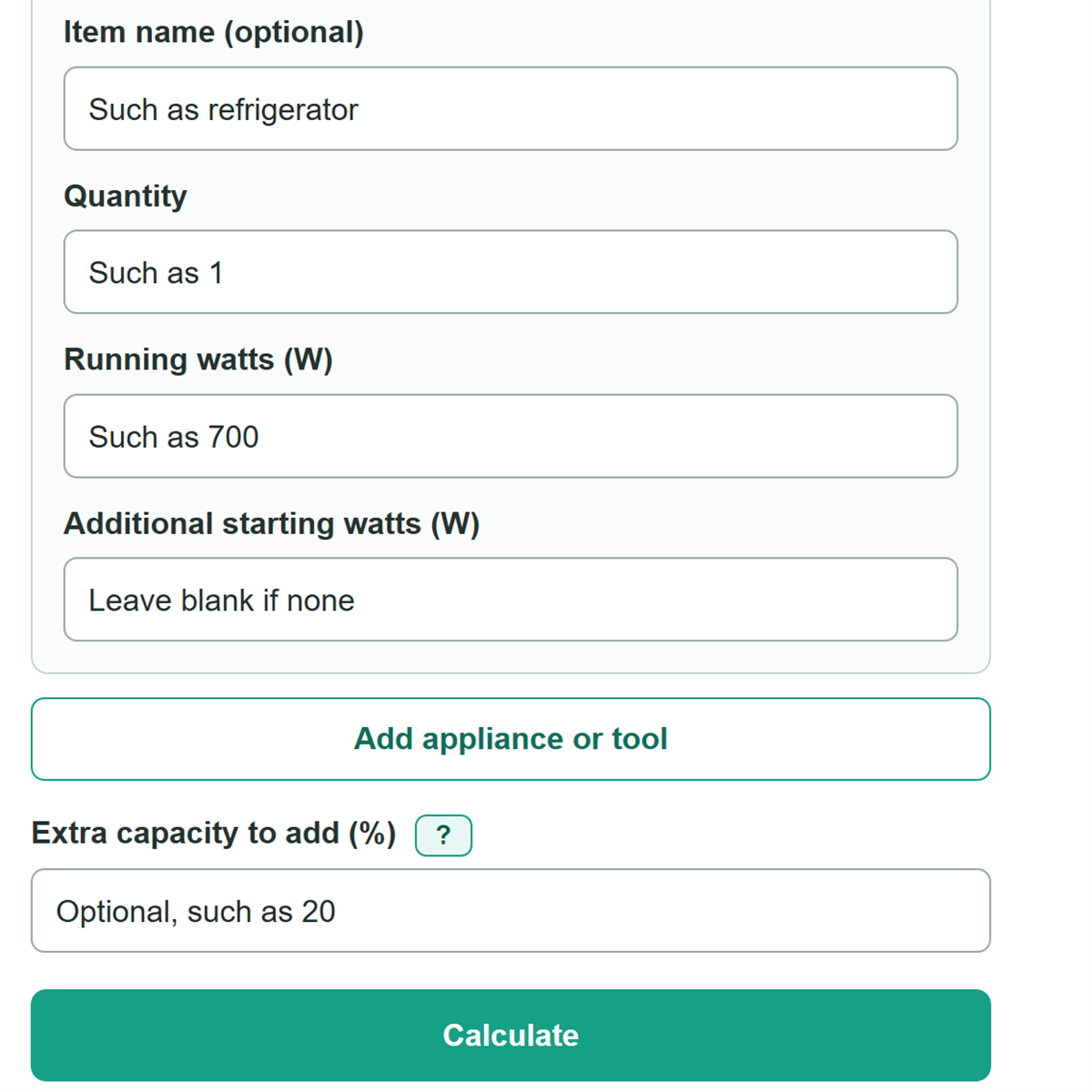
- Add a row for every appliance or tool that may operate at the same time.
- Enter the quantity and running watts for each item from its nameplate, manual, motor data sheet, or manufacturer specification.
- Enter Additional starting watts (W) only when you know the extra power needed above normal running watts during startup; leave it blank when there is no known surge.
- Enter Extra capacity to add (%) only if you want reserve capacity, then select Calculate.
- Sanity-check the result: compare generators using both ratings. Their running rating must meet the recommended running rating, and their starting rating must meet the recommended starting rating.
Definitions
Running watts: Power an appliance or tool needs while operating normally.
Additional starting watts: Extra temporary power needed above running watts when a motor or compressor starts.
Starting rating: A generator's short-term power capacity for a startup surge.
Simultaneous load: Appliances and tools expected to operate at the same time.
Headroom: Extra capacity added as a percentage of the calculated requirement.
Round up: Move a calculated requirement to the next higher 500 W planning step so the recommendation is not below the load.
Common mistakes and quick fixes
Mistake: Entering an appliance's total starting watts where the row asks for additional starting watts.
Fix: Check Appliances and tools running at the same time and then recalculate. Enter only the watts above that item's normal running demand in Additional starting watts (W).
Mistake: Adding startup surges together when those appliances start at different times.
Fix: Check Appliances and tools running at the same time and then recalculate. Enter each row separately. This worksheet uses the single largest quantity-adjusted additional startup demand. If different rows can start together, their overlapping surges need a separate sizing check.
Mistake: Including equipment that will not run at the same time.
Fix: Check Appliances and tools running at the same time and then recalculate. List only the appliances and tools in your actual simultaneous-use plan.
Mistake: Choosing a generator by its running rating alone.
Fix: Check Appliances and tools running at the same time and then recalculate. Check that its starting or surge rating also meets the recommended generator starting rating.
Mistake: Using a fractional quantity or leaving a row partly filled in.
Fix: Check Appliances and tools running at the same time and then recalculate. Use a whole quantity of 1 or more, and enter running watts for every active row.
Mistake: Typing a watt value with broken comma grouping, such as 1,01.
Fix: Check Appliances and tools running at the same time and then recalculate. Use a plain number such as 1000 or standard grouping such as 1,000.
Limitations & Key Assumptions / Boundary Conditions
- This worksheet assumes startup events from different rows do not overlap, so it adds only the largest additional startup demand to the total running load.
- Use the actual nameplate, manual, motor data sheet, or manufacturer value when available. Generic watt estimates may not match your equipment.
- A quantity greater than 1 multiplies both running watts and additional starting watts. Use it only when matching items could run and start together.
- The calculation does not account for voltage, phase, power factor, harmonics, altitude, temperature, fuel-related output loss, load management, transfer equipment, wiring, or local electrical code.
- For large HVAC equipment, pumps, variable-speed equipment, three-phase loads, home standby systems, or transfer-switch work, have the final design checked by qualified electrical and generator professionals.
- Meeting the calculated watt ratings does not address generator placement, grounding, ventilation, fuel handling, or other safe-use requirements.
Methodology
Worksheet calculation
Each active row adds its quantity times its running watts. A blank Additional starting watts (W) value counts as 0 W.
Minimum simultaneous running load = add(quantity x running watts) for every row
The calculator finds the largest quantity-adjusted additional startup demand from one row. It does not add startup demand from every row.
Largest additional startup demand = highest(quantity x additional starting watts) from one row
Minimum momentary starting load = minimum simultaneous running load + largest additional startup demand
Recommendation
A blank Extra capacity to add (%) value means 0% reserve. If entered, the same percentage is applied to both minimum loads. Each result is then rounded up to the next 500 W planning step so the recommended rating does not fall below the calculated need.
Recommended rating = round up(minimum load x (1 + extra capacity / 100)) to the next 500 W
Worked example
A refrigerator uses 700 W, and four LED lights use 15 W each. Their running load is 760 W. If the refrigerator needs an additional 1,500 W at startup, the momentary starting load is 2,260 W. With no extra capacity added, the calculator recommends at least 1,000 W running and 2,500 W starting. A generator must meet or exceed both ratings.