
Find a practical generator extension cord size and check voltage loss before you plug in a load.
Table of contents
How to use our Generator Extension Cord Size Calculator
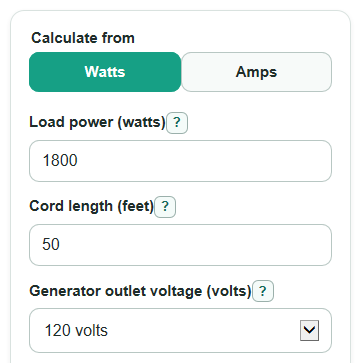
- Choose Calculate from based on the label you have: Load power (watts) or Load current (amps).
- Enter Cord length (feet) as the full cord length, then choose Generator outlet voltage (volts).
- Open Advanced options if you want to change How long the load may run, tighten Most voltage loss allowed (percent), or check Cord you already have (AWG).
- Click Calculate and read Recommended cord size first, then compare Current on the cord and Estimated voltage at the appliance.
- Sanity-check the result: if Voltage lost in the cord is close to your limit, use a shorter cord, a thicker AWG number, or reduce the load.
Definitions
AWG: American Wire Gauge. A smaller AWG number means a thicker wire, which usually carries more current with less voltage loss [2].
Load power (watts): The running power used by the appliance or group of appliances on this one cord.
Load current (amps): The electric current pulled through the cord. Higher amps need more cord capacity.
Voltage lost in the cord: The voltage used up by the cord's resistance before power reaches the appliance.
Estimated voltage at the appliance: The generator outlet voltage minus the estimated voltage lost in the cord.
Most voltage loss allowed (percent): The largest voltage drop you want to allow for this setup.
Planning cord rating: The amp value used by this calculator for each AWG size. The actual cord label still controls what you may use.
Common mistakes and quick fixes
Mistake: Putting the generator's total rating into Load power (watts) when only one appliance is on the cord.
Fix: Add only the running watts carried by that one extension cord.
Mistake: Measuring Cord length (feet) as the straight-line distance across the yard.
Fix: Enter the full cord length printed on the cord or the full unrolled path.
Mistake: Leaving Generator outlet voltage (volts) at 120 for a true 240-volt cord setup.
Fix: Select 240 volts only when the load and cord are actually wired for 240 volts.
Mistake: Using Short run, under 3 hours in How long the load may run during an overnight outage.
Fix: Choose Long run, 3 hours or more so the calculator uses extra amp margin.
Mistake: Treating Your cord check as a safety approval for any cord with the same AWG.
Fix: Also read the cord label, plug rating, outdoor rating, and condition before use.
Mistake: Ignoring Estimated voltage at the appliance when a motor or compressor starts poorly.
Fix: Lower Most voltage loss allowed (percent), shorten the cord, or use a thicker cord.
Limitations & Key Assumptions / Boundary Conditions
- This is a planning estimate for common copper extension cord sizes 16, 14, 12, 10, 8, and 6 AWG.
- The calculator cannot inspect the actual cord label, plug ends, damage, temperature rating, outdoor rating, or whether the cord is fully unrolled.
- For split 120/240-volt generator cords with uneven 120-volt loads, size from the highest leg amps when you know it. Total watts can hide an overloaded leg.
- Motor starting surge can be much higher than running watts or running amps, so a motor may still struggle even when the running calculation passes.
- Very long runs, damaged cords, loose connectors, wet locations, and undersized generator outlets can make real voltage lower than this estimate.
- Do not use this calculator to justify male-to-male cords, backfeeding a home outlet, indoor generator use, or bypassing a transfer switch or inlet required for your setup.
Methodology
How the calculator chooses a cord
This models a single-phase load. In watts mode, current = Load power (watts) divided by Generator outlet voltage (volts) and Power factor for watt-rated loads. In amps mode, it uses Load current (amps) directly and ignores the hidden power-factor field. The resistance-only voltage-loss calculation is a planning approximation, not a full AC impedance model.
current_amps = load_watts / (source_voltage * power_factor)
current_amps = load_amps
Next, it tests common copper AWG sizes in this order: 16, 14, 12, 10, 8, and 6. It uses the planning amp rating for each size and the copper resistance in ohms per 1000 feet. Thicker wire has lower resistance and less voltage drop [2].
usable_amp_limit = cord_amp_rating * load_factor
The load factor is 1 for Short run, under 3 hours and 0.8 for Long run, 3 hours or more. That means a 20-amp planning cord rating is treated as 16 amps for a long run.
The voltage drop estimate uses the full round trip through the outgoing and return conductors.
voltage_drop_volts = 2 * cord_length_ft * current_amps * (ohms_per_1000_ft / 1000)
voltage_drop_pct = (voltage_drop_volts / source_voltage) * 100
voltage_at_load = source_voltage - voltage_drop_volts
A cord size passes when the current is at or below the usable amp limit and the voltage drop percent is at or below Most voltage loss allowed (percent).
current_amps <= usable_amp_limit and voltage_drop_pct <= max_drop_pct
The Recommended cord size is the lightest listed AWG that passes both checks. If none passes, the calculator reports that no listed size passes for the entered load, length, and voltage loss limit.
Existing cord check
If you choose Cord you already have (AWG), the calculator runs the same amp and voltage loss checks on that selected cord. Your cord check passes only when both checks pass. If it fails, the recommendation stays visible so you can compare your cord with the needed size.
existing_ok = current_amps <= existing_usable_amp_limit and existing_voltage_drop_pct <= max_drop_pct
Mini-example
For 1800 watts on a 120-volt single-phase outlet at power factor 1, current is 15 amps. At power factor 0.8, the same real power requires 18.75 amps.
current_amps = 1800 / 120 = 15 amps
For a 50-foot 12 AWG copper cord, using 1.588 ohms per 1000 feet, the estimated voltage loss is 2.382 volts.
voltage_drop_volts = 2 * 50 * 15 * (1.588 / 1000) = 2.382 volts
The voltage drop is about 1.985 percent, and the estimated voltage at the appliance is about 117.6 volts.
voltage_drop_pct = (2.382 / 120) * 100 = 1.985 percent
voltage_at_load = 120 - 2.382 = 117.618 volts