
Estimate extension cord voltage loss, load-end voltage, and a voltage-drop-only AWG suggestion from cord length, load, and source voltage.
Table of contents
How to use our Extension Cord Voltage Drop Calculator
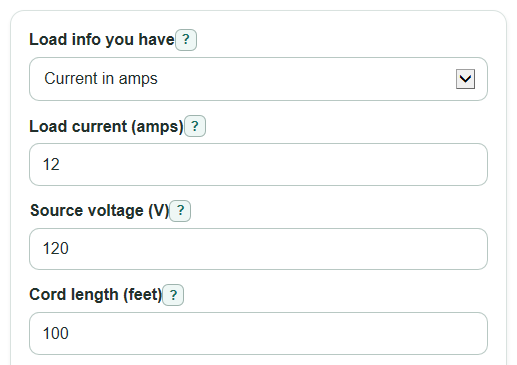
- Choose Load info you have: use Load current if the tool label lists amps, or Load power if it lists watts.
- Enter Source voltage, Cord length, and Cord wire gauge. Cord length means the physical one-way cord length from the outlet to the tool.
- Open Advanced options only if you want to change Voltage drop goal or Number format. The default goal is 3 percent.
- Select Calculate and read Voltage at the tool first, then compare Voltage lost with your Voltage drop goal.
- Sanity-check the answer: a longer Cord length, higher Load current, or higher AWG number should increase Voltage lost. A lower AWG number means a thicker cord and should reduce the drop.
Definitions
Load current: The running electrical current used by the tool or appliance, measured in amps.
Load power: The tool or appliance power in watts. In watts mode, the calculator estimates current as Load power divided by Source voltage.
Source voltage: The voltage at the outlet, generator, or supply before the extension cord drop is subtracted.
Cord length: The physical one-way length of the extension cord. The calculator automatically counts the outgoing and return wire path.
AWG: American Wire Gauge, a wire size system. A lower AWG number means a thicker wire with lower resistance.
Voltage drop goal: The maximum percent of Source voltage you want to lose in the cord.
Round-trip cord resistance: The total resistance of both conductors in the cord path, measured in ohms.
Voltage lost: The percent of Source voltage used up by the cord instead of reaching the tool.
Common mistakes and quick fixes
Mistake: Entering the full out-and-back wire path in Cord length.
Fix: Enter only the physical one-way Cord length; the calculator doubles it for the round-trip cord resistance.
Mistake: Leaving Load info you have on Load current while typing a watt value into Load power.
Fix: Change Load info you have to Power in watts if the label gives watts, or enter amps in Load current.
Mistake: Treating Cord wire gauge like size numbers where a bigger number means thicker.
Fix: Remember that a lower Cord wire gauge AWG number is thicker and usually has less Voltage lost.
Mistake: Using starting surge instead of running Load current.
Fix: Use the normal running Load current from the tool or appliance label; motor startup surge is not included.
Mistake: Reading Minimum AWG for your goal as a safety approval.
Fix: Use Minimum AWG for your goal as a voltage-drop-only guide, then check the cord label, plug, outlet, and tool manual.
Mistake: Setting Voltage drop goal to 0 or leaving it blank.
Fix: Enter a Voltage drop goal greater than 0 percent, such as 3 for a stricter check or 5 for a looser check.
Limitations & Key Assumptions / Boundary Conditions
- This is a voltage-drop estimate only. It does not approve the cord for the load, and it does not replace the cord's printed amp rating, plug rating, outlet rating, breaker size, outdoor rating, or tool manual.
- The resistance table uses copper conductor values at 20 C. Warm cords, old cords, damaged cords, connectors, reels, and coiled cords can have more heat and more loss.
- The load is treated as a steady running load. Motor starting surge, power-factor effects, and changing tool loads are not modeled.
- Cord length is the physical one-way length. If you enter the round-trip length, the Voltage drop will be about twice as high as it should be.
- The Minimum AWG for your goal is picked only from the common AWG choices in the calculator. If none meet the goal, the result will say that the listed choices do not meet it.
- If Voltage drop is greater than or equal to Source voltage, the calculator rejects the scenario instead of showing a negative Voltage at the tool.
Methodology
How the calculator finds the load current
If Load info you have is Current in amps, the calculator uses Load current directly. If Load info you have is Power in watts, it estimates current from the entered watts and Source voltage.
I = P / Vs
In that formula, I is current in amps, P is Load power in watts, and Vs is Source voltage in volts.
How cord resistance is counted
The calculator uses the selected Cord wire gauge to look up copper resistance in ohms per 1000 feet. The physical Cord length is doubled because current travels out to the tool and back through the cord.
R_total = 2 * L * R_awg / 1000
R_total is Round-trip cord resistance in ohms, L is Cord length in feet, and R_awg is the copper resistance for the selected AWG in ohms per 1000 feet. The resistance values used are 18 AWG 6.385, 16 AWG 4.016, 14 AWG 2.525, 12 AWG 1.588, 10 AWG 0.9989, 8 AWG 0.6282, 6 AWG 0.3951, and 4 AWG 0.2485 ohms per 1000 feet.
How voltage drop and heat loss are calculated
The calculator applies Ohm's law to the round-trip cord resistance, then subtracts the drop from Source voltage.
V_drop = I * R_total
V_load = Vs - V_drop
drop_percent = 100 * V_drop / Vs
P_loss = I * V_drop
V_drop is Voltage drop in volts, V_load is Voltage at the tool, drop_percent is Voltage lost as a percent, and P_loss is Heat made in the cord in watts.
How the AWG suggestion is chosen
For Minimum AWG for your goal, the calculator tests the common AWG choices using the same Source voltage, Cord length, load current, and Voltage drop goal. It returns the thinnest listed gauge that still meets the goal, because a lower AWG number is thicker and a higher AWG number is thinner.
choose the largest AWG number where 100 * (I * (2 * L * R_awg / 1000)) / Vs <= goal_percent
Worked mini-example
For a 50 foot, 14 AWG cord carrying a 1200 watt load on 120 V, current is 1200 / 120 = 10 amps. The 14 AWG round-trip resistance is 2 * 50 * 2.525 / 1000 = 0.2525 ohms. Voltage drop is 10 * 0.2525 = 2.525 V, so Voltage at the tool is 120 - 2.525 = 117.475 V. Voltage lost is 100 * 2.525 / 120 = 2.10 percent, and Heat made in the cord is 10 * 2.525 = 25.25 W.