
Estimate how many miles your EV can drive from its current charge down to the reserve you want to keep.
Advanced options
Table of contents
How to use our EV Range Calculator
- Enter Battery size (kWh), Current battery charge (%), and Keep as reserve (%) from your car or trip plan.
- Enter Efficiency and choose the matching Efficiency unit, such as Miles per kWh, Wh per mile, or kWh per 100 miles.
- Open Advanced options if you want to adjust Battery health (%), add an Energy use change (%), or check a Planned trip distance (miles).
- Click Calculate and read Miles until your reserve first, then check Trip miles left over if you entered a trip distance.
- Sanity-check the answer: if the range looks too high, confirm the Efficiency unit and remember that speed, cold weather, hills, cargo, heat, and air conditioning can lower real range.
Definitions
EV: An electric vehicle that stores electrical energy in a battery pack and uses it to power the motor [2].
Battery size (kWh): The amount of energy the battery can hold, measured in kilowatt-hours. A larger number usually means more possible range.
Current battery charge (%): The battery percent shown in the car right now.
Keep as reserve (%): The battery percent you plan not to use. The range estimate stops at this percent, not at 0%.
Efficiency: How far the EV goes for a given amount of energy, or how much energy it uses for a given distance.
kWh per mile: Kilowatt-hours used to drive one mile. Lower kWh per mile means more miles from the same battery energy.
Battery health (%): The battery's usable capacity compared with when it was new. Capacity can decline as a battery ages [1].
Energy use change (%): A percent adjustment for easier or harder driving conditions. Positive means the EV uses more energy per mile.
Trip miles left over: Estimated range minus Planned trip distance (miles). Positive means extra miles; negative means the estimate is short.
Common mistakes and quick fixes
Mistake: Entering the window-sticker pack size in Battery size (kWh) when your car reports a smaller usable size.
Fix: Use the usable Battery size (kWh) if you know it; otherwise treat the result as an estimate.
Mistake: Setting Keep as reserve (%) equal to or higher than Current battery charge (%).
Fix: Lower Keep as reserve (%) or charge the car so Current battery charge (%) is higher than the reserve.
Mistake: Choosing the wrong Efficiency unit for the number in Efficiency, such as entering 300 but leaving Miles per kWh selected.
Fix: Match Efficiency unit to the display: 3.4 is usually Miles per kWh, 300 is usually Wh per mile, and 28 is usually kWh per 100 miles.
Mistake: Using Energy use change (%) as a range change instead of an energy-use change.
Fix: Enter a positive Energy use change (%) for harder driving, because the calculator increases Energy used per mile.
Mistake: Reading a negative Trip miles left over as a calculator error.
Fix: A negative Trip miles left over means the Planned trip distance (miles) is longer than the estimated range by that many miles.
Mistake: Leaving Battery health (%) at 100 for an older EV that has known capacity loss.
Fix: If your car reports reduced capacity, enter that percent in Battery health (%) so Battery energy you can use is lower.
Limitations & Key Assumptions / Boundary Conditions
- The calculator estimates driving range from battery energy and efficiency. It does not know your route, speed, traffic, wind, elevation, tire pressure, cargo, or cabin heat and air conditioner use.
- Efficiency can change a lot between city driving, highway driving, cold weather, hot weather, hills, and heavy loads, so a recent trip average is usually better than a perfect-weather rating.
- Battery size (kWh) may mean gross pack size or usable battery size. If you enter gross size when the usable size is smaller, the range estimate can be too high.
- Battery health (%) is a simple capacity multiplier. It does not model temperature effects, battery management buffers, cell imbalance, or charging limits.
- Keep as reserve (%) is treated as a hard stop. Real cars may show low-battery warnings or reduce power before the reserve you enter.
- Trip miles left over is signed on purpose. A negative value is not rounded up to zero because it tells you how many estimated miles are missing.
- The result is not an EPA-certified range value. EPA range testing follows a controlled procedure, while this calculator uses your entered numbers [4].
Methodology
How the calculator turns your inputs into range
The calculator first converts the entered Efficiency into kWh per mile, because the range formula needs energy used for each mile.
If Efficiency unit is Miles per kWh: base kWh per mile = 1 / Efficiency
If Efficiency unit is Wh per mile: base kWh per mile = Efficiency / 1000
If Efficiency unit is kWh per 100 miles: base kWh per mile = Efficiency / 100
Next, Energy use change (%) adjusts that energy use. A positive value means harder conditions, so each mile uses more energy.
Energy used per mile = base kWh per mile * (1 + Energy use change (%) / 100)
The usable battery energy between Current battery charge (%) and Keep as reserve (%) is then found after Battery health (%) is applied.
Battery energy you can use = Battery size (kWh) * (Battery health (%) / 100) * ((Current battery charge (%) - Keep as reserve (%)) / 100)
The main range estimate divides that usable energy by the adjusted energy used per mile.
Miles until your reserve = Battery energy you can use / Energy used per mile
The full-charge comparison uses the same reserve and efficiency, but starts from 100% charge.
Range from 100% to your reserve = (Battery size (kWh) * (Battery health (%) / 100) * ((100 - Keep as reserve (%)) / 100)) / Energy used per mile
If Planned trip distance (miles) is entered, the calculator subtracts it from the main range estimate and keeps the sign.
Trip miles left over = Miles until your reserve - Planned trip distance (miles)
Mini-example
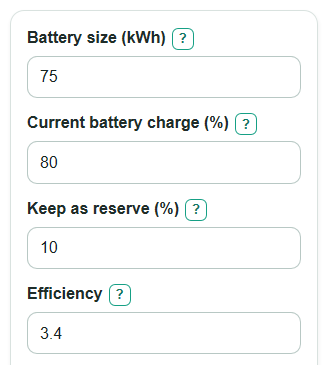
With Battery size (kWh) = 75, Current battery charge (%) = 80, Keep as reserve (%) = 10, Efficiency = 3.4 Miles per kWh, Battery health (%) = 100, and Energy use change (%) = 0, the usable charge window is 70% of the battery. Battery energy you can use is 75 * 1.00 * 0.70 = 52.5 kWh. Energy used per mile is 1 / 3.4 = 0.2941176 kWh per mile. Miles until your reserve is 52.5 / 0.2941176 = 178.5 miles.
Validation and display choices
Battery size (kWh) and Efficiency must be greater than 0. Current battery charge (%) must be from 0 to 100, and Keep as reserve (%) must be from 0 to less than 100. Current battery charge (%) must be higher than Keep as reserve (%) so the usable energy is positive. Battery health (%) must be greater than 0 and no more than 100. Energy use change (%) must be greater than -100 so Energy used per mile stays positive. Optional Planned trip distance (miles) must be 0 or more when entered. Normal range outputs are shown to 1 decimal place, while Energy used per mile is shown with enough detail to explain the math.