
Estimate generator amps and the next standard breaker size from kW, kVA, or rated full-load current.
Table of contents
How to use our Generator Breaker Size Calculator
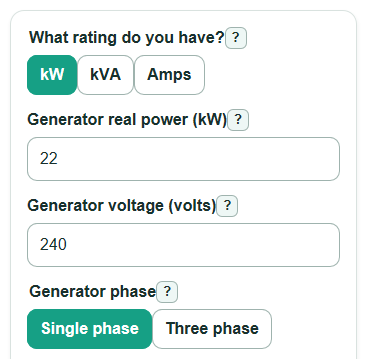
- Choose What rating do you have? to match the generator nameplate: kW, kVA, or amps.
- Enter the visible rating fields, such as Generator real power (kW), Generator voltage (volts), Generator phase, and Power factor when they apply.
- Open Advanced options only if you want to change Sizing rule or check a Circuit or inlet limit (amps) or AIC values.
- Click Calculate, then compare Recommended standard breaker size with the generator manual, wire size, inlet, cord, transfer switch, and panel ratings.
- Sanity-check the output: Generator full-load current should be close to the nameplate amps, and a negative Room left under circuit or inlet limit means the recommendation is above your entered limit.
Definitions
Generator real power (kW): The usable power rating in kilowatts. It is converted to amps using voltage and power factor.
Generator apparent power (kVA): The AC power rating in kilovolt-amps. It is converted to amps using voltage and phase.
Generator full-load current: The estimated or nameplate current the generator can supply at its rated output.
Power factor: A number from greater than 0 to 1 that relates real power in kW to apparent power in kVA for AC equipment.
Generator phase: The AC system type. Single phase is common for homes. Three phase uses the square root of 3 in the current formula.
Sizing rule: The multiplier applied before choosing a standard breaker size, such as 100%, 115%, or 125%.
AIC: Ampere interrupting capacity. It is the short-circuit current a breaker is rated to interrupt safely.
Common mistakes and quick fixes
Mistake: Using starting surge amps in Generator full-load current (amps) .
Fix: Enter the rated full-load output current from the nameplate or manual, not motor starting current.
Mistake: Leaving Power factor blank or entering a value above 1 when using Generator real power (kW) .
Fix: Enter a number greater than 0 and no more than 1, such as 1.00 or 0.80.
Mistake: Picking the wrong Generator phase for the system.
Fix: Use Single phase for most home standby generators, and Three phase only for a real three-phase generator.
Mistake: Treating Recommended standard breaker size as permission to exceed a Circuit or inlet limit (amps) .
Fix: If Room left under circuit or inlet limit is negative, do not upsize the connected equipment without a proper design review.
Mistake: Entering only Available fault current (kA) or only Breaker interrupting rating (kA) .
Fix: Enter both values to get Interrupting rating margin , or leave both blank if you do not have the data.
Limitations & Key Assumptions / Boundary Conditions
- This calculator estimates a planning breaker size. It does not verify wire size, temperature ratings, terminal ratings, transfer switch ratings, grounding, bonding, local code, permits, or inspection requirements.
- The 115% setting is a generator output planning multiplier. The actual installation may require a different rule based on the adopted code, generator instructions, overcurrent location, and equipment listing.
- The standard breaker list is a general planning list. Real product lines, panel listings, fused equipment, and local rules can limit which sizes are allowed.
- Circuit or inlet limit (amps) is only a comparison. A negative margin means the calculated recommendation is above the entered weakest link, not that the weakest link can be overloaded.
- The AIC check only compares Breaker interrupting rating (kA) with Available fault current (kA). It does not perform a full short-circuit study or series-rating check.
- If the calculated minimum is above 6000 amps, the standard list used here is not enough and engineered gear selection is needed.
Methodology
How the generator current is found
The calculator first finds Generator full-load current. If you choose amps, it uses the entered Generator full-load current (amps) directly. Hidden voltage, phase, and power factor fields are ignored in amps mode.
single-phase kW amps = Generator real power (kW) * 1000 / (Generator voltage (volts) * Power factor)
three-phase kW amps = Generator real power (kW) * 1000 / (1.7320508075688772 * Generator voltage (volts) * Power factor)
single-phase kVA amps = Generator apparent power (kVA) * 1000 / Generator voltage (volts)
three-phase kVA amps = Generator apparent power (kVA) * 1000 / (1.7320508075688772 * Generator voltage (volts))
amps mode = Generator full-load current (amps)
How the breaker recommendation is picked
The selected Sizing rule sets the multiplier: 1.15 for generator output planning, 1.00 for exact rated amps, or 1.25 for continuous-load planning. The optional continuous-load setting uses 125% before selecting a standard-size device [2].
Calculated minimum before rounding = Generator full-load current * sizing multiplier
Recommended standard breaker size = first standard size that is at least the calculated minimum
The standard sizes loaded in the calculator are 10, 15, 20, 25, 30, 35, 40, 45, 50, 60, 70, 80, 90, 100, 110, 125, 150, 175, 200, 225, 250, 300, 350, 400, 450, 500, 600, 700, 800, 1000, 1200, 1600, 2000, 2500, 3000, 4000, 5000, and 6000 amps. The calculator rounds up to the next listed size rather than rounding to the nearest size [1].
Optional checks
If Circuit or inlet limit (amps) is entered, the calculator keeps the signed margin.
Room left under circuit or inlet limit = Circuit or inlet limit (amps) - Recommended standard breaker size
If both fault-current fields are entered, the calculator also keeps the signed AIC margin.
Interrupting rating margin = Breaker interrupting rating (kA) - Available fault current (kA)
Mini example
For a 22 kW, 240 volt, single-phase generator with power factor 1.00, the full-load current is 22 * 1000 / (240 * 1.00) = 91.7 amps. With the default 115% sizing rule, the calculated minimum is 91.7 * 1.15 = 105.4 amps, so the next standard breaker size is 110 amps. If the entered circuit or inlet limit is 100 amps, the margin is 100 - 110 = -10 amps, which means the recommendation is 10 amps above that entered limit.