
Convert kilowatts to amps using voltage, circuit type, power factor, and optional efficiency for output-rated loads.
Advanced options
Table of contents
How to use our Kilowatts to Amps Calculator
- Enter Power (kW) as real power, not energy in kWh.
- Choose Circuit type, then enter Voltage (V) across the load.
- For AC circuits, enter Power factor (0 to 1); for three-phase AC, also choose Three-phase voltage entered as.
- Open Advanced options only if Efficiency (percent) is not 100 or you want a different Number display.
- Check the Formula used result to make sure the circuit type and voltage basis match your real circuit.
Definitions
Power (kW): Real power in kilowatts. One kilowatt equals 1000 watts.
Voltage (V): Electrical pressure in volts across the load. The same kW needs more amps at lower voltage.
Power factor (0 to 1): The part of AC current that becomes real power. A resistive heater is usually near 1; many motors are lower.
Three-phase voltage entered as: Whether the three-phase voltage is line-to-line or line-to-neutral. This changes the current formula.
Efficiency (percent): Output power divided by input power, written as a percent. Use it only when the entered kW is output power.
Apparent power: AC power in kilovolt-amperes, or kVA. It is real electrical kW divided by power factor.
Current: The amps estimated for each line conductor. For a balanced three-phase load, this is line current.
Common mistakes and quick fixes
Mistake: Putting energy use into Power (kW), such as a kWh bill value.
Fix: Use real power in Power (kW); kWh is energy over time and cannot be converted to amps by itself.
Mistake: Leaving Voltage (V) as a default number that does not match the load.
Fix: Enter the voltage measured across the load in Voltage (V), such as 120, 240, 277, or 480 when that is the actual circuit voltage.
Mistake: Using Power factor (0 to 1) as a percent, such as 85 instead of 0.85.
Fix: Enter Power factor (0 to 1) as a decimal from greater than 0 through 1.
Mistake: Choosing the wrong Three-phase voltage entered as value.
Fix: Pick Line-to-line if Voltage (V) is measured between two hot wires, or Line-to-neutral if it is measured from one hot wire to neutral.
Mistake: Setting Efficiency (percent) below 100 when Power (kW) is already electrical input power.
Fix: Leave Efficiency (percent) at 100 unless Power (kW) is output power, such as motor shaft power.
Mistake: Treating Current as a breaker size or wire ampacity.
Fix: Use Current only as the converted electrical current, then check code, duty cycle, temperature, and equipment rules separately.
Limitations & Key Assumptions / Boundary Conditions
- kW cannot be converted to amps from kW alone. The calculation also needs Voltage (V), and AC calculations need Power factor (0 to 1).
- Three-phase results assume a balanced load, so each phase carries the same current.
- The calculator converts electrical quantities only. It does not size breakers, fuses, wires, conduits, or code-compliant ampacity.
- Power factor can change with load, speed, and equipment condition. Use a measured or manufacturer value when possible.
- Efficiency (percent) should stay at 100 when Power (kW) is already electrical input power. Lower efficiency is for output-rated loads.
- Motor starting current, overloads, harmonics, voltage drop, temperature, duty cycle, and local electrical code can change real equipment sizing.
Methodology
How the calculator chooses the math
The calculator first converts the entered Power (kW) to electrical input watts. If Efficiency (percent) is 100, the entered kW is used directly. If efficiency is below 100, the electrical input power is higher than the output power.
P_elec_W = (P_kw / (efficiency_pct / 100)) * 1000
For DC, the calculator divides electrical watts by volts.
I_A = P_elec_W / V
For single-phase AC, the calculator also divides by power factor. AC real power depends on RMS voltage, RMS current, and power factor [2].
I_A = P_elec_W / (V * PF)
For three-phase AC with line-to-line voltage, the calculator uses the balanced three-phase real-power relationship with the square root of 3 factor [1].
I_A = P_elec_W / (sqrt(3) * V_LL * PF)
For three-phase AC with line-to-neutral voltage, the calculator uses three times line-to-neutral voltage because the balanced load has three equal phase paths.
I_A = P_elec_W / (3 * V_LN * PF)
For AC modes, apparent power is shown as kVA.
S_kVA = (P_elec_W / 1000) / PF
Mini-example
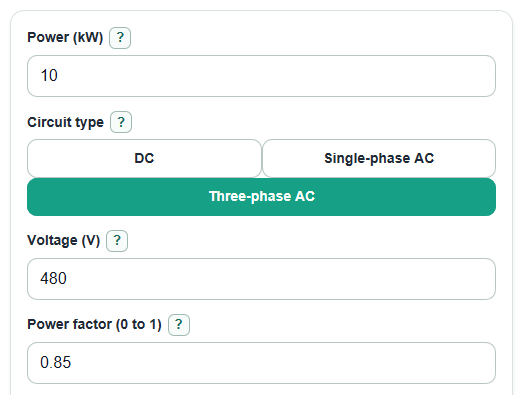
For the default case, Power (kW) is 10, Efficiency (percent) is 100, Voltage (V) is 480, Power factor (0 to 1) is 0.85, Circuit type is Three-phase AC, and Three-phase voltage entered as is Line-to-line. Electrical power used is 10 kW, apparent power is 10 / 0.85 = 11.7647 kVA, and current is 10000 / (1.7320508075688772 * 480 * 0.85) = 14.1507 A.
Input checks
Power and voltage must be greater than 0. AC power factor must be greater than 0 and at most 1. Efficiency must be greater than 0 and at most 100. Commas and spaces are removed before numbers are read, but nonnumeric text still causes an error.