
Estimate a standard breaker size from amps or watts, with the continuous-load rule and optional wire ampacity check.
Table of contents
How to use our Circuit Breaker Size Calculator
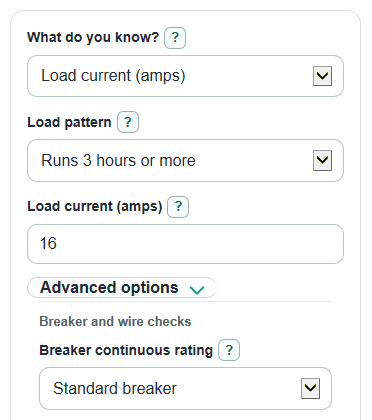
- Choose What do you know? based on the label you have: Load current if it gives amps, or Load power if it gives watts.
- Pick Load pattern. Use Runs 3 hours or more when the load can stay at its maximum current for at least 3 hours.
- Enter the visible amps or watts fields. If using watts, also enter Circuit voltage, then check Power setup and Power factor if they are not the default.
- Open Advanced options only if you need to change Breaker continuous rating, check Wire ampacity to check, choose a Breaker size list, or change Number format.
- After you calculate, compare Recommended standard breaker size with Minimum before rounding and Max continuous load on that breaker. If the wire check warns you, do not use the result until conductor sizing is verified.
Definitions
Recommended standard breaker size: The next breaker rating in the selected Breaker size list that is at least as large as the calculated minimum current.
Minimum before rounding: The current after applying the continuous-load rule, before moving up to a standard breaker size.
Load current used: The amperes used in the breaker calculation. In watts mode, this is converted from Load power and Circuit voltage.
Continuous part: The part of the load expected to run at its maximum current for 3 hours or more.
Other part: The part of the load that is not expected to run at its maximum current for 3 hours or more.
Power factor: A decimal from greater than 0 to 1 that adjusts watts-to-amps conversion for AC loads.
Breaker continuous rating: The selected rule for continuous load. Standard breaker uses the 125% sizing rule, while 100% rated equipment uses 100% only when the equipment is listed for that use.
Wire ampacity to check: The current the conductor is allowed to carry, entered only as a quick coordination check against the recommended breaker.
Common mistakes and quick fixes
Mistake: Entering the breaker you want into Load current.
Fix: Put the actual load amps in Load current, then let Recommended standard breaker size show the rounded breaker.
Mistake: Leaving Load pattern on Runs less than 3 hours for lights, heaters, or equipment that may run all afternoon.
Fix: Change Load pattern to Runs 3 hours or more, or use Some of each with Continuous part and Other part.
Mistake: Using Load power but forgetting that Circuit voltage, Power setup, and Power factor change the amps.
Fix: Match Circuit voltage to the load, choose the correct Power setup, and enter the real Power factor when known.
Mistake: Choosing 100% rated equipment under Breaker continuous rating for an ordinary breaker.
Fix: Keep Breaker continuous rating set to Standard breaker unless the breaker and enclosure are listed and installed for 100% continuous operation.
Mistake: Ignoring Wire ampacity to check when you already know the conductor ampacity.
Fix: Enter Wire ampacity to check and stop if Wire ampacity check says the recommended breaker may be too large for the wire.
Mistake: Using the Common branch sizes up to 60 A Breaker size list for a larger feeder or equipment load.
Fix: Use NEC standard sizes through 600 A for larger planning checks, or get engineered equipment selection when the load is above the list.
Limitations & Key Assumptions / Boundary Conditions
- This calculator is a planning estimate. It does not approve an installation or verify full NEC compliance.
- It sizes the overcurrent device from the entered load and selected assumptions. It does not size conductors, raceways, terminals, ambient-temperature corrections, voltage drop, fault current, motor starting, or equipment-specific rules.
- The Wire ampacity to check result is only a simple comparison between the entered ampacity and the recommended breaker size. Some code rules and equipment listings can require a different answer.
- Watts mode assumes the entered Load power is real power in watts. If the label gives volt-amperes, use Power factor 1 for the conversion.
- Three-phase watts mode assumes a balanced three-phase load and uses line-to-line Circuit voltage.
- Use 100% rated equipment only when the breaker, enclosure, and installation are listed for continuous operation at 100% of rating.
- If the Minimum before rounding is above the largest value in the selected Breaker size list, the calculator should not invent a breaker size. Use engineered equipment selection.
Methodology
How the load becomes amps
If What do you know? is Load current, the calculator uses the entered amps directly. If What do you know? is Load power, it converts watts to amps before applying the breaker rule.
current_amps = power_watts / (voltage_volts * power_factor)
This single-phase or DC formula uses Circuit voltage and Power factor. If Power setup is Three-phase, the balanced three-phase factor is included.
current_amps = power_watts / (sqrt(3) * voltage_volts * power_factor)
How the continuous-load rule is applied
For a standard breaker, continuous load is multiplied by 1.25. A common code summary is that overcurrent protection is sized at 125% of continuous load plus 100% of noncontinuous load, with an exception for listed 100% rated assemblies [1].
minimum_breaker_current = load_current * multiplier
For Some of each, only the Continuous part gets the continuous-load multiplier.
minimum_breaker_current = other_current + continuous_current * multiplier
The multiplier is 1.25 for continuous load on Standard breaker. It is 1.00 for noncontinuous load, and it is 1.00 for continuous load only when Breaker continuous rating is 100% rated equipment.
How the standard size is chosen
The calculator compares Minimum before rounding with the selected Breaker size list and chooses the smallest listed size that is greater than or equal to the minimum.
recommended_breaker = smallest_standard_size >= minimum_breaker_current
It also shows the continuous load that the recommended breaker can carry under the selected rating type.
max_continuous_on_recommended = recommended_breaker / 1.25
max_continuous_on_recommended = recommended_breaker for 100% rated equipment
Worked example
A 16 A load that runs 3 hours or more on a Standard breaker has this minimum:
16 A * 1.25 = 20 A. The next standard size is 20 A, so Recommended standard breaker size is 20 A. The Max continuous load on that breaker is 20 A / 1.25 = 16 A, and Extra room after rounding is 0 A.
Calculation choices
Numbers are stripped of commas and spaces before parsing. Required visible amps, watts, voltage, and power factor entries must be positive numbers. Power factor must be greater than 0 and no more than 1. Optional Wire ampacity to check may be blank, but a nonblank value must be a positive number.