
Estimate appliance electricity use and cost from watts, time used, electricity rate, and real-life schedule settings.
Advanced options
Table of contents
How to use our Energy Usage Calculator
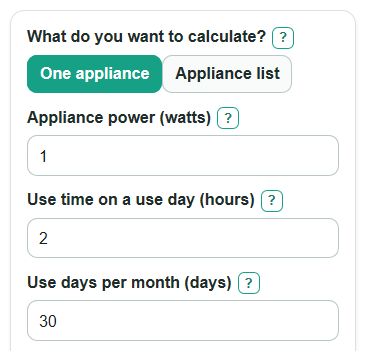
- Choose One appliance for a quick estimate, or Appliance list if you want to total several rows.
- Enter Appliance power, Use time on a use day, Use days per month, and Electricity rate; use dollars per kWh, so 15 cents is 0.15.
- Open Advanced options if you need Number of same appliances, Time drawing full power, Months used per year, or Number display.
- For Appliance list, enter one appliance per line in this order: name, watts, hours per day, days per month, count, active percent, months per year.
- After you calculate, sanity-check the Estimated monthly cost by comparing it with your bill size and checking whether Monthly energy used looks reasonable for the appliance wattage and hours.
Definitions
Watt (W): A unit of power. It tells how fast an appliance uses electricity while running.
Kilowatt-hour (kWh): A unit of energy used on many electric bills. One kilowatt-hour is the energy from using 1,000 watts for 1 hour [2].
Electricity rate ($ per kWh): The price you pay for each kilowatt-hour. Use the total rate from your bill if you know it.
Use day: A day when the appliance is actually used. Cost on one use day is based on that day's hours, not on the whole month.
Time drawing full power: The percent of the listed use time when the appliance is pulling its rated watts. It helps model devices that cycle on and off.
Megajoule (MJ): A science energy unit. The calculator converts monthly kWh to MJ by multiplying by 3.6.
Common mistakes and quick fixes
Mistake: Entering cents in Electricity rate, such as 15 instead of 0.15.
Fix: Enter dollars per kWh in Electricity rate; 15 cents is 0.15.
Mistake: Using minutes in Use time on a use day when the label asks for hours.
Fix: Convert minutes to hours before entering Use time on a use day; 30 minutes is 0.5 hours.
Mistake: Putting every day of the month in Use days per month for an appliance used only on weekends.
Fix: Count only use days in Use days per month, such as 8 or 9 for many weekend-only items.
Mistake: Leaving Time drawing full power at 100 for a cycling appliance like a heater, air conditioner, or refrigerator.
Fix: Lower Time drawing full power if the appliance turns itself on and off during the hours you listed.
Mistake: Forgetting Number of same appliances for a group of matching lights or fans.
Fix: Enter the count in Number of same appliances when the same Appliance power and schedule apply to each item.
Mistake: Treating Estimated yearly cost as a full-year cost for a seasonal item used only part of the year.
Fix: Set Months used per year to the number of months the appliance follows that monthly schedule.
Limitations & Key Assumptions / Boundary Conditions
- The calculator estimates electricity use from the wattage and schedule you enter. Real appliances can use more or less power at different settings.
- Appliance power should be the running wattage, not a short startup surge, unless you are intentionally estimating surge use.
- Time drawing full power is an approximation. For cycling devices, a plug-in energy monitor gives a better measurement.
- Electricity rate should include the charges you want counted. Bills may also include fixed fees, taxes, demand charges, or tiered rates that are not modeled here.
- Use days per month is limited to 31, Months used per year is limited to 12, and Time drawing full power must be greater than 0 and no more than 100.
- Appliance list totals only the rows you enter. It does not estimate your whole home unless your list includes every major electric load.
Methodology
Calculation method
The calculator follows the common appliance estimate method: power in watts times hours of use, converted to kilowatt-hours, then multiplied by the electricity price [4].
energy_per_use_day_kwh = (power_watts * quantity * (active_power_percent / 100) * hours_per_day) / 1000
monthly_energy_kwh = energy_per_use_day_kwh * days_per_month
yearly_energy_kwh = monthly_energy_kwh * months_per_year
cost = energy_kwh * electricity_rate
The division by 1000 changes watts to kilowatts because 1 kilowatt equals 1,000 watts [3]. Monthly energy in megajoules is calculated with this conversion:
monthly_energy_mj = monthly_energy_kwh * 3.6
List mode
In Appliance list mode, each row is calculated the same way as one appliance. The monthly kWh values are added together, and yearly kWh adds each row's monthly kWh times that row's Months used per year.
total_monthly_kwh = add(each_row_monthly_kwh)
total_yearly_kwh = add(each_row_monthly_kwh * row_months_per_year)
The Biggest user in the list is the row with the highest monthly kWh. Its share is calculated only when the total monthly kWh is greater than zero.
largest_item_share_percent = (largest_item_monthly_kwh / total_monthly_kwh) * 100
Mini-example
For a 1000 W appliance used 2 hours on 30 days per month at $0.15 per kWh, with 1 appliance, 100 percent full-power time, and 12 months per year, the use-day energy is (1000 * 1 * 1 * 2) / 1000 = 2 kWh. Monthly energy is 2 * 30 = 60 kWh. Monthly cost is 60 * 0.15 = $9.00. Yearly energy is 60 * 12 = 720 kWh, and yearly cost is 720 * 0.15 = $108.00.
Calculation choices
Zero hours or zero use days produce zero energy and zero cost. Blank or non-numeric required values are blocked instead of being treated as zero. In Appliance list mode, invalid rows are reported by row number so they are not silently skipped.
Sources
- Estimating Appliance and Home Electronic Energy Use | Department of Energy - Energy
- Measuring electricity - U.S. Energy Information Administration (EIA) - EIA
- Electricity explained - U.S. Energy Information Administration (EIA) - EIA
- Electric Power Monthly - U.S. Energy Information Administration (EIA) - EIA