
Enter total BTU to find its kWh energy equivalent, or choose kWh to BTU or BTU/h to kW for a different unit type.
Table of contents
How to use our BTU to kWh Converter
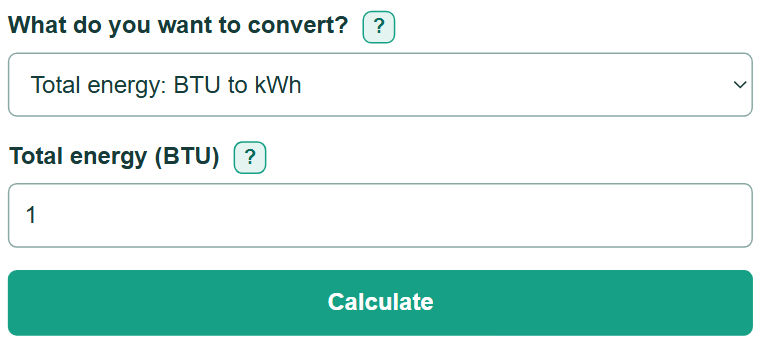
- Choose the task that matches the unit on your report, bill, or equipment label under "What do you want to convert?"
- Enter the non-negative number in the field shown. You may type the matching unit after the number, such as "3412 BTU".
- Select "Calculate" to see the equivalent total energy in kWh or BTU, or the equipment power rate in kW.
- Check the result unit before using it: BTU and kWh are total energy, while BTU/h and kW are rates.
Definitions
BTU: British thermal unit, a unit for a total amount of energy.
kWh: Kilowatt-hour, a unit for a total amount of energy. Electricity bills commonly use kWh.
BTU/h: BTU per hour, a rate of energy transfer often used to state HVAC capacity.
kW: Kilowatt, a rate of energy transfer or power. It is different from kWh.
Energy equivalent: The same amount of energy written in another unit. It does not predict cost, runtime, or equipment electricity use.
Common mistakes and quick fixes
Mistake: Entering a 12,000 BTU/h HVAC rating as total BTU energy.
Fix: Choose "Equipment rate: BTU/h to kW" and enter it in "Equipment rate (BTU/h)".
Mistake: Treating the kWh answer as appliance electricity use or a utility bill amount.
Fix: Read it as an energy equivalent only. Actual electricity use depends on runtime and equipment efficiency.
Mistake: Choosing BTU to kWh when the source already lists kWh.
Fix: Choose "Total energy: kWh to BTU" for the reverse conversion.
Mistake: Entering a negative number to mean the reverse direction.
Fix: Choose the reverse conversion task. Source energy amounts and equipment rates must be zero or greater.
Mistake: Typing a different unit after the number, such as kW in a total-energy field.
Fix: Use the unit named in the active field, or enter the number without a unit suffix.
Limitations & Key Assumptions / Boundary Conditions
- The converter uses a fixed unit relationship. It does not estimate an electricity bill, fuel cost, taxes, delivery charges, or fixed fees.
- A BTU-to-kWh energy equivalent does not show an appliance's electricity use. Runtime, efficiency, and operating conditions affect actual consumption.
- The BTU/h-to-kW task converts one rate to another. It cannot calculate total kWh without operating time.
- Use total-energy tasks only for BTU or kWh totals. Use the equipment-rate task for HVAC capacity or another BTU/h rate.
- Values must be finite and zero or greater. Zero is valid and converts to zero.
Methodology
Conversion method
The calculator uses 1 kWh = 3,412.14163312794 BTU (IT). [1] This fixed relationship converts total energy between BTU and kWh.
kWh = total BTU / 3412.14163312794
BTU = total kWh * 3412.14163312794
kW = BTU/h / 3412.14163312794
Worked example
For total energy, 3,412.14163312794 BTU divided by 3,412.14163312794 equals 1 kWh. For a rate, 3,412.14163312794 BTU/h divided by the same factor equals 1 kW. The number is the same, but kWh measures accumulated energy and kW measures a rate.
Why the rate formula works
A kilowatt is one kilowatt-hour of energy per hour. Therefore, the BTU-per-kWh relationship also gives the matching BTU/h-per-kW relationship. The calculator keeps total energy and equipment rates in separate tasks so a BTU/h nameplate value is not treated as a BTU total.