
Convert joules, kilojoules, megajoules, or gigajoules into kWh for electric-bill and device-energy questions.
Table of contents
How to use our Joules to kWh Converter
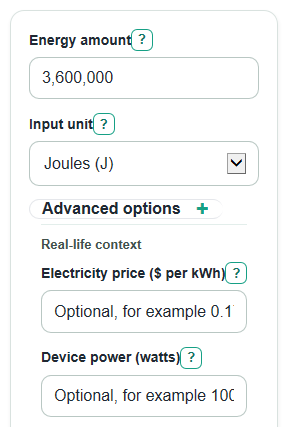
- Enter the Energy amount and choose the matching Input unit, such as Joules (J), Kilojoules (kJ), Megajoules (MJ), or Gigajoules (GJ).
- Open Advanced options only if you want extra context: add Electricity price ($ per kWh) for cost, Device power (watts) for run time, or change Rounding and Number style.
- Select Calculate to get Energy in kilowatt-hours (kWh) first, then Energy in watt-hours (Wh) and any optional context cards.
- Sanity-check the answer: 3,600,000 J should equal 1 kWh and 1,000 Wh, so a much smaller joule amount should usually give a small decimal kWh value.
Definitions
Joule (J): A small SI unit of energy. This converter changes joule-based amounts into electric-bill units.
Kilowatt-hour (kWh): An energy unit equal to using 1 kilowatt of power for 1 hour. Electric bills commonly use kWh.
Watt-hour (Wh): An energy unit equal to using 1 watt of power for 1 hour. There are 1,000 Wh in 1 kWh.
Input unit: The unit attached to the number you entered: J, kJ, MJ, or GJ.
Electricity price ($ per kWh): The price for one kilowatt-hour of electricity, used for the simple cost estimate.
Device power (watts): How fast a device uses energy. A higher watt value uses the same kWh in less time.
Smart rounding: A display choice that keeps very small nonzero kWh results from being rounded all the way to 0.
Common mistakes and quick fixes
Mistake: Typing a negative value in Energy amount .
Fix: Use 0 or a positive amount, because this converter treats energy as an amount, not a signed balance.
Mistake: Picking the wrong Input unit , such as leaving J selected when the number is in MJ.
Fix: Match the unit printed with your number before you calculate.
Mistake: Entering a monthly bill total in Electricity price ($ per kWh) .
Fix: Enter the price for one kWh, such as 0.17, not the total bill amount.
Mistake: Putting 0 in Device power (watts) .
Fix: Use a positive watt value from the device label, because run time divides by device power.
Mistake: Using Rounding set to 3 decimal places for a tiny energy amount and thinking 0.000 kWh means no energy.
Fix: Use Smart, 9 decimal places, or 12 decimal places when the converted kWh is very small.
Limitations & Key Assumptions / Boundary Conditions
- The cost estimate is only energy times Electricity price ($ per kWh). It does not include taxes, fixed monthly fees, demand charges, discounts, or tiered rates.
- The run-time estimate assumes Device power (watts) stays constant. Real devices may cycle on and off or change power while running.
- The converter accepts 0 energy, but it rejects negative Energy amount values because it is for converting an amount of energy.
- If Electricity price ($ per kWh) is blank, the cost card is skipped. If Device power (watts) is blank, the run-time card is skipped.
- Very large entries can be displayed with comma grouping or scientific notation depending on Number style, but the same conversion math is used.
- Rounding changes what you see on the screen, not the exact conversion used before rounding.
Methodology
Conversion steps
The calculator first changes the selected input unit into joules. The unit multiplier is 1 for J, 1,000 for kJ, 1,000,000 for MJ, and 1,000,000,000 for GJ.
energy_j = energy_amount * unit_to_j_factor
It then converts joules to kilowatt-hours by dividing by 3,600,000.
energy_kwh = energy_j / 3600000
It also shows watt-hours, which can be easier to read when the kWh answer is a tiny decimal.
energy_wh = energy_j / 3600
Optional context
If you enter Electricity price ($ per kWh), the calculator multiplies the converted kWh by that price.
cost_estimate = energy_kwh * electricity_price
If you enter Device power (watts), the calculator changes watts to kilowatts and divides the energy by that power.
run_time_hours = energy_kwh / (device_power_watts / 1000)
Mini-example
For 7,200,000 J, the kWh result is 7,200,000 / 3,600,000 = 2 kWh. The Wh result is 7,200,000 / 3,600 = 2,000 Wh. At $0.15 per kWh, the estimated cost is 2 * 0.15 = $0.30. With a 1,000 watt device, run time is 2 / (1,000 / 1,000) = 2 hours.
Validation and display choices
Commas and spaces are removed before parsing numeric entries. Blank optional fields are ignored, but filled optional fields must be valid numbers. Energy and electricity price cannot be negative. Device power must be greater than 0 when provided. Smart rounding is meant to avoid showing a nonzero tiny kWh value as 0 just because too few decimal places were displayed.
Sources
- kilowatt-hour (kWh) | Communication Standards - NLR
- Glossary - U.S. Energy Information Administration (EIA) - EIA
- U.S. EIA Electricity Annual Technical Notes (PDF) - average retail price of electricity represents per-kWh rate charged to consumers - EIA
- How Affordable and is Your Power? | Federal Energy Regulatory Commission - FERC