
Convert kilowatt-hours to BTU, MMBtu, therms, and joules with a simple energy converter that also helps you avoid mixing up energy and rate units.
Table of contents
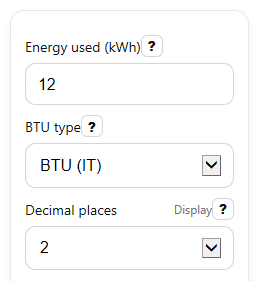
How to use our kWh to BTU Converter
- Enter Energy used (kWh) as a total amount of energy, such as appliance use or a bill total.
- Choose a BTU type. Leave it on BTU (IT) unless you specifically need the thermochemical convention.
- Pick Decimal places if you want more or less rounding in the displayed results.
- Click Calculate to see BTU, Million BTU, Therms, and Joules.
- Sanity-check the output: 1 kWh should be about 3,412 BTU, so a value near that means your conversion is in the right range.
Definitions
kWh: Kilowatt-hour, a unit of energy equal to using 1 kilowatt for 1 hour [2].
BTU: British thermal unit, a unit of energy often used in heating and fuel comparisons [1].
BTU (IT): International Table BTU. This is the default convention used by this calculator.
BTU (thermochemical): Another standard BTU definition. It is very close to BTU (IT), but not exactly the same.
MMBtu: One million BTU. This is a larger energy unit used for building and utility comparisons.
Therm: An energy unit equal to 100,000 BTU, often used on US natural gas bills.
Joule: The SI energy unit. This calculator also shows the conversion in Joules.
Common mistakes and quick fixes
Mistake: Entering power instead of energy in Energy used (kWh) , such as typing 5 for a 5 kW heater without the hours used.
Fix: Use total energy in kWh. If you only know power, multiply kW by hours first, then enter that result in Energy used (kWh) .
Mistake: Mixing up BTU with BTU per hour when reading HVAC equipment labels.
Fix: Treat BTU in this tool as energy only. The Note output reminds you this converter does not calculate heating or cooling rate.
Mistake: Changing BTU type without knowing why the answer changed a tiny amount.
Fix: Use BTU (IT) for the default online-converter convention. Switch only if you need the thermochemical standard for matching another source.
Mistake: Thinking Million BTU should be a large whole number for small kWh values.
Fix: Remember that Million BTU is BTU divided by 1,000,000, so small inputs often show a small decimal.
Mistake: Comparing Therms directly to electric bill kWh without converting first.
Fix: Use the Therms output for gas-style energy comparison and the BTU output for a direct thermal-energy equivalent.
Mistake: Assuming extra digits mean a more certain real-world number after changing Decimal places .
Fix: Decimal places only changes display rounding. It does not change the core conversion math.
Limitations & Key Assumptions / Boundary Conditions
- This tool converts energy only. It does not convert power or capacity, so it does not turn kW into BTU per hour.
- Energy used (kWh) must be 0 or greater. Negative values are blocked because typical bills and appliance use are nonnegative.
- The result depends slightly on the selected BTU type. BTU (IT) and BTU (thermochemical) differ by a very small amount.
- Decimal places changes only how results are shown on screen. It does not change the underlying conversion.
- Therms and Million BTU are energy equivalents only. Real fuel bills or HVAC system performance can differ because of equipment efficiency, losses, or billing rules.
Methodology
Conversion method
The calculator first reads Energy used (kWh) as a total energy amount. It then converts that value to BTU using the selected BTU type, and also shows the same energy as Million BTU, Therms, and Joules.
BTU (IT) = kWh x 3412.141633
BTU (thermochemical) = kWh x 3412.142
MMBtu = BTU / 1000000
therms = BTU / 100000
Joules = kWh x 3600000
Worked example
If Energy used (kWh) is 12 and BTU type is BTU (IT), the main conversion is 12 x 3412.141633 = 40945.699596 BTU. That is 0.040945699596 Million BTU, 0.40945699596 Therms, and 43,200,000 Joules. With 2 decimal places, the displayed results become 40,945.70 BTU, 0.04 MMBtu, 0.41 therms, and 43,200,000 J.
Why the BTU type matters
BTU is an energy unit [1], and kWh is also an energy unit [2]. The two BTU conventions in this calculator are both standard, but they use slightly different BTU sizes, so the answer can change by a tiny amount. For most everyday uses, the difference is too small to matter much, but choosing the same convention as your source avoids mismatch.
Assumptions and calculation choices
This tool uses fixed conversion factors and does not estimate equipment efficiency, fuel losses, or heat transfer. It treats Therms as exactly 100,000 BTU and MMBtu as exactly 1,000,000 BTU. If Decimal places is changed, only the displayed rounding changes; the core math does not.
Sources
The thermochemical option uses 1 BTU = 4.184 × 453.59237 × 5/9 joules (about 1054.35026449 J), giving about 3414.425093 BTU per kWh. IT BTU uses a different definition. The displayed therm equivalent is 100,000 of the selected BTU type; billing therm conventions can differ. See NIST conversion factors.