
Convert watts and BTU per hour in either direction, with matching kW and cooling-ton equivalents for quick HVAC comparisons.
Advanced options
Table of contents
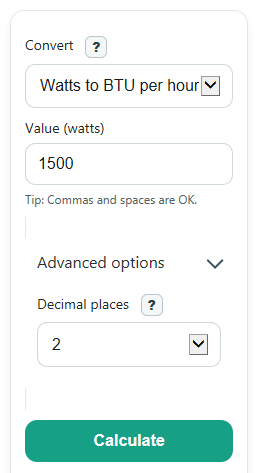
How to use our Watts to BTU per Hour Converter
- Choose a direction in Convert so the calculator knows whether your starting number is in watts or BTU per hour.
- Enter your number in Value. You can type commas or spaces, and zero or negative values are allowed.
- If you want, change Decimal places to control how many digits appear in the results.
- Click Calculate to see Converted value, Same power in kilowatts, Same power in tons of cooling, and the Formula used.
- Sanity-check the answer: 1,000 watts should equal about 3,412.14 BTU/h, and 12,000 BTU/h should equal about 1 ton of cooling.
Definitions
Watt (W): A unit of power, meaning how fast energy is used or moved. A watt is a rate, not a total amount [1].
BTU per hour (BTU/h): A power rate that shows how much heat is added or removed each hour.
BTU: A unit of energy. BTU by itself is not the same as BTU per hour.
Kilowatt (kW): 1,000 watts. This is often used on equipment labels and larger power ratings.
Ton of cooling: A cooling capacity equal to 12,000 BTU/h.
Decimal places: The number of digits shown after the decimal point in the displayed results.
Common mistakes and quick fixes
Mistake: Entering a number in Value without first checking Convert .
Fix: Make sure Convert matches your starting unit before you calculate.
Mistake: Treating the Converted value as BTU when the tool is showing BTU per hour.
Fix: Read the result unit carefully. This converter uses BTU per hour, which is a rate of power.
Mistake: Leaving Value blank or typing text that is not a number.
Fix: Enter a numeric Value such as 1500 or 12,000.
Mistake: Expecting Same power in tons of cooling to be a whole number every time.
Fix: Fractions are normal. One ton equals 12,000 BTU/h, so many inputs give a decimal ton value.
Mistake: Choosing too few digits in Decimal places and thinking a small result is zero.
Fix: Increase Decimal places when the value is small, especially for Same power in tons of cooling .
Mistake: Thinking a negative Converted value means the calculator broke.
Fix: Negative values are allowed for signed power flow, but most appliance and HVAC ratings are positive numbers.
Limitations & Key Assumptions / Boundary Conditions
- This tool converts power rates only. It does not convert total energy use over time, so BTU and BTU/h are not interchangeable.
- The tons output is a comparison value based on 12,000 BTU/h per ton. Real HVAC system sizing depends on more than rated capacity.
- Results depend on fixed conversion factors and the rounding you choose in Decimal places.
- Very small values can look like 0 if you choose too few decimal places, even when the unrounded value is not zero.
- Negative inputs are allowed for technical signed-power cases, but they usually do not match normal appliance or air-conditioner nameplate ratings.
- This converter does not estimate electricity use, heat load, room size, efficiency, or operating cost.
Methodology
How the conversion works
The calculator first reads the number in Value and the direction chosen in Convert. It strips commas and spaces, checks that the entry is a real finite number, and then applies the matching conversion factor.
BTU_per_hour = watts x 3.412141633
watts = BTU_per_hour x 0.29307107
kW = watts / 1000
tons = BTU_per_hour / 12000
Output logic
Converted value is the main answer in the other unit. Same power in kilowatts always shows the same power as kW. Same power in tons of cooling uses the BTU/h value, whether BTU/h was entered directly or found from watts first. The display then rounds results to the selected number of decimal places.
Mini example
If Convert is set to watts to BTU per hour and Value is 1,500, the main step is:
BTU_per_hour = 1500 x 3.412141633 = 5118.2124495
With 2 decimal places, Converted value shows 5,118.21 BTU/h. The companion outputs are 1.5 kW and about 0.42652 tons of cooling.
Assumptions and limits
The calculator uses fixed published conversion factors and a standard 12,000 BTU/h per ton relationship for the HVAC comparison output. It allows zero and negative values, but real equipment ratings are usually positive. If the input is blank or not a valid finite number, the calculator shows an error instead of a result.