
Convert Btu/h to watts or watts to Btu/h and see the same power rate in kW and HVAC tons.
Table of contents
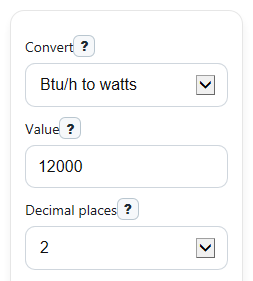
How to use our BTU to Watts Converter
- Choose a direction in Convert: either Btu/h to watts or Watts to Btu/h.
- Enter your number in Value. You can type commas or spaces, but the entry still has to be a real number.
- If you want a different level of rounding, change Decimal places.
- Click Calculate to see Converted value, Power in kilowatts, Cooling size in tons, and the Formula used.
- Sanity-check the result with Reverse factor reference: 1 Btu/h should be much smaller than 1 W, while 1 W should equal several Btu/h.
Definitions
Btu/h: British thermal units per hour. This is a power rate, often used for heating and cooling capacity.
Watt (W): A unit of power. It tells how fast energy is used or moved.
Kilowatt (kW): 1,000 watts. It is the same power rate written in a larger unit.
Refrigeration ton: An HVAC capacity unit equal to 12,000 Btu/h. It is not a weight.
Converted value: The main answer in the other unit you did not enter.
Formula used: The exact conversion factor applied for the direction you picked.
Reverse factor reference: The opposite one-unit conversion, used as a quick check that you chose the right direction.
Common mistakes and quick fixes
Mistake: Typing plain BTU into Value as if it were the same as Btu/h.
Fix: Use this tool only for a rate. If your source gives BTU over a time period, first convert it to Btu/h, then enter it in Value .
Mistake: Leaving Convert on the wrong direction and reading the Converted value backward.
Fix: Check whether you are starting with Btu/h or watts before you calculate.
Mistake: Entering text like "12k" or other non-numeric symbols in Value .
Fix: Enter digits only, with an optional decimal point. Commas are fine, but words and unit letters are not.
Mistake: Thinking Cooling size in tons is a weight result.
Fix: Read it as refrigeration tons, which is an HVAC capacity unit based on 12,000 Btu/h per ton.
Mistake: Using too few Decimal places and thinking the conversion is off.
Fix: Increase Decimal places if you need a closer rounded result for comparison or homework.
Mistake: Being surprised by a negative Converted value after entering a negative Value .
Fix: Negative values are allowed for signed engineering conventions, but most home and appliance ratings should be positive.
Limitations & Key Assumptions / Boundary Conditions
- This converter is for Btu/h and watts, which are power-rate units. It does not convert plain BTU energy by itself.
- If you only know BTU over a time period, you must first divide by time to get Btu/h before using the result here.
- Cooling size in tons is based on 12,000 Btu/h per ton, which is a standard HVAC shorthand and not a direct measure of weight.
- Negative inputs are allowed mathematically, but they usually only make sense for sign conventions in engineering work.
- Displayed results are rounded to the selected number of decimal places, so the shown value may differ slightly from the full calculation.
- Very large malformed entries or non-numeric text should be treated as input errors, not physical results.
Methodology
Conversion math
This calculator converts between two power-rate units: Btu/h and watts. It then shows the same power rate in kilowatts and refrigeration tons for extra HVAC context.
W = (Btu/h) x 0.2930711
Btu/h = W x 3.412142
kW = W / 1000
tons = (Btu/h) / 12000
How outputs are chosen
If Convert is set to Btu/h to watts, the main Converted value is in watts. If it is set to watts to Btu/h, the main result is in Btu/h. Power in kilowatts always comes from watts, and Cooling size in tons always comes from Btu/h.
Mini example
If you enter 12,000 in Value with Convert set to Btu/h to watts, the calculator multiplies by 0.2930711.
W = 12000 x 0.2930711 = 3516.8532
With 2 decimal places, Converted value becomes 3516.85 W. Then kilowatts are 3516.8532 / 1000 = 3.52 kW after rounding, and refrigeration tons are 12000 / 12000 = 1.00 ton.
Assumptions and limits
The calculator treats your entry as a power rate, not stored energy. It uses fixed standard conversion factors, allows zero, and also allows negative numbers for signed technical use. Real equipment ratings may differ slightly because of labeling, rounding, or test conditions, but the unit conversion itself is direct.