
Check which RV appliances can run together on a 30 amp hookup before you trip the breaker.
Advanced options
Table of contents
How to use our RV 30 Amp Load Calculator
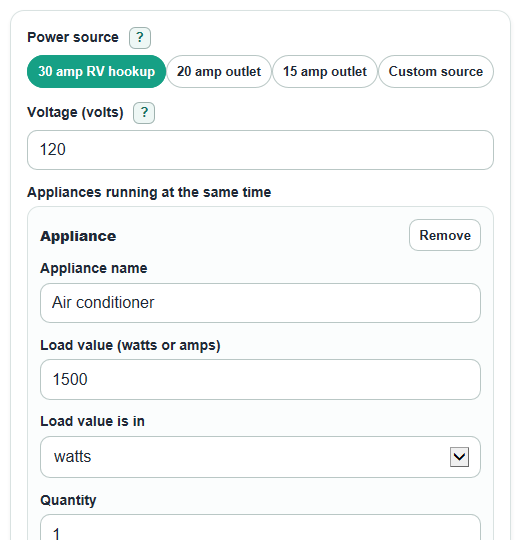
- Choose the Power source. Use 30 amp RV hookup for a normal campground TT-30 style connection, or choose Custom source if you know a different amp limit.
- Enter the Voltage. The default is 120 volts, which fits most simple RV load planning.
- Fill in Appliances running at the same time. For each row, enter the appliance name, load value, watts or amps, quantity, and whether it runs for 3+ hours.
- Open Advanced options only if you want to change the Long-running target or add an Extra startup load for a motor starting surge.
- Click Calculate, then sanity-check the answer: Total load right now should be below the source limit, and Load marked runs 3+ hours should be near or below the long-running target.
Definitions
Power source: The outlet, generator, adapter, or breaker limit feeding the RV.
Amps: Electric current, or how much electricity the appliances are pulling from the source.
Watts: Electric power, or how much work the appliances are using. Watts can be found from amps times volts.
Voltage: The electrical pressure used for the conversion between amps and watts. The default is 120 volts.
Appliances running at the same time: The group of loads you want to check as one real-life scenario.
Long-running target: A planning limit for loads marked runs 3+ hours. The default is 80 percent of the selected source.
Estimated startup peak: The normal running load plus any extra startup watts you entered for a short motor surge.
Common mistakes and quick fixes
Mistake: Leaving Voltage at 120 when your generator or source is rated differently.
Fix: Enter the voltage printed on the source so Total power right now and amps match the setup you are checking.
Mistake: Listing appliances in Appliances running at the same time that will never run together.
Fix: Make one realistic group at a time, such as air conditioner plus converter plus refrigerator, then calculate that group.
Mistake: Typing an amp value as watts in Appliances running at the same time .
Fix: Choose the matching unit for each row. If the appliance label says amps, set that row to amps.
Mistake: Marking a short-use appliance as long-running when setting the Long-running target .
Fix: Mark only loads that may run for 3+ hours, such as lights, a converter, or a refrigerator, so Load marked runs 3+ hours stays meaningful.
Mistake: Ignoring Extra startup load for a motor that trips the breaker when it starts.
Fix: Add a known startup watt estimate if you have one, then check Estimated startup peak .
Mistake: Treating a negative Amps left as a display problem.
Fix: A negative value means the load is over the source by that many amps; check Running-load excess and Continuous-planning excess to see which limits require reducing the load.
Limitations & Key Assumptions / Boundary Conditions
- The calculator is for 120-volt RV load planning. It does not inspect wiring, cords, adapters, transfer switches, or campground pedestal condition.
- Appliance nameplate ratings can differ from real draw. Motors, compressors, chargers, heaters, and inverters may change draw while running.
- The Extra startup load is only as accurate as the watt value you enter. Many appliances do not print startup watts on the label.
- The default Long-running target is a planning target, not a new breaker size. Changing it changes the comparison, not the actual breaker.
- If voltage drops under load, the real amp draw may be different from the calculator result. Long cords and weak pedestals can make voltage lower.
- The calculator does not decide which appliances are safe for your RV. It only checks the load numbers you enter against the selected source limit.
Methodology
Calculation steps
The calculator first chooses the source amp limit from Power source: 30 amps, 20 amps, 15 amps, or the entered Custom source limit.
source_amps = selected source amp limit
Each appliance row is converted to watts. If a row is entered in watts, the quantity multiplies the watt value. If a row is entered in amps, the calculator multiplies amps by Voltage to get watts.
row_watts = quantity * load_value
row_watts = quantity * load_value * voltage when the row unit is amps
Then the calculator adds all row watts and converts the total back to amps.
running_load_watts = sum of row_watts
running_load_amps = running_load_watts / voltage
The source capacity in watts is the selected source amps times voltage.
source_capacity_watts = source_amps * voltage
Headroom is kept as a signed number. Positive Amps left means room remains. Negative Amps left means the load is over the source limit.
percent_of_source = running_load_amps / source_amps * 100
amps_left = source_amps - running_load_amps
watts_to_cut = max(0, running_load_watts - source_capacity_watts)
Rows marked runs 3+ hours are added separately and compared with the selected Long-running target.
long_running_load_amps = long_running_load_watts / voltage
long_running_target_amps = source_amps * long_running_target_percent / 100
The startup estimate adds Extra startup load before converting to amps.
startup_peak_amps = (running_load_watts + startup_buffer_watts) / voltage
Load check checks the source limit, the mixed continuous-load allowance, and your separate long-running target. A mixed allowance above the source overrides an otherwise acceptable status. Within the calculated limits is a planning result, not an installation approval.
Mini-example
For a 30 amp source at 120 volts, source capacity is 3,600 watts. If the rows are a 1,500 watt air conditioner, a 300 watt converter, a 180 watt refrigerator, and 96 watts of lights, the total is 2,076 watts.
2,076 watts / 120 volts = 17.3 amps
That uses about 57.7 percent of a 30 amp source and leaves 12.7 amps. If only the converter, refrigerator, and lights are marked runs 3+ hours, the long-running load is 576 watts, or 4.8 amps, which is below the default 24 amp long-running target.
Continuous loads together with short-use loads
This planner assumes a standard breaker. Check short-use amps + 1.25 × continuous amps against the source rating. For example, 22 A continuous plus 4 A short-use needs a 31.5 A allowance, which exceeds a 30 A source even though the actual current is 26 A. A custom long-running target does not override this check. Running-load excess alone does not show the continuous allowance. Use nameplate input amps for motors or other loads whose watts do not equal volts times amps. Special 100%-rated installations require separate verification. See Schneider Electric breaker guidance.