
Enter the appliances and tools you will run together to find the generator running and starting or surge watt ratings you need.
Table of contents
How to use our Generator Load Calculator
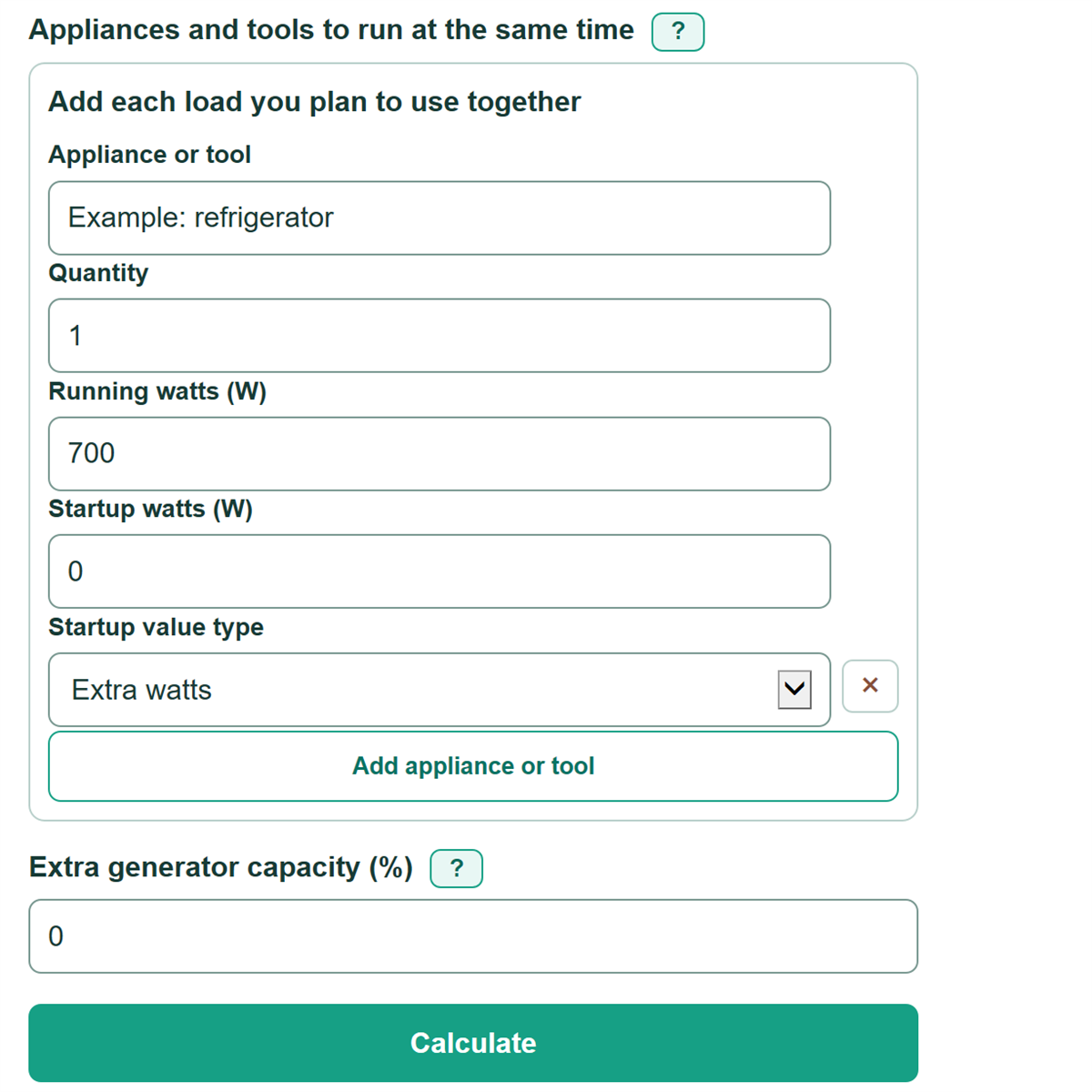
- Add each appliance or tool that you expect to run at the same time. Copy its wattage from its data plate, manual, manufacturer specification, or a watt meter.
- Enter the quantity and running watts for each item. Add separate rows for items with different watt ratings.
- Enter the startup watt figure and select whether it is total starting watts or extra starting watts above the running load.
- Enter extra generator capacity only if you want planning room above the entered load, then select Calculate.
- Choose a generator whose published running rating and starting or surge rating both meet or exceed the results. If either result seems too high or low, check the item quantities and startup value types.
Definitions
Running watts: The continuous power an appliance or tool uses while it operates.
Starting watts: The brief power demand when some motor-driven equipment starts.
Total starting watts: A startup figure that already includes the item's running watts. The calculator subtracts that item's running watts to find the added startup demand.
Extra starting watts: Startup power above an item's running watts. For a non-motor load, this can be 0 W.
Largest added startup demand: The biggest single startup increase among the listed items. It is added to the full running load to find the peak requirement.
Extra generator capacity: An optional percentage added to both calculated ratings for planning room above the entered load.
Common mistakes and quick fixes
Mistake: Entering amps in a watts field.
Fix: Copy watts from the equipment label or manual. Amps are not watts unless voltage, electrical type, and sometimes power factor are known.
Mistake: Treating total starting watts as extra starting watts.
Fix: Select "total starting watts" when the startup figure already includes the item's running watts.
Mistake: Adding every motor's startup demand when only one motor will start at a time.
Fix: Enter each item's own startup figure. The calculator adds only the largest startup increase to the full running load.
Mistake: Leaving out loads that will operate during the outage, trip, or job.
Fix: Include all items planned to run together, including lights, chargers, and small tools.
Mistake: Choosing a generator by its surge rating alone.
Fix: Its continuous running rating must meet the running requirement, and its starting or surge rating must meet the peak requirement.
Limitations & Key Assumptions / Boundary Conditions
- The calculation assumes one motor starts at a time. It does not calculate the peak if two or more motors are planned to start together.
- Results depend on the watt figures entered. Use the equipment data plate, manual, manufacturer specification, or a watt meter instead of a generic appliance estimate.
- The calculator sizes electrical capacity only. It does not calculate fuel use, installation needs, transfer equipment, cord limits, voltage drop, or local electrical requirements.
- A calculated rating is a minimum target, not proof that a specific generator will start every listed load. Check that generator's published continuous running and starting or surge ratings and its manual.
- Extra generator capacity is a planning choice. A value of 0% reports the requirement from the entered load without added reserve.
Methodology
How the math works
The calculator adds the running load from every row. Each row contributes its quantity multiplied by its running watts.
total_running_watts = sum(quantity * running_watts)
It then converts each startup entry into an added startup demand. An entry marked extra starting watts is used as entered. For total starting watts, the row's running watts are subtracted. The largest converted increase is added to the full running load for the starting or surge requirement.
largest_starting_increment_watts = max(extra_starting_watts, total_starting_watts - running_watts)
The extra generator capacity percentage, if entered, is applied to both calculated ratings.
required_running_watts = total_running_watts * (1 + reserve_percent / 100)
required_starting_watts = (total_running_watts + largest_starting_increment_watts) * (1 + reserve_percent / 100)
Worked example
A refrigerator uses 700 running W and has 1,400 extra starting W. Lights use 300 running W and have 0 extra starting W. The running load is 1,000 W, and the largest added startup demand is 1,400 W. With 20% extra generator capacity, the required running rating is 1,200 W and the required starting or surge rating is 2,880 W.
A generator must meet or exceed both ratings. Enough starting or surge watts do not make up for an insufficient continuous running rating.