
Estimate how long your generator can run, whether you know its fuel use per hour or only the runtime on its label.
Table of contents
How to use our Generator Runtime Calculator
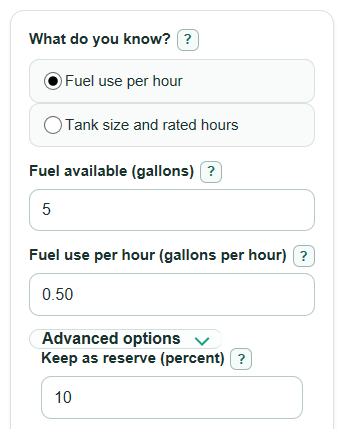
- Choose What do you know?: Fuel use per hour if you have gallons per hour, or Tank size and rated hours if you have a label runtime.
- Enter Fuel available (gallons), then fill in either Fuel use per hour (gallons per hour) or the matching Spec tank size (gallons) and Spec rated runtime (hours).
- Open Advanced options if you want to change Keep as reserve (percent), Target run time (hours), or Fuel price ($ per gallon).
- Select Calculate, then read Estimated run time first and Target check next to see if the fuel plan covers your target.
- Sanity-check the result by comparing Fuel use used in math with your generator manual, data plate, or a measured past run.
Definitions
Fuel available (gallons): The gallons you plan to count for this run before any reserve is held back.
Fuel use per hour (gallons per hour): The burn rate. It means how many gallons the generator uses in one hour at the load condition you are using.
Spec tank size (gallons): The tank amount printed with a rated runtime in the generator manual or label.
Spec rated runtime (hours): The number of hours the generator label says it can run with the spec tank size, often at a stated load.
Keep as reserve (percent): The share of your fuel that the calculator holds back instead of counting toward planned runtime.
Target run time (hours): The number of hours you want the generator to cover.
Fuel extra or short (gallons): A signed fuel gap. Positive means extra gallons remain. Negative means you need more gallons.
Common mistakes and quick fixes
Mistake: Entering percent load in Fuel use per hour (gallons per hour).
Fix: Enter actual gallons per hour, such as 0.50, or switch What do you know? to Tank size and rated hours.
Mistake: Using the full metal tank size for Fuel available (gallons) when you do not plan to fill it that high.
Fix: Enter the usable gallons you actually have on hand or plan to put in the tank.
Mistake: Mixing a Spec tank size (gallons) from one label with a Spec rated runtime (hours) from a different load condition.
Fix: Use the tank size and rated hours from the same generator label or manual line.
Mistake: Setting Keep as reserve (percent) to 100 or leaving it blank after editing it.
Fix: Use a number from 0 to less than 100, such as 10.
Mistake: Reading Fuel extra or short (gallons) as fuel burned.
Fix: Treat a positive number as extra fuel after the target and reserve, and a negative number as gallons short.
Mistake: Entering text or a negative number in Fuel price ($ per gallon).
Fix: Enter 0 or more, such as 3.50, or leave the field blank to skip Fuel cost for target run time.
Limitations & Key Assumptions / Boundary Conditions
- The result is an estimate. Real runtime changes with generator model, electrical load, maintenance, temperature, altitude, and fuel quality.
- The best Fuel use per hour (gallons per hour) comes from the generator manual, data plate, or your own measured run at a similar load.
- Spec label mode assumes the Spec tank size (gallons) and Spec rated runtime (hours) describe the same label condition.
- Keep as reserve (percent) is a planning reserve only. It does not know the generator's actual unusable tank fuel or shutoff behavior.
- Fuel cost for target run time uses the fuel burned during Target run time (hours). It does not price the reserve fuel that remains unused.
- Fuel-powered generators can produce carbon monoxide. Follow the manual and do not run a generator indoors or in enclosed spaces.
Methodology
How the calculator chooses fuel use
If What do you know? is Fuel use per hour, the calculator uses the burn rate you entered.
burn_rate_gph = user_entered_burn_rate_gph
If What do you know? is Tank size and rated hours, the calculator turns the label pair into gallons per hour.
burn_rate_gph = spec_tank_gal / spec_runtime_hours
Runtime and target math
The reserve is removed before runtime is calculated.
usable_fuel_gal = fuel_available_gal * (1 - reserve_percent / 100)
runtime_hours = usable_fuel_gal / burn_rate_gph
runtime_days = runtime_hours / 24
For the target check, the calculator finds the total fuel you would need on hand so the target hours can run and the reserve can still remain.
fuel_needed_for_target_gal = (target_hours * burn_rate_gph) / (1 - reserve_percent / 100)
fuel_gap_gal = fuel_available_gal - fuel_needed_for_target_gal
If Fuel price ($ per gallon) is entered, the cost card prices only the fuel burned during the target time.
cost_for_target = target_hours * burn_rate_gph * fuel_price_per_gal
Mini-example
Suppose Fuel available (gallons) is 5, Fuel use per hour (gallons per hour) is 0.50, Keep as reserve (percent) is 10, and Target run time (hours) is 8. Usable fuel is 5 * 0.90 = 4.5 gallons, so Estimated run time is 4.5 / 0.50 = 9 hours, or 0.375 days. Fuel needed for target is (8 * 0.50) / 0.90 = 4.44 gallons, so Fuel extra or short is 5 - 4.44 = 0.56 gallons extra. If Fuel price ($ per gallon) is 3.50, Fuel cost for target run time is 8 * 0.50 * 3.50 = $14.00.
Safety and calculation checks
The calculator blocks zero or negative fuel, zero or negative burn rate, reserve values of 100 percent or more, and invalid optional fuel prices. It ignores hidden mode-specific entries, so Spec tank size (gallons) and Spec rated runtime (hours) do not affect Fuel use per hour mode. Portable generators can produce carbon monoxide when fuel is burned, so runtime math does not replace safe outdoor placement and the generator manual [1].