
Estimate how much fuel your generator may use, how long stored fuel may last, and what the run may cost.
Table of contents
How to use our Generator Fuel Consumption Calculator
- Choose the Fuel type your generator will actually use, since gasoline, diesel, propane, and natural gas use different fuel units.
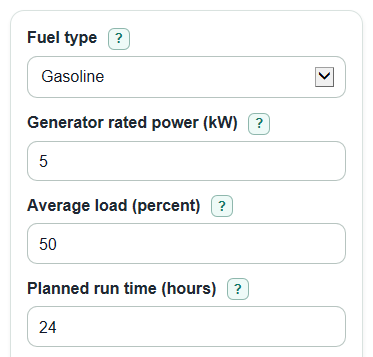
- Enter Generator rated power (kW), Average load (percent), and Planned run time (hours). Use running watts divided by 1,000 for kW, not starting watts.
- Open Advanced options if you want to add Fuel available, Fuel price, Run hours per day, or a Generator efficiency (percent) from your manual.
- Click Calculate, then use Fuel needed for the planned run as your main planning number and round up for safety.
- Sanity-check the result by comparing Estimated fuel used each hour with your generator manual or fuel-use label if you have one.
Definitions
Generator rated power (kW): The running power the generator can supply steadily, measured in kilowatts. One kilowatt equals 1,000 watts.
Average load (percent): The share of rated power you expect to use on average. A 5 kW generator at 50 percent load is carrying about 2.5 kW.
Planned run time (hours): The total time the generator will be on, not necessarily the full outage length.
Fuel available: The amount of fuel you want to compare with the estimate. It is gallons for gasoline, diesel, and propane, and cubic feet for natural gas.
Generator efficiency (percent): The percent of fuel energy that becomes electrical output. The calculator uses a default by fuel type unless you enter your own value.
Btu: A British thermal unit, a common unit for fuel heat content.
kWh: A kilowatt-hour, a unit of energy equal to using 1 kW for 1 hour.
Fuel needed for the planned run: The estimated total fuel for the run time you entered.
Fuel left over or extra needed: Fuel available minus estimated fuel needed. Positive means fuel left over. Negative means extra fuel may be needed.
Common mistakes and quick fixes
Mistake: Entering starting watts in Generator rated power (kW).
Fix: Use running watts divided by 1,000, so 5,000 running watts becomes 5 kW.
Mistake: Putting the full outage length in Planned run time (hours) when you will shut the generator off part of the day.
Fix: Enter only the hours the generator will actually run, and use Run hours per day (hours per day) for a part-day plan.
Mistake: Treating Average load (percent) as a guess with no check.
Fix: Add up the main devices you will run, compare them with Generator rated power (kW), and keep Average load (percent) from 1 to 100.
Mistake: Using gallons for Fuel available when Fuel type is Natural gas.
Fix: For Fuel available, use gallons for gasoline, diesel, or propane, and cubic feet for natural gas.
Mistake: Entering Fuel price as a monthly gas bill or total refill cost.
Fix: Use $ per gallon for gasoline, diesel, or propane, and $ per 100 cubic feet for natural gas.
Mistake: Reading Fuel left over or extra needed as an error when it is negative.
Fix: A negative Fuel left over or extra needed means the estimated extra fuel you may need for the planned run.
Limitations & Key Assumptions / Boundary Conditions
- Results are estimates. Real fuel use can change with generator model, maintenance, altitude, temperature, fuel quality, and changing loads.
- The calculator uses fuel heat content and an efficiency estimate. If your generator manual lists fuel use at a similar load, that manual number is usually better.
- Average load is treated as steady. Large motor starts, well pumps, air conditioners, and refrigerators can cause short surges that are not included.
- Natural gas results are shown in cubic feet, and cost uses $ per 100 cubic feet. Utility bills may add fixed fees, taxes, and delivery charges.
- Propane gallons on hand may not equal tank water capacity. Many propane tanks are not filled to 100 percent because space is needed for expansion.
- Very low loads can make some generators run less efficiently. Long low-load diesel operation may need extra care based on the generator manual.
- Running near 100 percent load leaves little room for startup surges and real-world changes, even if the fuel estimate itself calculates normally.
Methodology
How the estimate is built
The calculator first turns rated generator size and average load into the average electrical power being used.
actual_load_kw = generator_kw * (load_percent / 100)
It then converts the selected fuel heat content from Btu per fuel unit into kWh per fuel unit. The fuel heat contents are based on standard fuel property values for gasoline, diesel, propane, and natural gas [2].
fuel_energy_kwh_per_unit = btu_per_unit / 3412.142
Efficiency means useful electric output divided by fuel energy input [1]. If Generator efficiency (percent) is blank, the calculator uses the default for the selected fuel: gasoline 18 percent, diesel 30 percent, propane 20 percent, or natural gas 22 percent.
fuel_per_hour = actual_load_kw / (fuel_energy_kwh_per_unit * (efficiency_percent / 100))
The main answer multiplies the hourly fuel estimate by the planned run time.
total_fuel_needed = fuel_per_hour * run_hours
If Fuel available is entered, the calculator estimates how long that fuel may last and whether you have extra fuel or a shortfall.
runtime_from_fuel = fuel_available / fuel_per_hour
days_from_fuel = runtime_from_fuel / run_hours_per_day
fuel_left_or_short = fuel_available - total_fuel_needed
If Fuel price is entered, liquids use $ per gallon. Natural gas uses $ per 100 cubic feet.
cost = total_fuel_needed * fuel_price
natural_gas_cost = (total_fuel_needed / 100) * fuel_price
Mini example
For a 5 kW gasoline generator at 50 percent load for 24 hours, the average power is 2.5 kW. With the default 18 percent gasoline efficiency, the estimate is about 0.394 gallons per hour and about 9.46 gallons for the planned run. If you have 10 gallons, the estimate shows about 0.54 gallons left over. At $3.50 per gallon, the estimated fuel cost is about $33.11.
Input checks
The calculator blocks a generator size at or below 0 kW, an Average load (percent) outside 1 to 100, a negative Planned run time (hours), and a custom Generator efficiency (percent) outside 1 to 60. Blank optional fields are skipped instead of being treated as zero.