
Enter your critical loads once to estimate battery backup time, daily energy use, and generator running and starting watt targets.
Table of contents
How to use our Critical Loads Backup Power Calculator
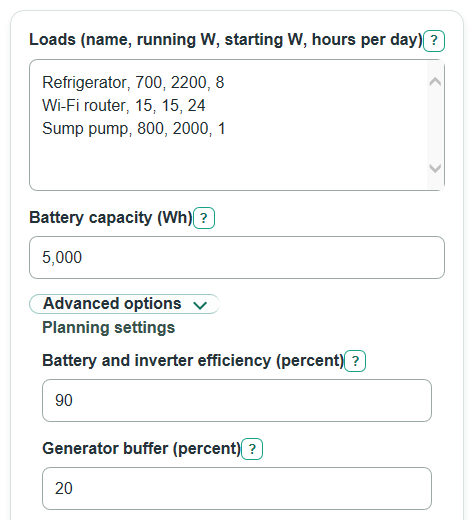
- Enter one load per line in Loads (name, running W, starting W, hours per day), using commas between the name, normal watts, short starting watts, and planned daily use.
- Enter Battery capacity (Wh). Use usable outlet energy if you know it, or use stored battery energy and adjust efficiency in Advanced options.
- Open Advanced options if needed, then set Battery and inverter efficiency (percent) and Generator buffer (percent).
- Select Calculate and read battery time first, then compare Generator running watts with buffer and Generator starting watts with buffer with matching generator ratings.
- Sanity-check the plan by comparing Daily battery energy needed with the battery size and Battery time if everything runs nonstop with any situation where all loads may run together.
Definitions
Critical loads: Devices you plan to keep powered during an outage, such as a refrigerator, router, pump, or medical device.
Running W: The normal watts a load uses after it is already on.
Starting W: The short burst of watts some motors need when they first start.
Wh: Watt-hours, a measure of stored or used energy. A 100 W load running for 2 hours uses 200 Wh.
kWh/day: Kilowatt-hours per day. 1 kWh equals 1000 Wh.
Battery and inverter efficiency (percent): The percent of battery energy expected to reach outlets after conversion losses.
Generator buffer (percent): Extra watt capacity added above the calculated load target.
Common mistakes and quick fixes
Mistake: Putting a phrase like "700 W for 8 hours" into the running-watt part of Loads (name, running W, starting W, hours per day) .
Fix: In Loads (name, running W, starting W, hours per day) , put the normal watts and hours in separate comma-separated spots, such as Refrigerator, 700, 2200, 8.
Mistake: Entering starting watts that are lower than running watts in Loads (name, running W, starting W, hours per day) .
Fix: Use a starting W value at least as high as running W, or repeat the running W if the device has no motor surge.
Mistake: Entering 5 in Battery capacity (Wh) when the battery is 5 kWh.
Fix: Convert kWh to Wh first, so 5 kWh becomes 5000 in Battery capacity (Wh) .
Mistake: Leaving Battery and inverter efficiency (percent) at 90 when Battery capacity (Wh) already means usable outlet energy.
Fix: Set Battery and inverter efficiency (percent) to 100 if the battery value already accounts for usable AC output.
Mistake: Comparing only Generator running watts with buffer with a generator and ignoring Generator starting watts with buffer .
Fix: Compare running watts with the generator running rating and starting watts with the generator starting or surge rating.
Limitations & Key Assumptions / Boundary Conditions
- The load list is a planning list. Actual devices cycle on and off, and their real watts can differ from labels or meter readings.
- Battery time for listed daily use spreads daily energy over 24 hours. It is not a schedule that proves power is available at every moment.
- Generator starting watts assumes one listed load starts while all other listed loads are already running. Multiple motors starting together can need more.
- Battery capacity (Wh) should be usable energy if you know it. If you enter nameplate battery energy, efficiency losses and battery cutoff behavior can change runtime.
- The calculator does not check voltage, phase, fuel, transfer switches, wiring, code rules, or whether a generator can handle a specific motor.
Methodology
How the load list is read
Each nonblank line is treated as one load with a name, running W, starting W, and hours per day. Running W must be greater than 0, hours per day must be from 0 through 24, and starting W must be at least running W unless it is left blank. If starting W is blank, the calculator uses the running W for that line.
Energy and battery time
Daily energy is found by multiplying each load's running watts by its planned hours per day, then adding the lines.
daily_wh_i = running_watts_i * hours_per_day_i
total_daily_wh = add(daily_wh_i for every load)
daily_energy_need_kwh = total_daily_wh / 1000
Usable battery energy is the entered battery capacity after the efficiency percent is applied.
usable_battery_energy_wh = battery_capacity_wh * inverter_efficiency_percent / 100
For the listed daily-use estimate, the calculator spreads the daily energy over 24 hours.
average_scheduled_watts = total_daily_wh / 24
backup_hours_typical_use = usable_battery_energy_wh / average_scheduled_watts
backup_days_typical_use = backup_hours_typical_use / 24
The nonstop check divides usable battery energy by the total running watts if every listed load stays on.
peak_running_watts = add(running_watts_i for every load)
battery_time_all_on_hours = usable_battery_energy_wh / peak_running_watts
Generator watt targets
Starting watts are estimated by adding the largest extra starting surge to the total running watts. Extra starting surge is the amount above normal running watts for each load.
extra_starting_i = max(starting_watts_i - running_watts_i, 0)
estimated_starting_watts_before_buffer = peak_running_watts + max(extra_starting_i)
The generator buffer is then applied to both running and starting targets.
buffer_factor = 1 + generator_headroom_percent / 100
generator_running_watts_with_buffer = peak_running_watts * buffer_factor
generator_starting_watts_with_buffer = estimated_starting_watts_before_buffer * buffer_factor
Mini example
For Refrigerator, 700, 2200, 8; Wi-Fi router, 15, 15, 24; and Sump pump, 800, 2000, 1, daily energy is 700 * 8 + 15 * 24 + 800 * 1 = 6760 Wh, or 6.76 kWh/day. Peak running watts are 1515 W. The largest extra starting surge is 1500 W, so estimated starting watts before buffer are 3015 W. With a 5000 Wh battery and 90 percent efficiency, usable battery energy is 4500 Wh. Battery time for listed daily use is 4500 / (6760 / 24) = 15.98 hours. With a 20 percent generator buffer, the running target is 1818 W and the starting target is 3618 W.
Displayed values are rounded for readability, but the calculator keeps full precision during the calculation.