
Estimate refrigerator battery runtime from battery size, fridge watts, cycle time, inverter losses, and your planned battery reserve.
Table of contents
How to use our Refrigerator Battery Backup Runtime Calculator
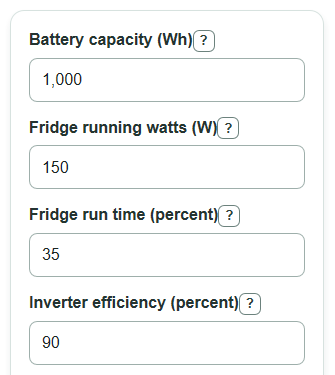
- Enter Battery capacity in Wh from your power station or battery label.
- Enter Fridge running watts and Fridge run time. Use running watts for normal compressor operation, not the higher start-up number.
- Set Inverter efficiency and Battery left unused to match your plan. If you are unsure, 90 percent efficiency and 20 percent reserve are reasonable planning defaults.
- Use Advanced options if you want the Inverter fit check. Enter Fridge starting watts, Inverter continuous rating, and Inverter surge rating.
- Sanity-check the Estimated fridge runtime by comparing Average fridge power use with what you know about the fridge. A very low Fridge run time can make runtime look too long.
Definitions
Battery capacity: The stored energy listed in watt-hours, or Wh, on the battery or power station.
Fridge running watts: The watts the refrigerator uses after the compressor has started.
Fridge starting watts: The short burst of power needed when the compressor starts. This can be much higher than running watts [1].
Fridge run time: The percent of time the compressor is on. A cycling fridge does not use its running watts every minute.
Inverter efficiency: The percent of battery energy that remains after changing battery power into outlet power.
Battery left unused: The percent of battery capacity you plan to keep in reserve.
Surge watts left over: Inverter surge rating minus Fridge starting watts. Negative means the inverter may not start the fridge.
Running watts left over: Inverter continuous rating minus Fridge running watts. Negative means the inverter may be too small for steady running.
Common mistakes and quick fixes
Mistake: Using Fridge starting watts in Fridge running watts.
Fix: Put the normal running number in Fridge running watts and put the start-up number in Fridge starting watts.
Mistake: Treating Fridge run time as 100 percent for a cycling refrigerator.
Fix: Use the percent of time the compressor is actually on, because Average fridge power use depends on Fridge run time.
Mistake: Leaving Battery left unused at 0 percent when you want a reserve.
Fix: Enter your planned reserve in Battery left unused so Usable battery energy after losses matches your outage plan.
Mistake: Reading Estimated fridge runtime as a guarantee that food will stay safe.
Fix: Treat Estimated fridge runtime as a power-use estimate and follow food-safety guidance during an outage.
Mistake: Entering only Inverter surge rating and expecting a full Inverter fit check.
Fix: Enter Fridge starting watts, Inverter continuous rating, and Inverter surge rating so Surge watts left over and Running watts left over can both be checked.
Mistake: Ignoring a negative Surge watts left over or Running watts left over.
Fix: A negative value means a shortfall, so choose a larger inverter or power station before relying on that setup.
Limitations & Key Assumptions / Boundary Conditions
- The runtime estimate assumes the refrigerator is the only load on the battery.
- Real runtime can change with room temperature, door openings, fridge age, thermostat setting, battery age, and battery temperature.
- The calculator uses average refrigerator power from Fridge running watts and Fridge run time. It does not model each compressor start cycle.
- The Inverter fit check compares watt ratings only. It does not check waveform quality, voltage, outlet limits, battery management cutoffs, or manufacturer surge-duration rules.
- If the refrigerator label gives amps, locked-rotor amps, or kWh per year instead of watts, convert or measure those values before entering them.
- Battery capacity in Wh is treated as the rated energy before inverter loss and reserve. Some power stations may report usable AC watt-hours differently.
Methodology
Core math
The calculator first estimates the refrigerator's average power use. A fridge cycles on and off, so average watts are lower than the running watts when Fridge run time is below 100 percent.
average_fridge_watts = running_watts * (duty_cycle_percent / 100)
Next it adjusts Battery capacity for inverter loss and the planned reserve.
usable_battery_wh = battery_capacity_wh * (inverter_eff_percent / 100) * (1 - reserve_percent / 100)
Runtime is usable battery energy divided by average refrigerator power. This watt-hour divided by watt relationship is the same basic energy-use relationship used for appliance runtime estimates [2].
runtime_hours = usable_battery_wh / average_fridge_watts
Inverter fit check
The optional fit check does not change Estimated fridge runtime. It checks whether the inverter or power station appears large enough for start-up and steady running.
surge_headroom_watts = inverter_surge_watts - starting_watts
continuous_headroom_watts = inverter_continuous_watts - running_watts
inverter_fit_status = Pass when both headroom values are at least 0; Fail when either value is below 0; Not checked when optional ratings are missing
Mini-example
For a 1000 Wh battery, 150 W Fridge running watts, 35 percent Fridge run time, 90 percent Inverter efficiency, and 20 percent Battery left unused, the average fridge power is 150 * 0.35 = 52.5 W. Usable battery energy is 1000 * 0.90 * 0.80 = 720 Wh. Estimated fridge runtime is 720 / 52.5 = 13.71 hours.
If the same fridge has 900 W Fridge starting watts, a 300 W Inverter continuous rating, and a 1200 W Inverter surge rating, Surge watts left over is 1200 - 900 = 300 W and Running watts left over is 300 - 150 = 150 W, so the Inverter fit check passes.
Validation choices
Battery capacity and Fridge running watts must be greater than 0. Fridge run time must be greater than 0 and no more than 100 percent. Inverter efficiency must be greater than 0 and no more than 100 percent. Battery left unused must be at least 0 percent and less than 100 percent. Optional inverter watt fields may be blank, but any entered optional watt value must be positive.