
Estimate a home service load in volt-amperes and amps, then compare common dwelling methods before local code review.
Table of contents
How to use our Electrical Load Calculator
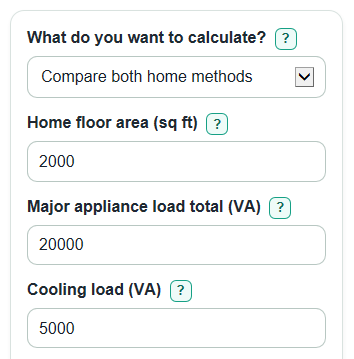
- Choose What do you want to calculate? Use compare mode if you want to see Standard method load and Optional method load side by side.
- Enter Home floor area, Major appliance load total, Cooling load, and Electric heating load from plans or equipment nameplates.
- Open Advanced options only if you need to change Service voltage, circuit counts, Service sizes to check, or Number format.
- Click Calculate and read Calculated demand load first, then Estimated service current and Next service size from your list.
- Sanity-check the result: Heating or cooling load used should be the larger HVAC load, and General load before demand rules should rise when floor area or circuit counts rise.
Definitions
Volt-amperes (VA): The load size used in service calculations. For this estimate, VA divided by volts gives amps.
Home floor area: The dwelling area in square feet used for the 3 VA per square foot general load allowance.
Major appliance load total: The counted VA for fixed or large appliances you choose to include, such as a range, dryer, water heater, or EV charger.
Standard method load: A dwelling-style estimate that applies demand tiers to the general load, then adds counted appliances and the larger heating or cooling load.
Optional method load: A dwelling-style estimate that applies a 10000 VA first tier and a 40 percent remaining tier to general plus appliance load, then adds the larger heating or cooling load.
Estimated service current: The calculated demand load divided by Service voltage, shown in amps.
Common mistakes and quick fixes
Mistake: Entering only one room or one floor in Home floor area.
Fix: Use the finished dwelling area in square feet that should be counted for the service estimate.
Mistake: Putting amps instead of volt-amperes in Major appliance load total.
Fix: Use VA from nameplates or convert first if you only have watts or amps.
Mistake: Adding both Cooling load and Electric heating load by hand before entering them.
Fix: Enter each load separately; the calculator chooses Heating or cooling load used as the larger value.
Mistake: Leaving Service sizes to check with no size above the Estimated service current.
Fix: Add a larger amp size to Service sizes to check or confirm the inputs before deciding that no listed size fits.
Mistake: Treating Next service size from your list as a permit approval.
Fix: Use it as a planning estimate and have the final service size checked under local code and equipment rules.
Limitations & Key Assumptions / Boundary Conditions
- This is a planning estimate, not a permit-ready electrical design or a replacement for a qualified electrician.
- Local amendments, utility rules, equipment ratings, conductor sizing, panel limits, and inspection requirements can change the final service size.
- The calculator does not apply separate demand factors for ranges, dryers, EV chargers, water heaters, or other appliances. Enter Major appliance load total as the VA you want counted.
- The calculator counts the larger of Cooling load and Electric heating load, not both together. That may not match every heat pump, backup heat, or multi-system setup.
- Compare mode highlights the smaller of the standard and optional method estimates for review. It does not mean that method is allowed for every project.
- The service size result is limited to Service sizes to check. If no listed size fits, the calculator will not round down to an unsafe smaller size.
Methodology
Calculation steps
The calculator starts with a dwelling-style general load, adds the counted appliance load, uses the larger heating or cooling load, then converts the selected demand load to amps. The NEC-style constants used here are common residential load-calculation allowances, and local code review controls the final design [1].
General load before demand:
general_raw_va = Home floor area * 3 + Kitchen small-appliance circuits * 1500 + Laundry circuits * 1500
Standard method general demand:
if general_raw_va <= 3000: standard_general_va = general_raw_va
else if general_raw_va <= 120000: standard_general_va = 3000 + (general_raw_va - 3000) * 0.35
else: standard_general_va = 3000 + 117000 * 0.35 + (general_raw_va - 120000) * 0.25
Standard method load:
standard_demand_va = standard_general_va + Major appliance load total + max(Cooling load, Electric heating load)
Optional method load:
optional_base_va = general_raw_va + Major appliance load total
optional_demand_va = min(optional_base_va, 10000) + max(optional_base_va - 10000, 0) * 0.40 + max(Cooling load, Electric heating load)
Selected demand load:
standard mode: selected_demand_va = standard_demand_va
optional mode: selected_demand_va = optional_demand_va
compare mode: selected_demand_va = min(standard_demand_va, optional_demand_va)
Service current and service size:
Estimated service current = selected_demand_va / Service voltage
Next service size from your list = first listed amp size that is at least Estimated service current
Mini-example
For a 2000 sq ft home with 2 kitchen small-appliance circuits, 1 laundry circuit, 20000 VA of major appliances, 5000 VA cooling, 3000 VA electric heat, and 240 V service, the general load before demand is 10500 VA.
general_raw_va = 2000 * 3 + 2 * 1500 + 1 * 1500 = 10500 VA
standard_general_va = 3000 + (10500 - 3000) * 0.35 = 5625 VA
standard_demand_va = 5625 + 20000 + 5000 = 30625 VA
optional_demand_va = 10000 + (10500 + 20000 - 10000) * 0.40 + 5000 = 23200 VA
In compare mode, the selected demand load is 23200 VA. At 240 V, the estimated service current is about 96.7 A, so a list that includes 100 A would return 100 A as the next listed service size.