
Enter your constant-voltage LED strip label details to find the minimum matching power-supply wattage and DC output current.
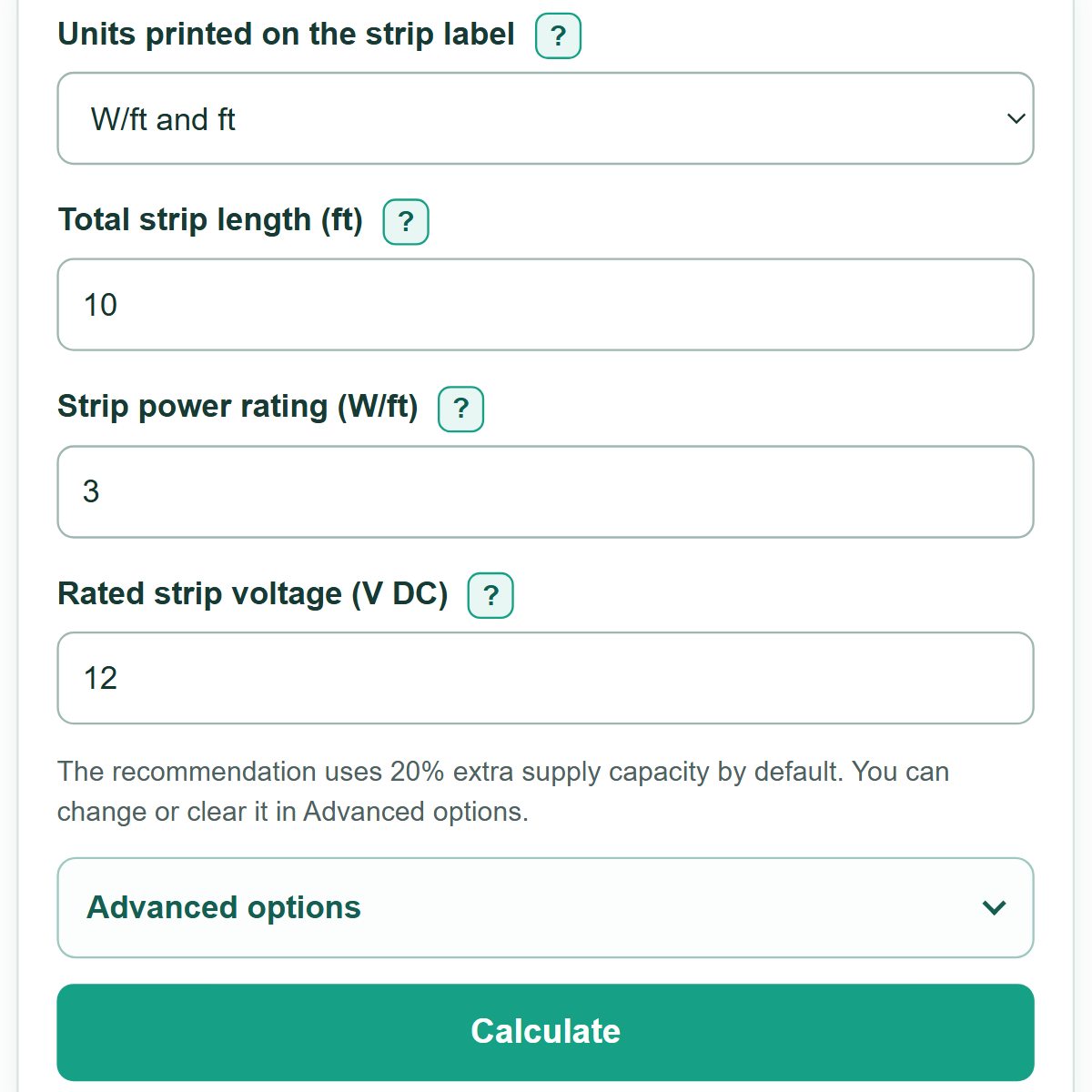
The recommendation uses 20% extra supply capacity by default. You can change or clear it in Advanced options.
Advanced options
Choose a voltage-matched constant-voltage supply rated at or above this wattage.
Choose a supply with a DC output-current rating at or above this value.
This confirms how the length and power rating were interpreted.
The supply must be constant voltage and match the strip's rated DC voltage.
This is the full-power strip load before extra capacity is added.
This is the calculated strip current before extra capacity is added.
This planning allowance is added once above the full rated LED load.
Table of contents
How to use our LED Power Supply Calculator
- Choose "Units printed on the strip label" to match the units shown on the reel, package, product page, or datasheet.
- Enter the total length of every strip section powered by this one supply, then copy the strip's W/ft or W/m rating.
- Enter "Rated strip voltage (V DC)" exactly as printed, such as 12 or 24.
- Change "Extra supply capacity (percent)" in "Advanced options" if your project or supply maker specifies a different allowance.
- Click "Calculate." Check that full rated LED load equals length times power per length, then choose a constant-voltage supply with the shown voltage and ratings at or above the recommended watts and amps.
Definitions
Constant-voltage LED strip: An LED strip made to run from a fixed DC voltage, such as 12 V or 24 V.
Strip power rating: The watts used by each foot or meter of strip at full rated output.
Full rated LED load: Total connected strip length multiplied by the strip's rated watts per foot or meter.
Extra supply capacity: Wattage added above the full rated LED load when planning the supply size.
DC output current: The current, measured in amps, that a power supply can provide at its output voltage.
Foot-to-meter conversion: One foot equals exactly 0.3048 meter.
Common mistakes and quick fixes
Mistake: Entering W/m while "W/ft and ft" is selected.
Fix: Select the unit pair printed on the strip label before entering length and power rating.
Mistake: Choosing enough watts but the wrong output voltage.
Fix: Match the supply's DC output voltage exactly to "Rated strip voltage (V DC)."
Mistake: Using LED count, brightness, or a guess as the power rating.
Fix: Copy the full-power W/ft or W/m rating from the reel, package, product page, or datasheet.
Mistake: Counting only one strip section when several sections share one supply.
Fix: Add the length of every strip section connected to that supply.
Mistake: Treating extra supply capacity as proof that the installation is suitable.
Fix: Separately check wire size, voltage drop, controller and connector ratings, fuses, and the strip maker's maximum run guidance.
Limitations & Key Assumptions / Boundary Conditions
- This calculator is for constant-voltage LED strips. It does not select constant-current drivers for individual LEDs or COB arrays.
- It uses the strip's stated full-power rating. Dimming can reduce actual use, but the calculation starts with the rated load.
- The extra supply capacity setting is a planning allowance, not a manufacturer requirement or safety guarantee.
- The calculation does not check wire voltage drop, maximum strip-run length, power-feed placement, controller current limits, connector ratings, fuse size, dimming compatibility, enclosure, or environmental rating.
- The power supply must match the strip's DC voltage and meet or exceed both calculated wattage and calculated output current.
Methodology
Calculation method
The calculator multiplies the total connected strip length by the power rating printed on the strip label to find the full rated LED load.
full rated LED load (W) = strip length x strip power rating
It adds the chosen extra supply capacity to that load. A blank "Extra supply capacity (percent)" field means 0 percent extra capacity.
recommended minimum capacity (W) = full rated LED load x (1 + extra capacity / 100)
It divides watts by the strip's rated DC voltage to calculate current. The recommended current includes the added capacity.
full rated LED current (A) = full rated LED load / rated strip voltage
minimum supply output current (A) = recommended minimum capacity / rated strip voltage
Worked example
A 10 ft strip rated at 3 W/ft has a full rated load of 30 W. With 20 percent extra capacity, the recommended minimum supply capacity is 36 W. At 12 V DC, the minimum supply output current is 3 A.
Changing label units
When you switch between W/ft with feet and W/m with meters, the calculator converts both entered values together. Their product stays the same, so the calculated watt load does not change. The conversion uses 1 ft = 0.3048 m.