
Estimate LED strip amps, power supply size, and amps per equal feed from strip voltage, length, and watts.
Table of contents
How to use our LED Strip Amps Calculator
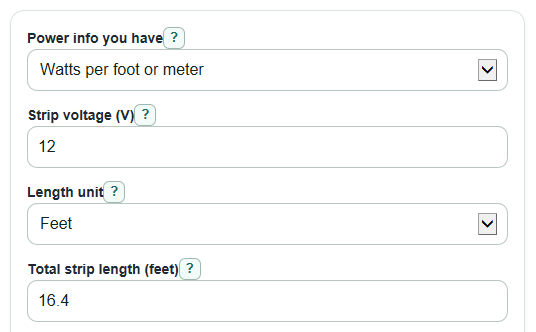
- Choose Power info you have: use watts per foot or meter when the strip gives W/ft or W/m, or use Total watts for the whole strip when that is already known.
- Enter Strip voltage (V) exactly as printed on the strip or controller, because the power supply voltage must match the strip voltage.
- If using watts per length, select Length unit, then enter Total strip length and Strip power in the same unit.
- Open Advanced options if you want to change Extra power supply room (percent), Planned brightness limit (percent), Equal power feeds, or Number format.
- Check the results: Recommended power supply current should be higher than LED strip current at full brightness when headroom is above 0 percent, and Current per equal power feed should drop when Equal power feeds is increased.
Definitions
Volt (V): The electrical pressure of the strip. The power supply voltage must match the LED strip voltage.
Amp (A): The amount of electric current the strip draws from the power supply.
Watt (W): Electrical power. For DC strip sizing, watts come from volts times amps.
Total strip power: The total watts for the strip section connected to this supply output.
Extra power supply room (percent): Added margin above the strip load so the supply is not planned right at its rated limit.
Planned brightness limit (percent): A simple estimate of how much of full-brightness current the strip may use while running.
Equal power feeds: The number of connection points that are expected to share the full-brightness strip current evenly.
Common mistakes and quick fixes
Mistake: Entering a power supply voltage in Strip voltage (V) instead of the LED strip voltage.
Fix: Use the voltage printed on the strip, such as 5, 12, or 24, and buy a supply with that same voltage.
Mistake: Choosing Power info you have as watts per foot or meter, then typing the whole reel watts into Strip power.
Fix: Put whole-strip watts in Total strip power (W), or divide the total watts by length before using Strip power.
Mistake: Mixing Length unit with Strip power, such as feet for Total strip length but W/m for Strip power.
Fix: Use feet with W/ft or meters with W/m so Total strip power is not too high or too low.
Mistake: Treating Planned brightness limit (percent) as the power supply sizing value.
Fix: Use Recommended power supply current for buying the supply, because controller settings can change later.
Mistake: Setting Equal power feeds to 2 or more when one feed will carry most of the strip current.
Fix: Use Equal power feeds only when the feeds are planned to share the load about evenly.
Mistake: Typing 0.20 in Extra power supply room (percent) when you mean 20 percent.
Fix: Enter 20 for a 20 percent margin, then choose a supply rated at or above Recommended power supply current.
Limitations & Key Assumptions / Boundary Conditions
- The calculator is for low-voltage constant-voltage LED strips where the strip voltage is known.
- Actual current can differ from the estimate if the strip's real wattage differs from the label, if colors are mixed, or if the controller limits output.
- The Equal power feeds result assumes each feed shares current evenly. Real current sharing depends on wire length, wire size, connectors, strip copper, and voltage drop.
- The calculator does not choose wire gauge, fuse size, connector rating, controller channel rating, or maximum safe strip run length.
- Extra power supply room (percent) is a planning margin. Follow the strip, controller, and power supply instructions if they require a different margin.
- Planned brightness limit (percent) gives a rough running estimate only. Use full-brightness current and headroom when selecting a power supply.
- A power supply with more available amps is not a problem by itself, but the voltage must match the strip and the wiring must be rated for the current.
Methodology
How the calculator finds strip current
The calculator first finds total strip power, then divides by strip voltage. This uses the DC power relationship where power equals voltage times current [1].
P_total = L * W_per_unit
This is used when Power info you have is watts per foot or meter. The selected Length unit applies to both total length and watts per unit.
P_total = W_total
This is used when Power info you have is Total watts for the whole strip.
I_full = P_total / V
Recommended supply current adds the selected headroom percent. The watt version uses the same headroom multiplier.
I_supply = I_full * (1 + H / 100)
P_supply = P_total * (1 + H / 100)
Estimated running current uses the planned brightness limit. Current per feed divides the full-brightness current by the number of equal feeds.
I_run = I_full * (B / 100)
I_feed = I_full / F
Worked example
A 5 meter strip rated 14.4 W per meter has total strip power of 5 * 14.4 = 72 W. On a 12 V strip, full-brightness current is 72 / 12 = 6 A. With 20 percent extra power supply room, recommended supply current is 6 * 1.20 = 7.2 A, and recommended supply size is 72 * 1.20 = 86.4 W. With 2 equal power feeds, current per equal power feed is 6 / 2 = 3 A.
Calculation choices
The calculator does not round the electrical result down. Pick the next available power supply rating at or above Recommended power supply current, at the same voltage as the strip. For common constant-voltage LED strips, the strip pulls the current it needs from a matching-voltage supply; extra available wattage is not the same as forcing extra current into the strip [2]. Long runs can still need separate checks for voltage drop, wire size, connectors, and controller ratings [3].