
Choose LED driver current, voltage range, wattage reserve, or a resistor value for your series-parallel LED layout.
Advanced options
Table of contents
How to use our LED Driver Calculator
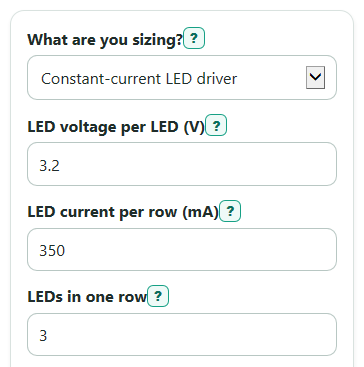
- Pick What are you sizing?: use Constant-current LED driver for bare LEDs or COB LEDs, or Constant-voltage supply with resistor for a fixed voltage supply.
- Enter LED voltage per LED (V), LED current per row (mA), LEDs in one row, and Number of rows in parallel from your LED datasheet and wiring plan.
- If you choose resistor mode, enter Supply voltage (V) and remember the calculator assumes one resistor for each parallel row.
- Open Advanced options if you want to change LED voltage swing (%), Power reserve (%), driver voltage limits, Number display, or Round resistor to.
- After calculating, sanity-check that LED row voltage fits the driver range, Total driver current matches your row count, and resistor heat is low enough for the resistor wattage you plan to buy.
Definitions
Constant-current LED driver: A driver that tries to hold LED current steady. The LED row voltage tells it how much voltage it must be able to provide.
Constant-voltage supply with resistor: A fixed-voltage supply that uses a resistor in series with each LED row to limit current.
LED voltage per LED (V): The forward voltage of one LED at the current you plan to use.
LED current per row (mA): The current through one series row. One milliamp is 0.001 amp.
LED row voltage: The voltage needed by one series row of LEDs. Series LED voltages add together.
Total driver current: The current the driver or supply must provide after all parallel rows are added.
LED voltage swing (%): Extra room above and below the calculated row voltage for LED part differences and temperature changes.
Power reserve (%): Extra wattage added to the calculated load so the driver or supply is not planned right at its limit.
Resistor heat per row: The power a row resistor turns into heat in resistor mode.
Common mistakes and quick fixes
Mistake: Using a typical battery label for Supply voltage (V) without checking the real loaded voltage.
Fix: Enter the voltage the LED circuit will actually see, and make sure Supply voltage (V) is higher than LED row voltage in resistor mode.
Mistake: Treating LED current per row (mA) as the total current for all rows.
Fix: Enter the current for one series row only; Total driver current adds Number of rows in parallel for you.
Mistake: Putting the total LED count into LEDs in one row when some LEDs are in parallel rows.
Fix: Enter only the LEDs wired end-to-end in one row, then enter the row count in Number of rows in parallel.
Mistake: Buying a constant-current driver because Recommended driver or supply shows the right current, but ignoring Driver fit check.
Fix: Compare Lowest useful driver voltage and Highest useful driver voltage with Driver lowest output voltage (V) and Driver highest output voltage (V).
Mistake: Sharing one resistor across multiple rows in constant-voltage mode.
Fix: Use Rounded resistor per row or Exact resistor per row for each row, and check Wiring note for the parallel-row warning.
Mistake: Choosing a resistor wattage equal to Resistor heat per row.
Fix: Pick a resistor rated above Resistor heat per row, because real parts run hot when used near their limit.
Limitations & Key Assumptions / Boundary Conditions
- LED voltage per LED (V) should come from the LED datasheet at your planned current. A random LED color guess can make the driver range or resistor value wrong.
- Constant-current mode sizes the driver by current, LED row voltage range, and wattage reserve. It does not replace the driver datasheet limits for dimming, ambient temperature, enclosure rating, or safety approvals.
- Driver fit check is only complete when both Driver lowest output voltage (V) and Driver highest output voltage (V) are entered.
- Resistor mode assumes a constant-voltage supply and one resistor per LED row. It is not meant for a single resistor shared across parallel LED rows.
- Resistor calculations use steady DC values. Pulsed drivers, PWM dimming details, LED binning, heat rise, and supply tolerance can change real current and heat.
- LED load power is electrical LED power, not light output. It does not tell you brightness or lumens.
- The E12, E24, and E96 options round to the next higher resistor value. Real resistor tolerance can still make actual current vary.
Methodology
Core calculations
The calculator first finds the voltage of one series LED row. Parallel rows use the same row voltage, but their currents add together.
V_row = N_series * V_f
I_total = I_row * N_parallel
P_led = V_row * I_total
LED current per row is converted from milliamps to amps before power, driver, and resistor math. Percent entries are converted to decimals, so 10% becomes 0.10.
Constant-current driver mode
A constant-current LED driver is selected mainly by current. The driver current should match the calculated Total driver current, and its output voltage range should cover the LED row voltage after the selected voltage swing.
V_min = max(V_row * (1 - H), 0.000001)
V_max = V_row * (1 + H)
P_recommended = P_led * (1 + R)
If optional driver voltage limits are entered, Driver fit check compares the entered driver range with the calculated lowest and highest useful driver voltages. If only one driver limit is entered, the calculator still shows the electrical results but reports that both limits are needed for a full fit check.
Resistor mode
For a constant-voltage supply, the supply must be higher than the LED row voltage. The remaining voltage is dropped by the resistor in each row.
R_exact = (V_supply - V_row) / I_row
I_actual = (V_supply - V_row) / R_used
P_resistor_row = (V_supply - V_row) * I_actual
Efficiency_percent = 100 * P_led_actual / (V_supply * I_actual * N_parallel)
When resistor rounding is selected, the calculator uses the next higher value from the chosen E-series list. That usually lowers the current instead of raising it above the target.
Mini example
Suppose you have three LEDs in one row, each LED is 3.2 V, the row current is 350 mA, and there is one row. The row voltage is 3 * 3.2 = 9.6 V. The total current is 350 mA, or 0.35 A. LED load power is 9.6 * 0.35 = 3.36 W. With 10% LED voltage swing, the useful driver range is 8.64 V to 10.56 V. With 20% power reserve, the minimum driver wattage is 3.36 * 1.20 = 4.032 W.
Calculation choices
Hidden mode-only inputs are not used. Supply voltage affects only resistor mode. Resistor-only outputs are shown only in resistor mode. Scientific notation is used only by the selected Number display rule, so the math is the same even if the displayed format changes.