
Use this calculator to plan LED strip power injection points from strip length, strip power, feed spacing, and feed wire voltage drop.
Table of contents
How to use our LED Strip Power Injection Calculator
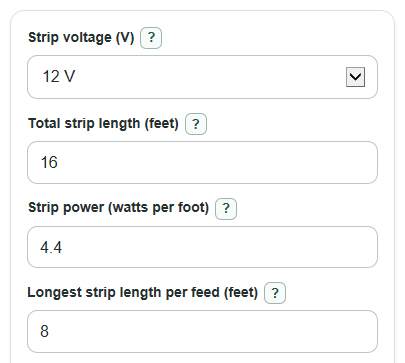
- Choose Strip voltage (V), then enter Total strip length (feet) and Strip power (watts per foot) from the strip label or listing.
- Enter Longest strip length per feed (feet) as the longest strip section you want one feed point to power.
- Open Advanced options if you want to change Planned brightness for power math (percent), Power supply headroom (percent), Wire length from supply to each feed (feet), Feed wire size (AWG), or Allowed wire voltage drop (percent).
- Click Calculate, then use Extra injection points needed, Total feed points, Suggested spacing between feed points, and Where to add extra feeds to plan the layout.
- Sanity-check the result: Feed wire voltage drop should be at or below your Allowed wire voltage drop (percent), and Current per feed should be reasonable for your wire, connectors, fuses, controller, and power supply.
Definitions
Feed point: A place where power wires connect to the LED strip.
Injection point: An extra feed point added after the first feed at the start of the strip.
Strip voltage (V): The DC voltage the strip is made for, usually 5 V, 12 V, or 24 V.
Strip power (watts per foot): The full-brightness power used by one foot of strip.
AWG: American Wire Gauge, a wire size system where a smaller number means thicker wire.
Voltage drop: Voltage lost as current moves through wire resistance. Too much drop can make LEDs dim or unstable.
Headroom: Extra power supply capacity above the estimated LED load.
Current per feed (A): The estimated amps carried by each feed wire if the strip load is shared evenly.
Common mistakes and quick fixes
Mistake: Entering the power supply wattage in Strip power (watts per foot).
Fix: Use the LED strip rating per foot, then check Recommended power supply size for the supply wattage.
Mistake: Using Wire length from supply to each feed (feet) for the LED strip length.
Fix: Put the lit strip length in Total strip length (feet) and the one-way power wire distance in Wire length from supply to each feed (feet).
Mistake: Setting Longest strip length per feed (feet) longer than the strip can handle without dimming.
Fix: Lower Longest strip length per feed (feet) to add more feed points and shorten each powered section.
Mistake: Treating Feed wire voltage drop as the total voltage loss in the whole strip.
Fix: Feed wire voltage drop only checks the external feed wires; also inspect strip-end brightness and connector quality.
Mistake: Leaving Planned brightness for power math (percent) below 100 when the strip may run full white later.
Fix: Use 100 for worst-case planning unless the controller will truly limit maximum brightness.
Mistake: Assuming Thinnest listed wire that meets your limit is automatically safe for every connector or fuse.
Fix: Use Current per feed to check connector, fuse, controller, and wire amp ratings separately.
Limitations & Key Assumptions / Boundary Conditions
- The calculator plans feed count and feed-wire drop. It does not model voltage loss inside the LED strip copper, solder pads, connectors, switches, or controllers.
- Each feed is treated as sharing the LED load evenly. Real current sharing can change if wire lengths, solder joints, or strip sections are different.
- Wire voltage drop uses copper AWG resistance values near room temperature. Aluminum wire, copper-clad aluminum wire, hot cable, or unusual cable construction can lose more voltage.
- Wire length is one-way from the power supply to each feed. The calculation doubles it to include the positive and return conductors.
- Brightness percent changes the power math only. Use 100% if the strip could ever run at full white or full rated load.
- The power supply size is a planning number. It does not check product limits, fuse sizing, controller channel limits, data signal limits, waterproofing, or local electrical code.
- Extra feed positions are rounded layout targets. Move them slightly as needed to land on valid cut marks, solder pads, or connector points.
Methodology
What the calculator does
The calculator first splits the strip into equal powered sections based on the longest strip length you want one feed to handle. It then estimates LED load, current per feed, power supply size, voltage lost in each matching feed wire, and the thinnest listed AWG size that stays within your chosen drop limit. Voltage drop can cause dim LEDs at the far end, and shortening the run or adding power injection is a common fix [2].
Formulas used
estimated_led_power_w = strip_length_ft * strip_power_w_per_ft * brightness_percent / 100
total_feed_points = ceil(strip_length_ft / max_length_per_feed_ft)
additional_injection_points = max(total_feed_points - 1, 0)
recommended_spacing_ft = strip_length_ft / total_feed_points
extra_injection_position_i_ft = i * recommended_spacing_ft
current_per_feed_a = estimated_led_power_w / (supply_voltage_v * total_feed_points)
recommended_power_supply_w = estimated_led_power_w * (1 + power_supply_headroom_percent / 100)
round_trip_resistance_ohm = 2 * feed_wire_length_ft * awg_ohms_per_ft
feed_wire_drop_v = current_per_feed_a * round_trip_resistance_ohm
feed_wire_drop_percent = 100 * feed_wire_drop_v / supply_voltage_v
voltage_at_feed_v = supply_voltage_v - feed_wire_drop_v
wire_power_loss_w = total_feed_points * current_per_feed_a * current_per_feed_a * round_trip_resistance_ohm
For the wire recommendation, the calculator tests the listed wire sizes from thinnest to thickest: 24, 22, 20, 18, 16, 14, 12, then 10 AWG. It returns the first size whose calculated drop is less than or equal to Allowed wire voltage drop (percent). If none pass, it reports that no listed size meets the limit.
Mini example
With a 12 V strip, Total strip length (feet) of 16, Strip power (watts per foot) of 4.4, Longest strip length per feed (feet) of 8, and Planned brightness for power math (percent) of 100, the estimated LED power is 16 * 4.4 * 100 / 100 = 70.4 W. The feed count is ceil(16 / 8) = 2, so Extra injection points needed is 1 and Suggested spacing between feed points is 8 ft.
Current per feed is 70.4 / (12 * 2) = 2.93 A. With 10 ft of 18 AWG feed wire, round-trip resistance is 2 * 10 * 0.006385 = 0.1277 ohm. Feed wire voltage drop is 2.93 * 0.1277 = 0.375 V, or 3.12% of 12 V, leaving about 11.63 V at each feed. With 20% headroom, the recommended power supply size is 70.4 * 1.20 = 84.48 W.