
Find the LED watts you need from your target lumens, LED efficiency, and number of bulbs or fixtures.
Advanced options
Table of contents
How to use our LED Wattage Calculator
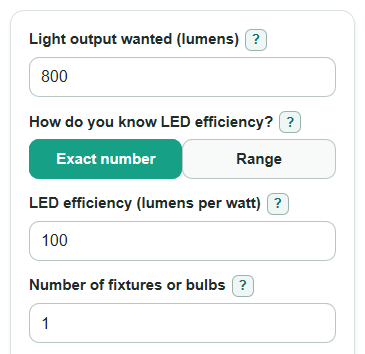
- Enter Light output wanted (lumens) from the bulb box, fixture spec, or the brightness target for the room.
- Use Typical estimate — 100 lm/W as a starting point, change Enter my own lm/W if you know the product efficacy, or choose Range if you only know a low and high possible efficiency.
- Enter Number of fixtures or bulbs so the calculator can split the total LED power into Power per fixture, low end and Power per fixture, high end.
- Open Advanced options if you want Yearly cost, high end, Yearly savings, high end, or a different Number display.
- Sanity-check the answer: higher LED efficiency (lumens per watt) should lower the required watts, and using more fixtures should lower watts per fixture but not the total LED watts.
Definitions
Lumens: A measure of light output or brightness. Lighting labels use lumens for brightness and watts for energy use [1].
LED efficiency (lumens per watt): How many lumens an LED makes for each watt of electric power it uses. A higher value means fewer watts are needed for the same lumens.
Watts: A unit of electric power. In this calculator, watts mean the actual power used by the LED setup, not the old incandescent equivalent printed for comparison.
kWh/year: Kilowatt-hours per year. Electric bills often charge by kilowatt-hour, so this converts LED watts and daily use time into yearly energy use.
Low end and high end: In range mode, low end is the wattage from the highest LED efficiency, and high end is the wattage from the lowest LED efficiency.
Common mistakes and quick fixes
Mistake: Entering an old bulb watt number in Light output wanted (lumens).
Fix: Use the lumen value from the bulb or fixture label, because lumens describe brightness.
Mistake: Using LED equivalent watts in Old lighting power (watts, optional).
Fix: Enter the actual old watts used, such as 60 for a 60 W incandescent bulb, or leave it blank.
Mistake: Reversing Lowest LED efficiency (lumens per watt) and Highest LED efficiency (lumens per watt).
Fix: Put the smaller efficiency in the lowest field and the larger efficiency in the highest field.
Mistake: Entering a fixture count that is not a whole number in Number of fixtures or bulbs.
Fix: Use a positive whole number, such as 1, 4, or 12.
Mistake: Leaving Use time (hours per day) at a value that does not match real use.
Fix: Enter your average daily use, from 0 to 24 hours, before trusting yearly energy or cost outputs.
Mistake: Treating Power per fixture, high end as the total power for all fixtures.
Fix: Use Required LED power, high end for total LED power, and use per-fixture outputs only for each bulb or fixture.
Limitations & Key Assumptions / Boundary Conditions
- The calculator uses the lumens and LED efficiency you enter. Real fixture output can change because of lens losses, heat, dimmers, fixture design, and product tolerances.
- Power per fixture, low end and Power per fixture, high end assume the light output is split evenly across all fixtures or bulbs.
- Yearly energy and cost use 365 days per year and the entered Use time (hours per day). Seasonal use or timers can change the real cost.
- Electricity price ($ per kWh) is treated as one flat rate. Real bills can include tiered rates, taxes, demand charges, or time-of-use pricing.
- Savings outputs appear only when Old lighting power (watts, optional) is entered, and that field must use actual old watts, not LED equivalent watts.
- This calculator estimates electrical power for brightness. It does not check fixture watt limits, bulb shape, color temperature, beam angle, dimmer compatibility, or code requirements.
Methodology
Core wattage math
The calculator first turns the wanted light output into LED power. Lumens are used for brightness, while watts are used for power use [1].
watts = lumens / efficacy_lm_per_w
With Typical estimate — 100 lm/W, the calculator uses the editable Enter my own lm/W value and shows one required LED power estimate. Range shows separate low- and high-end estimates.
Range mode
When you enter a possible efficiency range, the best-efficiency LED needs the fewest watts and the lowest-efficiency LED needs the most watts.
watts_low = lumens / efficacy_high
watts_high = lumens / efficacy_low
Per-fixture watts
The calculator divides total LED power by the number of fixtures or bulbs after finding the total wattage.
watts_per_fixture = total_watts / fixture_count
Yearly energy, cost, and savings
If Advanced options are used, yearly energy converts watts and daily use time into kilowatt-hours.
kwh_per_year = watts * hours_per_day * 365 / 1000
cost_per_year = kwh_per_year * electricity_price
If old lighting power is entered, savings are kept as signed values. A negative value means the new LED setup uses more power or costs more to run than the old setup.
saved_power_watts = old_total_watts - led_watts
yearly_savings = old_yearly_cost - led_yearly_cost
Mini-example
For 800 lumens at 100 lumens per watt, the required LED power is 800 / 100 = 8 W. If that light is on 3 hours per day, yearly energy is 8 * 3 * 365 / 1000 = 8.76 kWh/year. At $0.16 per kWh, yearly cost is 8.76 * 0.16 = $1.40 per year.