
Convert space distances between AU, kilometers, meters, miles, light-years, and parsecs with clear results and simple meaning notes.
How to use our Astronomical Unit Calculator
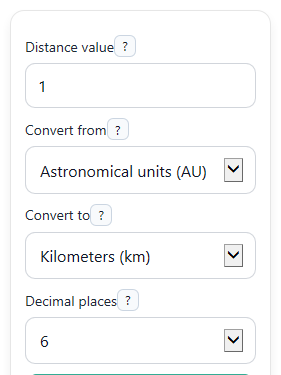
- Enter a non-negative number in Distance value.
- Choose your starting unit under Convert from and your target unit under Convert to.
- If you want, change Decimal places to show fewer or more digits without changing the actual math.
- Click Calculate to see the main Converted distance, the Same distance in common space units list, and the plain-language unit note.
- Sanity-check the result by reading Exact or approximate note and comparing the main answer with the common-units list, especially if you converted a very large or very small distance.
Definitions
AU: Astronomical unit. This is a standard space distance equal to exactly 149,597,870,700 meters.
Light-year (ly): The distance light travels in one Julian year. It is much larger than 1 AU, so it is useful for distances between stars.
Parsec (pc): A longer astronomy distance unit tied to parallax geometry. One parsec is about 206,265 AU.
Converted distance: The main answer in the unit you chose under Convert to.
Decimal places: How many digits appear after the decimal point in displayed results.
Exact or approximate note: A short note telling you whether the result comes from an exact defined value or from a value rounded for display.
Common mistakes and quick fixes
Mistake: Leaving Distance value blank or typing text instead of a number.
Fix: Enter a real number such as 1, 0.5, or 2500 in Distance value .
Mistake: Entering a negative number in Distance value for a physical distance.
Fix: Use 0 or a positive number because this calculator treats distance as non-negative.
Mistake: Picking the wrong starting unit in Convert from , like entering miles but leaving AU selected.
Fix: Match Convert from to the unit your number already uses before you calculate.
Mistake: Reading Converted distance as exact to every shown digit.
Fix: Check Exact or approximate note to see whether the displayed value is exact by definition or a rounded derived value.
Mistake: Thinking changing Decimal places changes the actual conversion.
Fix: Use Decimal places only to change how many digits are shown; the internal conversion stays the same.
Mistake: Looking only at Converted distance and missing the scale of the answer.
Fix: Read Same distance in common space units to compare the same distance in AU, km, m, mi, ly, and pc.
Limitations & Key Assumptions / Boundary Conditions
- This calculator accepts only distances that are 0 or greater. Negative entries are blocked because physical distance is not negative here.
- Results are computed through meters as the base unit, then converted to the target unit.
- The astronomical unit in meters is exact, but many shown equivalents are rounded to the selected Decimal places for readability.
- Light-year and parsec values depend on the standard definitions used in the formulas, so tiny differences can appear if another source uses different rounding or presentation rules.
- Very large or very small answers may be hard to read in ordinary decimal form, even though the conversion itself is still valid.
- This tool is for unit conversion only. It does not account for orbital paths, travel time, relativity, or changing distances in real space missions.
Methodology
How the conversion works
The calculator first changes the entered distance into meters, then changes meters into your chosen target unit. Using one base unit keeps every conversion consistent.
value in target = value in source x source-to-meter / target-to-meter
Constants used
1 AU = 149597870700 m
1 ly = c x Jy
c = 299792458 m/s
Jy = 365.25 x 86400 s = 31557600 s
1 pc = (648000 / pi) x AU
1 mi = 1609.344 m
Worked mini-example
Suppose you enter 1 in Distance value, choose Convert from = AU, and choose Convert to = km. First convert 1 AU to meters, which gives 149,597,870,700 m. Then divide by 1,000 meters per kilometer.
1 AU to km = 149597870700 / 1000 = 149597870.7 km
If you instead convert 1 parsec to AU, the calculator uses the parsec relation above, giving about 206,264.806247 AU.
How to read the extra outputs
Same distance in common space units shows the same converted distance in AU, km, m, mi, ly, and pc so you can compare scale quickly. What this unit means gives a short beginner-friendly note about the target unit. Exact or approximate note explains whether the shown relationship is exact by definition or rounded for display.
Assumptions and limits
The calculator uses fixed standard unit definitions and does not model real-world motion or changing positions. Display rounding depends on Decimal places, so the shown digits may be shorter than the full internal value.