
Enter pKa and separate weak-acid and conjugate-base amounts to calculate ideal buffer pH, or find the ratio needed for a target pH.
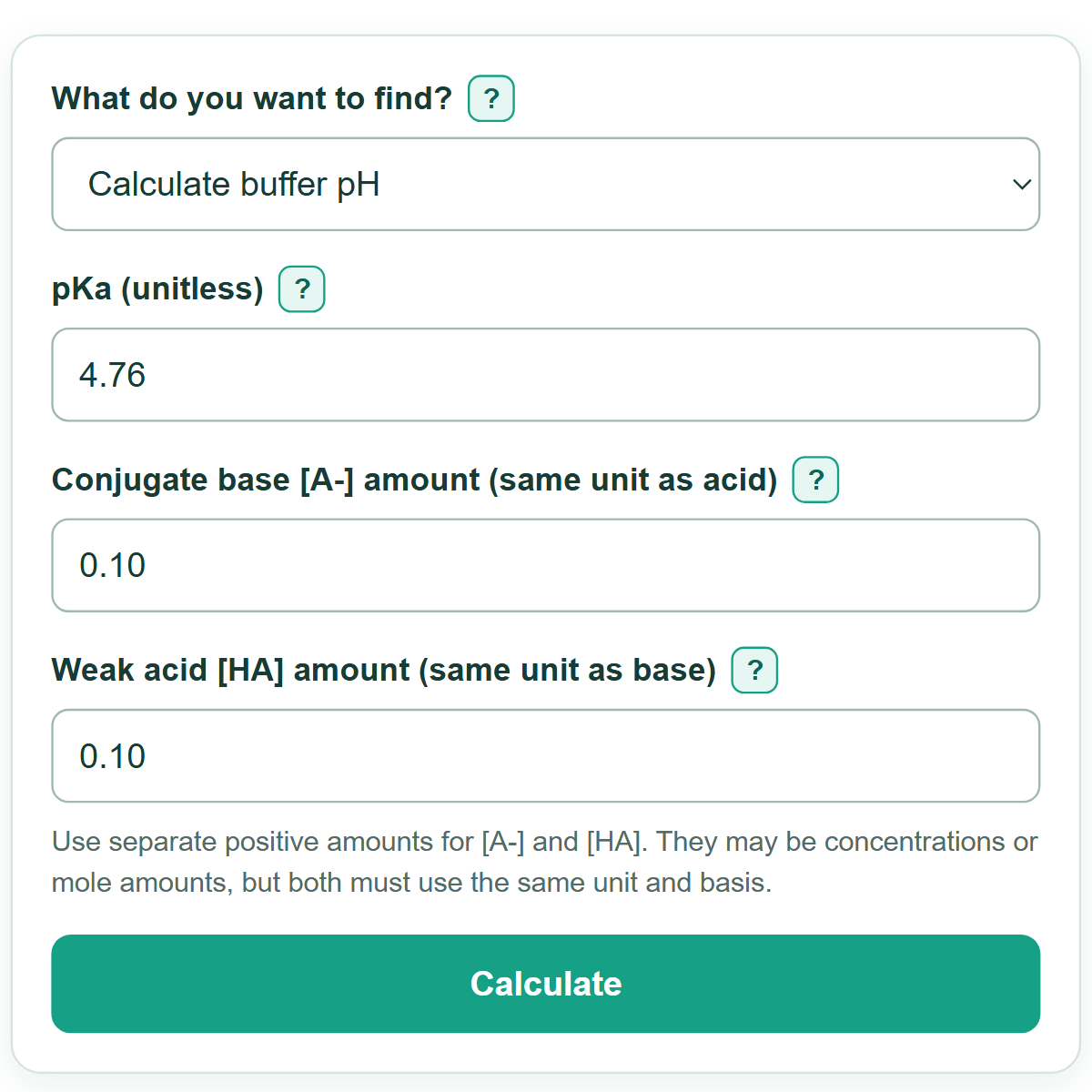
Use separate positive amounts for [A-] and [HA]. They may be concentrations or mole amounts, but both must use the same unit and basis.
Table of contents
How to use our Henderson-Hasselbalch Calculator
- Choose "Calculate buffer pH" when pH is unknown, or "Find base-to-acid ratio" when you need a proportion for a target pH.
- Enter the pKa for the exact weak acid from your worksheet, lab manual, or chemical reference.
- For pH, enter separate positive amounts for conjugate base [A-] and weak acid [HA] using the same unit and basis. For a ratio, enter the target pH instead.
- Select "Calculate" and use the first result as the answer for the task you selected.
- Check the result: a 1:1 [A-]/[HA] ratio gives pH equal to pKa, and a ratio from 0.1 to 10 is within the common working range.
Definitions
pKa: A number that describes weak-acid strength. A lower pKa means a stronger acid.
Weak acid [HA]: The acid form of the buffer pair.
Conjugate base [A-]: The form left after the weak acid loses a hydrogen ion.
Base-to-acid ratio [A-]/[HA]: Conjugate-base amount divided by weak-acid amount, using the same concentration or mole basis.
Buffer: A mixture of a weak acid and its conjugate base that resists some change in pH when acid or base is added.
Target pH: The desired pH used to calculate the needed [A-]/[HA] proportion.
Common mistakes and quick fixes
Mistake: Reversing [A-] and [HA].
Fix: Enter conjugate base [A-] as the numerator and weak acid [HA] as the denominator.
Mistake: Entering total buffer amount instead of the two components.
Fix: Enter separate amounts of weak acid and conjugate base. The total alone cannot determine their ratio.
Mistake: Mixing moles with molarity, or mmol with mol.
Fix: Use the same physical basis and unit for both amounts so the units cancel in the ratio.
Mistake: Entering zero or a negative component amount.
Fix: Enter a positive amount for both components because the logarithm requires a positive [A-]/[HA] ratio.
Mistake: Treating pH as a measure of buffer capacity.
Fix: Use this result for ideal pH or component proportion only; capacity also depends on how much buffer is present.
Limitations & Key Assumptions / Boundary Conditions
- This calculator uses the ideal Henderson-Hasselbalch equation for a weak acid and its conjugate base.
- Both buffer components must be positive and expressed on the same basis, such as both in moles or both in molarity.
- The 0.1 to 10 ratio message is a common working-range guide, not a guarantee of buffer performance.
- Activity effects, temperature, ionic strength, dilution, and other equilibria can make measured pH differ from this estimate.
- This calculation does not find buffer capacity, recipe amounts, or the pH of a strong acid or strong base solution.
Methodology
Calculation
The calculator uses the Henderson-Hasselbalch equation for a weak acid, HA, and its conjugate base, A-. Conjugate base is the numerator, and weak acid is the denominator. [1]
pH = pKa + log10([A-]/[HA])
In "Calculate buffer pH" mode, it divides the entered conjugate-base amount by the weak-acid amount, then adds the base-10 logarithm of that ratio to pKa. In "Find base-to-acid ratio" mode, it rearranges the equation.
[A-]/[HA] = 10^(target pH - pKa)
Composition shares
The active ratio is converted to the share of each component in the two-part mixture. These shares describe the proportion only, not buffer capacity.
Conjugate-base share = 100 x ratio / (1 + ratio)
Weak-acid share = 100 / (1 + ratio)
Worked mini-example
If pKa is 4.76, [A-] is 0.20, and [HA] is 0.10 on the same basis, the ratio is 2.
pH = 4.76 + log10(2) = 5.061
A 1:1 ratio makes pH equal to pKa. Ratios from 0.1 to 10 correspond to pH values within 1 pH unit of pKa. [2]