
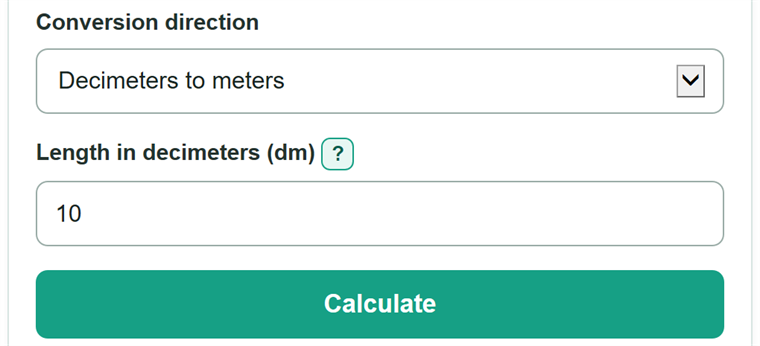
Enter a length in decimeters to convert it to meters, or choose the reverse direction for meters to decimeters.
Table of contents
How to use our Decimeter to Meter Converter
- Choose the direction that matches the unit written beside your known length.
- Enter a length of 0 or more. You can type a plain number or a matching suffix, such as 25 dm or 2.5 m.
- Click Calculate to view the converted linear length and its equation.
- Check the size of the number: converting dm to m makes it 10 times smaller, while converting m to dm makes it 10 times larger.
Definitions
Decimeter (dm): A metric unit of linear length equal to one tenth of a meter.
Meter (m): A metric unit of linear length. One meter equals exactly 10 decimeters. [1]
Linear length: Distance measured in one direction, such as the length of a pencil or a line on a drawing.
Scientific notation: A short form for a very small or large number. For example, 1e-5 means 0.00001.
Common mistakes and quick fixes
Mistake: Multiplying by 10 when converting decimeters to meters.
Fix: Divide by 10. For example, 25 dm equals 2.5 m.
Mistake: Entering a meter measurement while "Decimeters to meters" is selected.
Fix: Choose the direction that matches the unit beside the number you entered.
Mistake: Typing commas incorrectly, such as 1,01 or 1,,000.
Fix: Use commas only to group thousands, such as 1,000. Use a decimal point for decimals, such as 1.01.
Mistake: Typing cm, km, dm2, or dm3 into a linear-length field.
Fix: Enter a bare number or the matching dm or m suffix. Area and volume use different conversion factors.
Mistake: Reading a tiny nonzero value as zero.
Fix: Read scientific notation carefully. For example, 1e-5 means 0.00001, not zero.
Limitations & Key Assumptions / Boundary Conditions
- This converter accepts nonnegative physical length magnitudes; negative entries are rejected.
- It converts linear length only. Square units, such as dm2, and cubic units, such as dm3, require different conversion factors.
- The unit conversion is exact, but an entered measurement may already be rounded or limited by the measuring tool.
- Enter one finite number, with an optional matching dm or m suffix. Ranges, formulas, and mismatched unit suffixes are not accepted.
Methodology
Conversion rule
One meter contains exactly 10 decimeters. [1] To convert decimeters to meters, divide by 10. To convert meters to decimeters, multiply by 10.
meters = decimeters / 10
decimeters = meters * 10
Worked example
For 25 dm, divide by 10 to get 2.5 m. For the reverse direction, 1.25 m multiplied by 10 equals 12.5 dm.
25 dm / 10 = 2.5 m
Display and boundaries
The calculator keeps the converted value before formatting it for display. A tiny nonzero value may appear with extra decimal places or scientific notation so it is not shown as zero. The rule applies only to one-dimensional length, not area or volume.