
Enter A, activation energy, and temperature to calculate a reaction rate constant, or choose another Arrhenius value to find.
Values from your problem or experiment
Units
Advanced options
Table of contents
How to use our Arrhenius Equation Calculator
- Choose the unknown in "What do you want to find?". Keep "Find rate constant k" for a standard Arrhenius rate-constant problem.
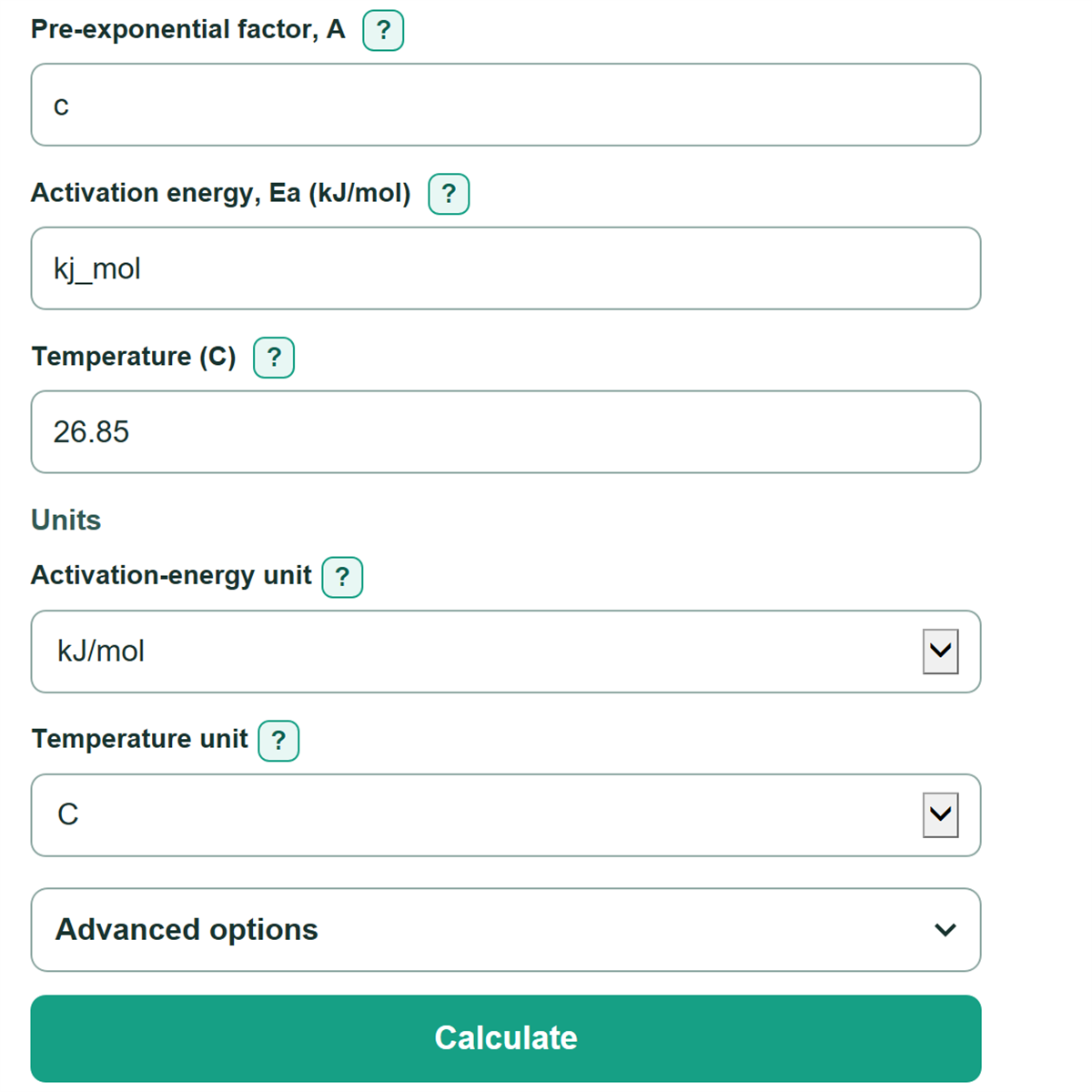
- Enter the values from your problem, lab data, or fitted model. Choose the activation-energy unit and temperature unit printed beside those values.
- Fill in each field shown for the selected calculation. For a two-temperature calculation, keep each rate constant paired with its own temperature.
- Click "Calculate". Check the Kelvin temperature shown in the results, because every Arrhenius calculation must use a temperature above 0 K.
- Report the requested value with its displayed unit. If your assignment specifies precision, choose it under "Advanced options" before calculating.
Definitions
Arrhenius equation: A model that relates a reaction rate constant to temperature, activation energy, and a pre-exponential factor: k = A exp(-Ea/(RT)). [2]
Rate constant (k): A number in a rate law that describes reaction speed under stated conditions. Its unit depends on reaction order.
Pre-exponential factor (A): The scale factor in the Arrhenius equation. It has the same unit as k.
Activation energy (Ea): The energy term in the Arrhenius model, commonly stated in J/mol or kJ/mol.
Absolute temperature: Temperature measured in Kelvin (K). The Arrhenius equation uses Kelvin, not Celsius or Fahrenheit.
R: The molar gas constant, 8.31446261815324 J/(mol K), used after Ea is converted to J/mol. [1]
ln: The natural logarithm. It is defined only for positive numbers.
Common mistakes and quick fixes
Mistake: Entering 25 as Kelvin when the source says 25 C.
Fix: Enter 25 and choose C. The calculator converts it to 298.15 K.
Mistake: Entering Ea in kJ/mol while "Activation-energy unit" is set to J/mol.
Fix: Match the selector to the unit beside Ea. For example, enter 50 with kJ/mol for 50 kJ/mol.
Mistake: Entering zero or a negative value for A or a known k.
Fix: Check the source value and any scientific notation. The supported equations require positive A and positive known rate constants.
Mistake: Using different units for k1 and k2 in a two-temperature calculation.
Fix: Convert one rate constant first so k1 and k2 have the same unit before entering them.
Mistake: Treating k as reaction time, percent yield, or product amount.
Fix: Report k as a rate constant with its reaction-order-dependent unit, such as s^-1 or L mol^-1 s^-1.
Mistake: Using the same temperature for T1 and T2 when finding activation energy from two temperatures.
Fix: Use two different temperatures, each paired with its measured rate constant.
Limitations & Key Assumptions / Boundary Conditions
- The calculation assumes Arrhenius behavior over the entered temperatures; a reaction can depart from this model if its mechanism or controlling conditions change.
- Predicting k at a second temperature assumes that A and Ea do not change between the two conditions.
- Every entered temperature must convert to more than 0 K.
- A and any known k used in a logarithm must be positive. Finding Ea from two temperatures also requires different T1 and T2 values.
- The calculator preserves a rate-constant unit you enter, but does not infer reaction order or convert between rate-constant unit systems for different reaction orders.
- Very large exponent magnitudes can exceed normal computer number range, so no numeric result is shown in that case.
- A negative fitted Ea can be calculated, but its physical interpretation depends on the experimental system and model.
Methodology
Equation and unit conversion
The calculator uses the Arrhenius relationship between rate constant, pre-exponential factor, activation energy, and absolute temperature. [2] It converts entered temperatures to Kelvin and Ea to J/mol before using the gas constant.
k = A exp(-Ea / (R T))
T(K) = T(C) + 273.15
T(K) = (T(F) - 32) x 5/9 + 273.15
Ea(J/mol) = Ea(kJ/mol) x 1000
R is 8.31446261815324 J/(mol K), the CODATA molar gas constant. [1]
Other unknowns
For another selected unknown, the calculator uses the matching rearrangement. In two-temperature calculations, k1 and k2 must use the same unit.
Ea = -R T ln(k / A)
A = k exp(Ea / (R T))
T = -Ea / (R ln(k / A))
k2 = k1 exp((-Ea / R) x (1 / T2 - 1 / T1))
Ea = R ln(k2 / k1) / (1 / T1 - 1 / T2)
Worked mini-example
With A = 1000 s^-1, Ea = 2.494338785445972 kJ/mol, and T = 26.85 C, the calculator converts Ea to 2494.338785445972 J/mol and T to 300 K. The equation gives k = 367.879441171442 s^-1, which is about 368 s^-1 to three significant figures.
Rounding and checks
The significant-figures setting changes displayed rounding only; calculations use unrounded values. The calculator also checks that temperatures are above 0 K and that values used inside ln are positive.