
Check whether your planned kitchen appliance watts fit a breaker and see common small-appliance circuit cautions before you wire or plug in.
Table of contents
How to use our Kitchen Circuit Load Calculator
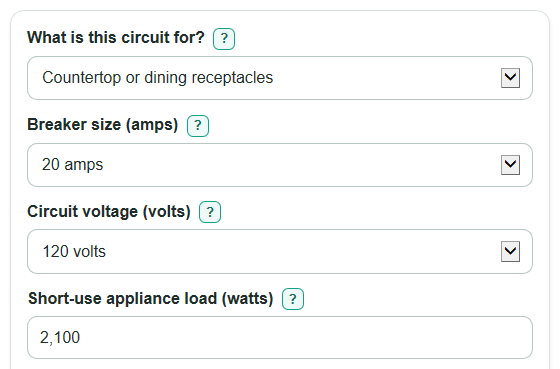
- Choose What is this circuit for? so the calculator knows whether to show the countertop and dining receptacle checks.
- Select Breaker size (amps) and Circuit voltage (volts) from the breaker and circuit you plan to use.
- Enter Short-use appliance load (watts) for appliances that run less than 3 hours, and Long-run appliance load (watts) for loads expected to run 3 hours or more.
- Open Advanced options if you want to check 20A small-appliance circuits serving the kitchen area, Largest one portable appliance (watts), or Fastened-in-place load on the same shared circuit (watts).
- After you click Calculate, sanity-check Circuit check used and Power room left for short-use loads: a negative room-left value means the plan is over the simplified check by that many watts.
Definitions
Watts: Power, or how fast an appliance uses electrical energy. Use the appliance nameplate watts when you can.
Amps: Current, or how much electric flow the circuit carries. The breaker rating is in amps.
Volts: Electrical pressure. Most kitchen countertop receptacles are 120 volts; some large kitchen appliances use 240 volts.
Breaker size: The maximum current the circuit breaker is meant to carry before it trips under overload conditions.
Short-use appliance load: The total watts for appliances expected to run less than 3 hours at a time.
Long-run appliance load: The total watts for loads expected to run 3 hours or more. These get the 125% check.
Small-appliance circuit: A 20A branch circuit used for kitchen, pantry, breakfast room, dining room, or similar receptacles.
Fastened-in-place load: A load from equipment that is fixed in place, such as an appliance that is mounted or built in.
Common mistakes and quick fixes
Mistake: Putting every appliance into Short-use appliance load (watts), including one that can run for 3 hours or more.
Fix: Move those watts to Long-run appliance load (watts) so the larger long-run check is applied.
Mistake: Choosing 15 amps for Breaker size (amps) when What is this circuit for? is Countertop or dining receptacles.
Fix: Use the actual breaker, then treat the Circuit status caution as a prompt to check the required 20A small-appliance circuit rule.
Mistake: Reading Breaker watts at selected voltage as the final safe load for every setup.
Fix: Use Circuit check used and Amps used for the circuit check, because Long-run appliance load (watts) is multiplied for the code-style check.
Mistake: Leaving 20A small-appliance circuits serving the kitchen area at 2 without checking whether more circuits are needed for the entered load.
Fix: Compare it with 20A small-appliance circuits needed for this load.
Mistake: Entering a range or formula in Largest one portable appliance (watts), such as 1500-1800 or 12*120.
Fix: Enter one watt value, such as 1800, so Largest portable appliance room can be checked.
Limitations & Key Assumptions / Boundary Conditions
- This is a branch-circuit planning check, not a full kitchen design or panel load calculation.
- The calculator uses nameplate watts or volt-amperes as entered. Real appliance draw can be lower or higher during startup, heating cycles, or motor starts.
- The long-run check treats loads expected to run 3 hours or more as continuous and applies a 1.25 multiplier.
- Small-appliance circuit flags are simplified. Local code adoption, amendments, inspector decisions, appliance instructions, and circuit layout can change what is allowed.
- It does not size wire, choose receptacles, check GFCI or AFCI protection, check voltage drop, or verify box fill.
- The largest portable appliance check is only applied for 15A or 20A circuits in this calculator.
- If Circuit voltage (volts) is 240 while What is this circuit for? is Countertop or dining receptacles, treat the result as a caution because those kitchen receptacle circuits are normally planned as 120V circuits.
Methodology
How the load is checked
The calculator first turns watts into amps. Watts are power, amps are current, and volts connect them. It adds the short-use load normally, then counts the long-run load at 125% for the branch-circuit check.
actual_running_amps = (short_watts + long_watts) / circuit_voltage
required_circuit_amps = (short_watts / circuit_voltage) + (1.25 * long_watts / circuit_voltage)
The checked amps are compared with Breaker size (amps). Power room left for short-use loads is kept signed, so a negative value shows how many watts the plan is over by.
remaining_short_watts = (breaker_amps - required_circuit_amps) * circuit_voltage
limit_used_percent = (required_circuit_amps / breaker_amps) * 100
circuit_max_watts = breaker_amps * circuit_voltage
Advanced checks
If Largest one portable appliance (watts) is entered on a 15A or 20A circuit, the calculator compares it with 80% of the breaker watts at the selected voltage.
largest_portable_room_watts = (0.80 * breaker_amps * circuit_voltage) - largest_portable_watts
For Countertop or dining receptacles, the small-appliance circuit count is at least 2, then increases if the checked amps would need more 20A circuits for the entered load.
small_appliance_min_circuits_needed = max(2, ceil(required_circuit_amps / 20))
Worked example
For a 20A, 120V circuit with 1200 watts of short-use load and 700 watts of long-run load, actual running amps are (1200 + 700) / 120 = 15.83 amps. The circuit check is 1200 / 120 + 1.25 * 700 / 120 = 17.29 amps. The circuit check used is 17.29 / 20 * 100 = 86.5%, and the power room left is (20 - 17.29) * 120 = 325 watts.
Status wording
If the checked amps are at or below the breaker amps, Circuit status is a pass-style planning message. If checked amps are above the breaker amps, it is over the check. Separate caution text may also appear for small-appliance circuit count, a non-20A small-appliance breaker choice, a largest portable appliance over the 80% check, or a fastened-in-place load over the shared-circuit check.