
Check whether long-running and short-use devices are likely to overload an outlet circuit before you plug them in.
Table of contents
How to use our Outlet Load Calculator
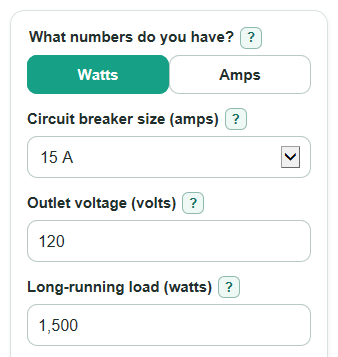
- Choose What numbers do you have? based on the device labels: Watts for W ratings or Amps for A ratings.
- Set Circuit breaker size and Outlet voltage. Use the breaker that feeds the outlet, not only the number printed on the receptacle face.
- Enter Long-running load for devices expected to run at full load for 3 hours or more, and Short-use load for devices used briefly.
- Open Advanced options only if you have a known Power factor for watt entries or want Extra room to leave as a cushion.
- After you calculate, sanity-check Circuit capacity used and Room left on this check. A negative room-left value means the entered load is over the selected limit.
Definitions
Circuit breaker size: The amp rating of the breaker protecting the branch circuit that feeds the outlet.
Outlet voltage: The voltage used to convert watts to amps. Most standard US household receptacles are entered as 120 V unless you are checking a true 240 V outlet.
Long-running load: A load expected to run at its maximum current for 3 hours or more.
Short-use load: A load used for a shorter time, such as many tools, vacuums, or kitchen appliances.
Power factor for watt entries: A number from 0.01 to 1.00 used when converting watts to amps for some AC loads. Lower power factor means more amps for the same watts.
Breaker check load: The mixed-load value compared with the usable breaker capacity: 125% of Long-running load plus 100% of Short-use load.
Room left on this check: Usable breaker capacity minus Breaker check load. Positive means room left; negative means over the selected limit.
Common mistakes and quick fixes
Mistake: Using the outlet faceplate as Circuit breaker size when the breaker is different.
Fix: Check the panel label for the breaker that feeds that outlet, then choose that Circuit breaker size.
Mistake: Putting a heater that runs all afternoon under Short-use load.
Fix: Enter it under Long-running load if it may run at full load for 3 hours or more.
Mistake: Mixing watts and amps after choosing What numbers do you have?.
Fix: If you choose Watts, fill Long-running load and Short-use load in W; if you choose Amps, fill those same labels in A.
Mistake: Leaving Power factor for watt entries at 1.00 for a motor when the label gives a lower value.
Fix: Enter the known Power factor for watt entries so the amp estimate is not too low.
Mistake: Reading Circuit capacity used below 100% as permission to add any device.
Fix: Also check More long-running load room and Important note, especially for motors, power strips, extension cords, or shared circuits.
Limitations & Key Assumptions / Boundary Conditions
- This is a planning check, not approval to change wiring, replace breakers, ignore manufacturer instructions, or ignore local electrical code.
- The outlet is usually limited by the branch circuit breaker and the wiring on that circuit, not only by the outlet faceplate.
- The check assumes the entered loads can run at the same time. If devices cycle on and off, the real current can be lower or higher at a given moment.
- Startup current is not modeled. Motors, compressors, pumps, welders, and some tools can draw much more current when starting.
- Extension cords, multi-outlet power strips, plug adapters, damaged cords, medical equipment, EV charging equipment, generators, and dedicated appliances can have extra rules or lower safe limits.
- Power factor only affects watt-entry mode. If you do not know it, the default 1.00 can understate amps for some motors and electronics.
- Extra room to leave reduces the usable breaker capacity for this check. It is a cushion chosen by the user, not a code rule.
Methodology
What the calculator checks
The calculator separates loads that may run for 3 hours or more from loads used briefly. For the main check, it compares 125% of the Long-running load plus 100% of the Short-use load with the usable breaker capacity. This mixed continuous and noncontinuous load method is more specific than applying a flat 80% shortcut to every load [1].
Formulas used
usable_capacity_amps = breaker_amps * (1 - safety_margin_percent / 100)
load_amps = load_watts / (outlet_voltage * power_factor)
actual_load_amps = continuous_load_amps + short_load_amps
breaker_check_amps = 1.25 * continuous_load_amps + short_load_amps
capacity_used_percent = 100 * breaker_check_amps / usable_capacity_amps
remaining_capacity_amps = usable_capacity_amps - breaker_check_amps
long_running_room_amps = ((usable_capacity_amps - short_load_amps) / 1.25) - continuous_load_amps
continuous_limit_amps = usable_capacity_amps * 0.80
continuous_limit_watts = continuous_limit_amps * outlet_voltage * display_power_factor
Worked example
For a 20 A breaker, 120 V outlet, 1500 W long-running heater, 300 W short-use device, power factor 1.00, and 0% extra room, the long-running current is 1500 / (120 * 1.00) = 12.5 A. The short-use current is 300 / (120 * 1.00) = 2.5 A. The breaker check load is 1.25 * 12.5 + 2.5 = 18.125 A. Capacity used is 100 * 18.125 / 20 = 90.625%, so Room left on this check is 20 - 18.125 = 1.875 A.
How to read the result
Load check result is based on whether Breaker check load is at or below usable breaker capacity. Circuit capacity used at or below 100% fits the selected check. Room left on this check is signed, so a negative value means the load is over the selected limit. More long-running load room is also signed; a negative value means the long-running load would need to be reduced if the short-use load stays the same.
Sources
- Sizing Branch Circuits for Continuous & Noncontinuous Load Types - Designmaster
- North Carolina Office of State Fire Marshal - NEC 210.11: branch circuits in dwellings / load basis discussion - Ncosfm
- George Fox University (EHS/Plant Services) - Safety Practices: Electrical Circuit Care (don't overload; 80% rule) [PDF] - Georgefox