
Check appliance loads against a breaker using watts, amps, voltage, and the 3-hour continuous-load rule.
Advanced options
Table of contents
How to use our Appliance Circuit Load Calculator
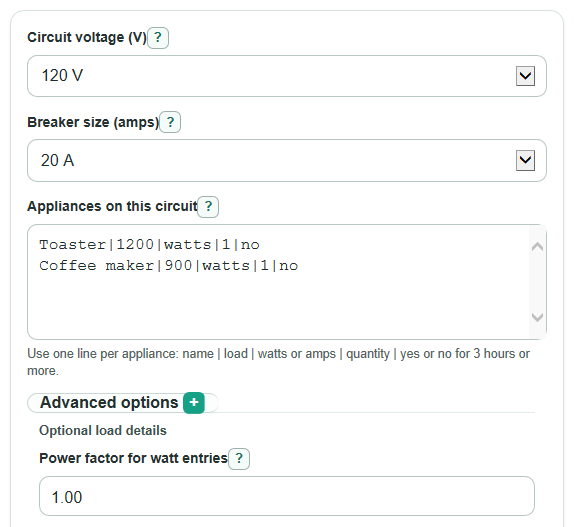
- Choose the Circuit voltage and Breaker size that match the circuit you are checking.
- Enter each item in Appliances on this circuit with its name, load value, watts or amps, quantity, and whether it can run 3 hours or more.
- Use Advanced options only when needed: change Power factor for watt entries for motor-type loads, or add Other known load on this circuit.
- Select Calculate, then read Circuit check, Load used for the breaker check, and Breaker headroom first.
- Sanity-check the output by comparing Actual running load before the 3-hour adjustment with the appliance nameplates; a much different value usually means a wrong unit, voltage, quantity, or power factor.
Definitions
Circuit voltage: The voltage used for the amp calculation, usually 120 V for standard US outlets or 240 V for many large appliances.
Breaker size: The amp rating printed on the circuit breaker, such as 15 A or 20 A.
Appliances on this circuit: The list of loads you want to check together, with each load entered in watts or amps.
Power factor for watt entries: A decimal from 0.10 to 1.00 that adjusts watts-to-amps math for some AC loads, especially motors and compressors.
Other known load on this circuit: Extra current, in amps, from lights, outlets, or equipment that shares the same circuit but is not entered as an appliance row.
Continuous load: A load expected to run for 3 hours or more; this calculator multiplies only those marked loads by 1.25 for the breaker check.
Load used for the breaker check: The adjusted amp load compared with the selected breaker size.
Breaker headroom: Breaker size minus adjusted load; positive means room left, and negative means the adjusted load is over the breaker size.
All-day planning limit for this breaker: 80 percent of the breaker size, useful when every load may run for 3 hours or more.
Biggest adjusted item: The appliance or other load that adds the most amps after any 3-hour adjustment.
Common mistakes and quick fixes
Mistake: Picking Circuit voltage as 240 V for a normal 120 V outlet.
Fix: Use 120 V for most standard household outlets and 240 V only for appliances or circuits labeled that way.
Mistake: Setting Breaker size to the breaker you wish you had instead of the breaker installed now.
Fix: Use the amp number printed on the existing breaker; do not use this result as approval to install a larger breaker.
Mistake: Mixing watts and amps in Appliances on this circuit, such as typing 12 amps but leaving the row unit as watts.
Fix: Match each row unit to the nameplate: choose watts for W ratings and amps for A ratings.
Mistake: Entering a total count like 2.5 in Appliances on this circuit quantity.
Fix: Use a whole-number quantity, such as 1, 2, or 3, for identical appliances.
Mistake: Leaving Power factor for watt entries at 1.00 for a motor or compressor when you have a better value from the nameplate or manual.
Fix: Enter the known power factor between 0.10 and 1.00 so watt-to-amp estimates are not too low.
Mistake: Treating a negative Breaker headroom value as unused room.
Fix: A negative Breaker headroom means the adjusted load is over the selected Breaker size.
Limitations & Key Assumptions / Boundary Conditions
- This is a planning check for likely branch-circuit load. It is not permission to install wiring, replace receptacles, or change a breaker.
- The result depends on the accuracy of appliance nameplate values, the selected Circuit voltage, and the 3-hour yes or no choices.
- Startup surge, motor inrush current, equipment duty cycles, heat, voltage drop, and nuisance tripping are not modeled.
- Power factor only changes watt-entry conversions and estimated watts. Amp entries are used directly for the breaker check.
- The listed breaker comparison is limited to 15 A, 20 A, 30 A, 40 A, 50 A, and 60 A. It is not a wire-sizing rule.
- Real electrical work must account for conductor material, wire gauge, temperature rating, cable type, installation method, receptacle rating, equipment instructions, and local code.
- If a circuit has multi-wire branch circuits, shared neutrals, subpanels, hardwired equipment, or unknown wiring, ask a qualified electrician before relying on a simple load check.
Methodology
How the load is counted
Each appliance row is first converted to a running amp load. Rows entered in amps are already current, so they are multiplied only by quantity. Rows entered in watts are converted with volts and power factor.
row_amps = (watts_per_item x quantity) / (circuit_voltage x power_factor)
row_amps = amps_per_item x quantity
For rows marked as running 3 hours or more, the calculator applies the 125 percent continuous-load adjustment to that row only. Noncontinuous rows stay at 100 percent. The same rule is used for Other known load on this circuit when it is marked as continuous [1].
adjusted_row_amps = row_amps x 1.25 if runs_3h_or_more is yes, otherwise row_amps
adjusted_load_amps = sum(adjusted_row_amps) + adjusted_other_load_amps
How the breaker check is made
The Circuit check passes when the adjusted load is at or below the selected Breaker size. Breaker headroom is signed, so an overload stays negative instead of being hidden as zero.
passes = adjusted_load_amps <= breaker_amps
headroom_amps = breaker_amps - adjusted_load_amps
headroom_percent = (headroom_amps / breaker_amps) x 100
The all-day planning limit is 80 percent of the breaker size, which is the same as dividing the breaker size by 1.25. A household load guide commonly uses breaker amps times voltage for watt capacity and then checks long-running load against 80 percent of that capacity [2].
all_day_limit_amps = breaker_amps x 0.80
Estimated watts and breaker comparison
Estimated running power adds watt rows directly and estimates watts for amp rows by multiplying amps, volts, and power factor. This watt total is for comparison only; the breaker check is based on amps.
estimated_running_watts = sum(watt_rows_watts) + sum(amp_row_amps x circuit_voltage x power_factor) + other_load_amps x circuit_voltage x power_factor
The breaker comparison chooses the first size in the built-in list that is at least as large as the adjusted load. If the adjusted load is above 60 A, the calculator shows that the load is beyond the built-in comparison list.
recommended_breaker_amps = first size in [15, 20, 30, 40, 50, 60] where size >= adjusted_load_amps
Mini-example
Suppose a 120 V circuit has a 20 A breaker, a 1,200 W toaster, a 900 W coffee maker, power factor 1.00, and neither appliance is marked as running 3 hours or more. The toaster is 1,200 / 120 = 10.0 A. The coffee maker is 900 / 120 = 7.5 A. The adjusted load is 17.5 A, the same as the running load because no 1.25 adjustment applies. Breaker headroom is 20 - 17.5 = 2.5 A, or 12.5 percent of the breaker size, so the check passes for that entered load.