
Estimate running and starting power separately for appliances and tools, with planning allowances for extra room and expected power loss.
Advanced options
Table of contents
How to use our Generator Wattage Calculator
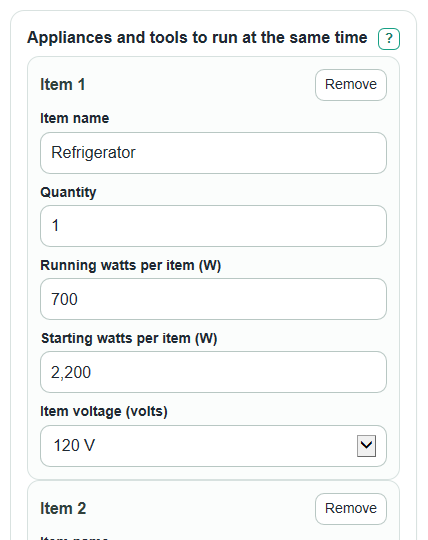
- Add each item in Appliances and tools to run at the same time, with quantity, running watts, starting watts, and 120 V or 240 V.
- Choose How should start-up power be counted?: use the largest-motor option when loads start one at a time, or all-at-once when several motors may restart together.
- Enter Extra room to add as a percent, then use Advanced options if you want to include Expected power loss or change Voltage for amp check.
- Click "Calculate". Compare "Running power comparison" with the continuous running rating, then check "Starting power comparison" against the manufacturer's starting capability and duration. Both checks matter.
- Sanity-check the result by looking at Watts needed after everything is running and Biggest extra start-up load; one very large motor can drive the whole generator size.
Definitions
Running watts: The watts an item uses after it is already on and working normally.
Starting watts: The short burst of watts some motors, pumps, compressors, and tools need when they first start.
Extra start-up load: Starting watts minus running watts for a row, floored at 0 so an item never lowers the start-up total.
Headroom: Extra percent added above the calculated load so the generator is not planned right at the edge.
Expected power loss: A percent reduction used when the generator may produce less than its label rating.
Nameplate ratings: Continuous running power and short-duration starting power are different specifications. Check both ratings and the manufacturer's conditions.
Kilowatt: A larger power unit equal to 1000 watts.
Starting comparison divided by voltage: The starting comparison in watts divided by the selected voltage. It is not the continuous running current and does not model power factor or split-phase balance.
Common mistakes and quick fixes
Mistake: Using surge watts as running watts in Appliances and tools to run at the same time .
Fix: Put normal steady watts in running watts, and short start-up watts in starting watts.
Mistake: Leaving starting watts blank for a refrigerator, pump, compressor, or saw in Appliances and tools to run at the same time .
Fix: Check the label or manual; if the item has no extra start-up load, enter the same value as running watts.
Mistake: Choosing Largest motor starts by itself for How should start-up power be counted? when several motors can restart together after an outage.
Fix: Choose All start-up loads may happen at once for a more conservative result.
Mistake: Typing a negative value in Extra room to add or using 0 percent when you still plan to add small loads later.
Fix: Use 0 or a higher percent; 20 percent is a common planning starting point in this calculator.
Mistake: Entering Expected power loss as 100 percent or more.
Fix: Use a value from 0 to less than 100 percent, or leave it at 0 if you are not adjusting for loss.
Mistake: Treating Starting comparison divided by voltage as proof that cords, outlets, or transfer equipment are safe.
Fix: Use it as a quick check only; have permanent wiring and transfer equipment sized by a qualified electrician.
Limitations & Key Assumptions / Boundary Conditions
- This calculator is for wattage planning only. It does not size home wiring, extension cords, breakers, transfer switches, or medical backup systems.
- Appliance labels and manuals are better than generic wattage guesses. Real starting watts can change by model, motor type, age, and load.
- The largest-motor method assumes only one row's extra start-up load happens at a time. Use the all-at-once method if multiple motors may restart together.
- The amp check is a simple watts divided by volts estimate. It does not account for power factor, split-phase load balance, plug limits, or electrical code requirements.
- Power loss is applied as a planning adjustment to the generator label rating. The calculator does not predict actual derating for a specific fuel, altitude, temperature, or generator model.
- Portable generators create carbon monoxide. Use them outdoors and far from doors, windows, vents, garages, and other openings.
Methodology
How rows are counted
Each row is counted by quantity, so two matching heaters or lights are included twice.
row_running_watts = quantity * running_watts_per_item
row_extra_start_watts = quantity * max(starting_watts_per_item - running_watts_per_item, 0)
If starting watts are lower than running watts, the extra start-up load is set to 0 for that row. The row is still valid.
How start-up watts are counted
The calculator first adds all steady running watts.
total_running_watts = sum(row_running_watts)
If Largest motor starts by itself is selected, only the biggest extra start-up load is added to the running total.
startup_watts_needed = total_running_watts + max(row_extra_start_watts)
If All start-up loads may happen at once is selected, every row's extra start-up load is added.
startup_watts_needed = total_running_watts + sum(row_extra_start_watts)
How the generator rating is found
Running and starting loads are compared separately. Each comparison adds the selected headroom and divides by the remaining output fraction after expected power loss. These are planning allowances, not manufacturer performance guarantees.
running_comparison_watts = total_running_watts * (1 + headroom_percent / 100) / (1 - power_loss_percent / 100)
starting_comparison_watts = startup_watts_needed * (1 + headroom_percent / 100) / (1 - power_loss_percent / 100)
starting_comparison_kw = starting_comparison_watts / 1000
starting_comparison_amps = starting_comparison_watts / amp_voltage
A generator's short-duration starting capability can differ from its continuous running rating. Check the exact model, fuel, conditions and duration in its specifications; a matching watt number alone does not establish compatibility with every motor. See Honda's generator selection guidance.
Worked mini-example
Using the default rows, running watts are 700 + 800 + 120 + 100 = 1720 W. The largest extra start-up load is the refrigerator at 2200 - 700 = 1500 W, so start-up need is 1720 + 1500 = 3220 W. With 20 percent extra room and 0 percent power loss, "Running power comparison" is 1720 * 1.20 = 2064 W. "Starting power comparison" is 3220 * 1.20 = 3864 W, or 3.864 kW. Compare 2064 W with continuous running output and check starting capability of 3864 W for the required duration. At 120 V the starting comparison divided by voltage is 3864 / 120 = 32.2 A; this is not the continuous current.