
Use this Q10 calculator to find Q10 from two measured rates or predict a new rate from a known Q10 and temperature change.
How to use our Q10 Calculator
- Choose "What do you want to find?" and enter the visible fields using one consistent rate unit and one consistent temperature scale.
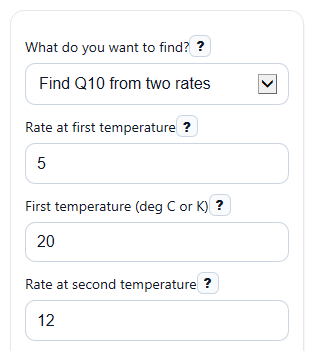
- For "Find Q10 from two rates," fill in "Rate at first temperature," "First temperature (deg C or K)," "Rate at second temperature," and "Second temperature (deg C or K)."
- For "Predict a rate from known Q10," fill in "Rate at first temperature," "First temperature (deg C or K)," "Known Q10," and "Target temperature (deg C or K)."
- Click Calculate, then read "Answer" first and use "Rate change factor" and "What this means" to understand whether the rate is higher, lower, or about the same.
- Sanity-check the result: if the target temperature is warmer and Q10 is above 1, the predicted rate should usually be higher; if temperatures are the same, the rate should stay the same and the factor should be 1.
Definitions
Q10: A unitless temperature coefficient that tells how much a rate changes for a 10-degree increase in temperature.
Rate at first temperature: Your starting or reference rate, called R1 in the formula.
Rate at second temperature: The measured rate at another temperature, called R2 in the formula.
Known Q10: A Q10 value you already have and want to use to predict a new rate.
Target temperature (deg C or K): The temperature where you want the new predicted rate.
Rate change factor: How many times larger or smaller one rate is compared with the reference rate. Above 1 means faster, below 1 means slower.
Temperature change: The difference between the two temperatures used in the calculation. It can be positive or negative.
Common mistakes and quick fixes
Mistake: Entering different temperature scales in "First temperature (deg C or K)" and "Second temperature (deg C or K)."
Fix: Use all temperatures in deg C or all in K so the "Answer" and "Temperature change" are based on one shared scale.
Mistake: Using 0 or a negative number in "Rate at first temperature" or "Rate at second temperature."
Fix: Enter rates greater than 0 only. This calculator needs positive rates to compute "Answer" correctly.
Mistake: Making "First temperature (deg C or K)" equal to "Second temperature (deg C or K)" in Find Q10 mode.
Fix: Change one temperature so the "Temperature change" is not 0. Q10 cannot be found from two rates at the same temperature.
Mistake: Entering a rate in one unit for "Rate at first temperature" and a different unit for "Rate at second temperature."
Fix: Keep the same rate unit throughout so the "Rate change factor" compares like with like.
Mistake: Typing 0 or a negative value for "Known Q10" in Predict a rate mode.
Fix: Enter a positive "Known Q10" value. Q10 is a factor, so it must be greater than 0 for the "Answer" to work.
Mistake: Thinking a Q10 below 1 is always an error when "Rate at second temperature" is lower at a warmer temperature.
Fix: A value below 1 can be valid. Read "What this means" to see that the rate decreases as temperature rises.
Limitations & Key Assumptions / Boundary Conditions
- All temperature inputs must use the same scale throughout, either all deg C or all K.
- All rate inputs must use the same rate unit throughout; the calculator does not convert units for you.
- Rates must be greater than 0. Zero or negative rates are not valid for this Q10 setup.
- In Find Q10 mode, the two temperatures cannot be equal because the formula would divide by zero.
- The prediction mode assumes one constant Q10 across the whole temperature range, which may be less realistic over large temperature gaps.
- A warning is appropriate when the temperature gap is more than about 20 degrees because real biological or chemical systems may not keep the same temperature response over a broad range.
- This calculator cannot detect if you mixed Celsius and kelvin by mistake when the numbers still look possible.
Methodology
How the calculator works
There are two modes. In the first mode, the calculator finds Q10 from two measured rates at two different temperatures. In the second mode, it uses a known Q10 to predict a new rate at a target temperature.
Formulas used
Q10 = (R2 / R1)^(10 / (T2 - T1))
R_target = R_ref * Q10^((T_target - T_ref) / 10)
factor = Q10^(DeltaT / 10)
The number 10 is used because Q10 is defined as the rate-change factor for a 10-degree temperature interval [1]. Celsius and kelvin can both be used because a temperature difference of 10 deg C is the same size as 10 K.
What each part means
R1 or R_ref is the starting rate. R2 is the measured rate at the second temperature. T1 or T_ref is the starting temperature. T2 or T_target is the other temperature. DeltaT means temperature change, found by subtracting the first or reference temperature from the second or target temperature.
Mini examples
Example 1:
Find Q10 from two rates. If the rate is 5 at 20 deg C and 12 at 30 deg C, then the rate ratio is 12/5 = 2.4. Because the temperature change is 10 degrees, Q10 = 2.4. That means the rate is 2.4 times as large for each 10-degree rise in this case.
Example 2:
Predict a new rate. If the reference rate is 5 at 20 deg C and the known Q10 is 2, then at 30 deg C the factor is 2^((30-20)/10) = 2. The predicted rate is 5 x 2 = 10.
Example 3:
Cooling. If the reference rate is 12 at 30 deg C and Q10 is 2, then at 20 deg C the factor is 2^(-10/10) = 0.5. The predicted rate is 12 x 0.5 = 6. A factor below 1 means the rate gets smaller.
How to interpret the result
In Find Q10 mode, a value near 1 means temperature has little effect on the rate across that interval. A value around 2 means the rate roughly doubles for each 10-degree increase. A value below 1 means the rate decreases as temperature rises.
Error handling and assumptions
The calculator blocks impossible setups such as equal temperatures in Find Q10 mode, non-numeric entries, zero or negative rates, and a non-positive Known Q10. It also ignores hidden inputs from the other mode so only the visible fields affect the result.
Results are estimates based on a constant-Q10 model. Real systems can change behavior across wider temperature ranges, so large temperature jumps should be treated more cautiously [3].
Sources
- 32.11: Part 3 - A Warmer World: Temperature Effects On Chemical Reactions - Biology LibreTexts - Libretexts
- Holy Cross Integrative Physiology notes (PDF): temperature regulation and Q10 relationship (R2 = R1 * Q10...) - Holycross
- Effect of warming on the temperature dependence of soil respiration rate in arctic, temperate and tropical soils - Waseda University - Elsevierpure
- Arrhenius Plot Analysis, Temperature Coefficient and Q10 Value Estimation for the Effect of Temperature on Molybdenum Reduction Rate by Pantoea sp. strain HMY-P4 | Journal of Environmental Microbiology and Toxicology - Hibiscuspublisher