
Enter molality or mass data to calculate a solution's freezing point decrease and estimated freezing temperature.
Table of contents
How to use our Freezing Point Depression Calculator
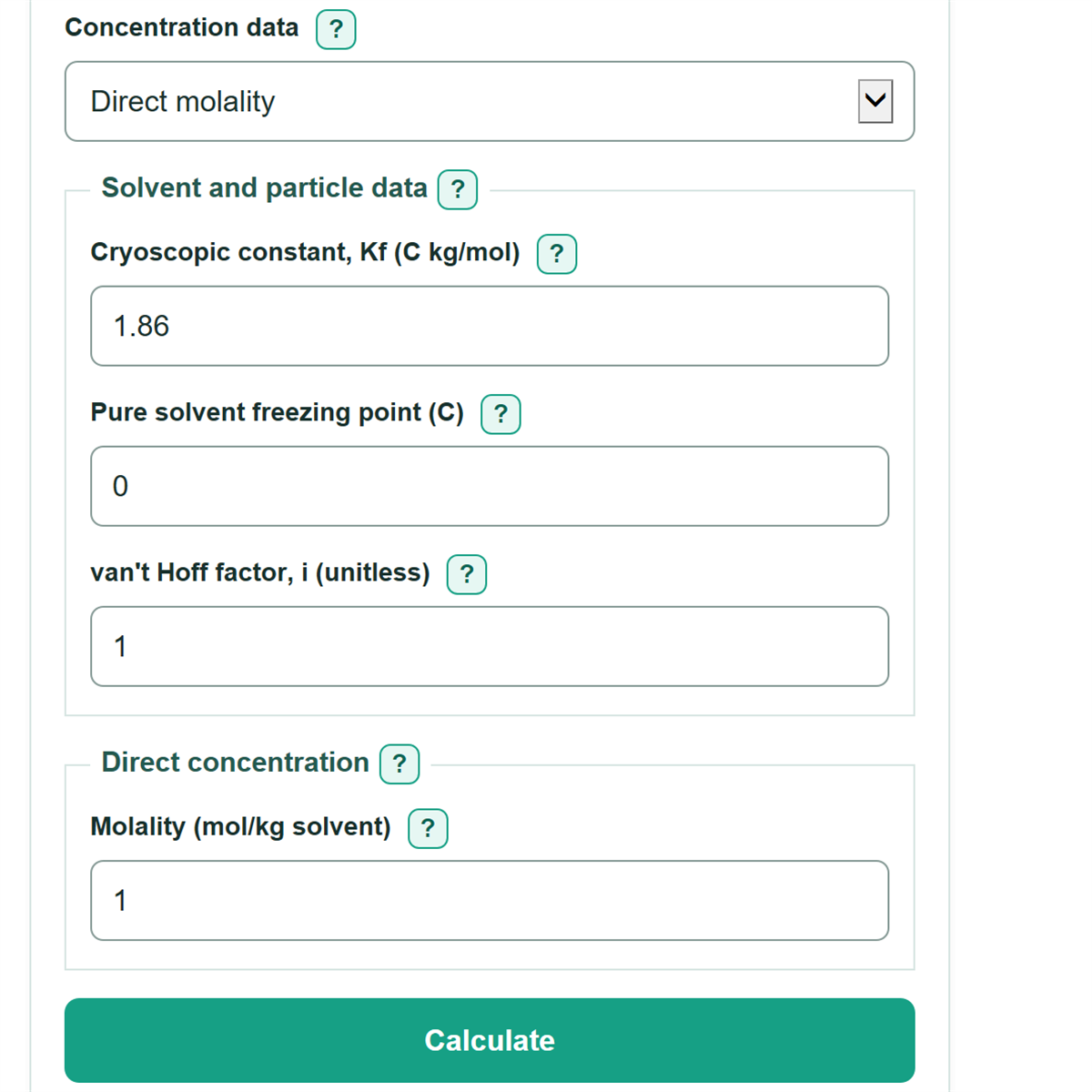
- Choose Direct molality if your problem gives molality, or choose Masses if you have solute mass, molar mass, and solvent mass.
- Enter the solvent's cryoscopic constant, Kf, and the freezing point of the pure solvent from the problem or lab handout.
- Enter the van't Hoff factor, i. Keep 1 for a nonelectrolyte unless your problem gives a different value.
- Enter the visible concentration values, then click Calculate.
- Check that the estimated solution freezing point equals the pure solvent freezing point minus the positive freezing point decrease.
Definitions
Cryoscopic constant, Kf: A property of a solvent that links dissolved-particle concentration to freezing point decrease. Its unit is C kg/mol.
Molality, m: Moles of solute per kilogram of solvent. It differs from molarity, which is based on liters of solution.
van't Hoff factor, i: The effective number of dissolved particles produced per formula unit of solute in the calculation.
Freezing point depression: The positive temperature decrease between a pure solvent and its solution. For an ideal dilute solution, it depends on the concentration of dissolved particles. [1]
Effective particle molality: Molality multiplied by i. This is the concentration used in the freezing point depression equation.
Common mistakes and quick fixes
Mistake: Entering molarity instead of molality.
Fix: Use molality in mol/kg of solvent. Molarity uses liters of solution and cannot be substituted into this equation.
Mistake: Using total solution mass as solvent mass in Masses mode.
Fix: Enter only the mass of the solvent before the solute was added.
Mistake: Entering Kb instead of Kf.
Fix: Use the cryoscopic constant Kf for freezing point depression. Kb is used for boiling point elevation.
Mistake: Making the freezing point decrease negative.
Fix: Enter positive physical inputs. The decrease is shown as a positive amount, then subtracted from the pure solvent freezing point.
Mistake: Leaving i as 1 when the problem gives an electrolyte particle factor.
Fix: Enter the stated or measured van't Hoff factor for that solute and solution.
Limitations & Key Assumptions / Boundary Conditions
- The calculation uses the ideal dilute-solution equation, so concentrated solutions can differ because particle interactions and activity are not included.
- The entered van't Hoff factor is treated as constant, although real electrolytes can dissociate incompletely or change behavior with concentration.
- The result estimates an equilibrium freezing point. A sample can begin visibly freezing at a different temperature because of supercooling or experimental conditions.
- The calculation does not model eutectic mixtures, phase diagrams, impurities, or chemical reactions between the solute and solvent.
- In Masses mode, molality is based on solvent mass only, not total solution mass.
Methodology
Calculation method
The calculator finds molality from the selected concentration path. Direct molality uses the entered value. Masses mode divides solute mass by molar mass to find moles, then divides by solvent mass in kilograms.
m = (solute mass in g / molar mass in g/mol) / (solvent mass in g / 1000)
It multiplies molality by the van't Hoff factor to find the effective dissolved-particle concentration.
effective particle molality = i x m
The ideal dilute-solution equation calculates the freezing point decrease. [1]
ΔTf = i x Kf x m
The decrease is a positive magnitude. The calculator subtracts it from the pure solvent freezing point to estimate the solution freezing point.
solution freezing point = pure solvent freezing point - ΔTf
Worked mini-example
Suppose Kf is 1.86 C kg/mol, the pure solvent freezes at 0 C, i is 1, and molality is 0.20 mol/kg solvent. The decrease is 1 x 1.86 x 0.20 = 0.372 C. The estimated solution freezing point is 0 C - 0.372 C = -0.372 C.
Calculation boundaries
Kf, i, solute molar mass, and solvent mass must be greater than 0. Molality and solute mass may be 0, which gives a 0 C decrease. A pure solvent freezing point may be negative. Results depend on the supplied ideal-model inputs.