
Choose the process in your thermodynamics problem, enter the given values, and calculate its signed entropy change with the matching equation.
Advanced options
Table of contents
How to use our Entropy Calculator
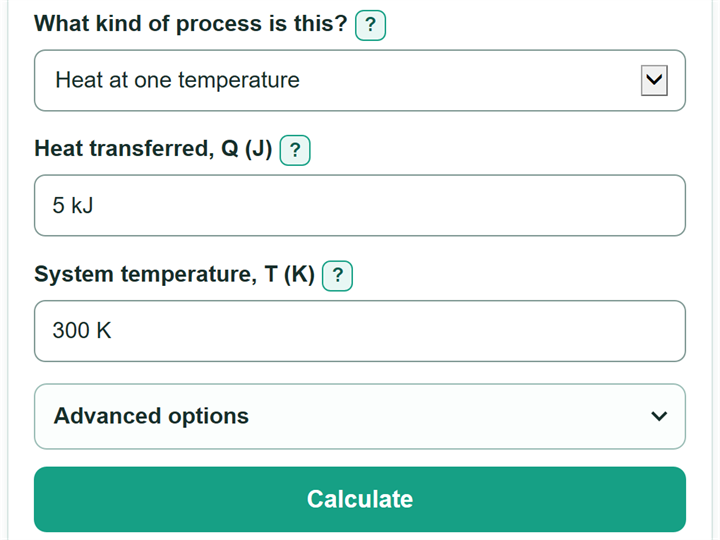
- Choose the process that matches the wording and quantities in your problem.
- Enter only the fields shown for that process. A temperature without a suffix is read as kelvin; add C or F when copying Celsius or Fahrenheit.
- Keep the signs shown for heat, standard enthalpy, and Gibbs free energy. For a phase change, enter a positive transition enthalpy and choose the direction.
- Click Calculate and confirm that the displayed equation describes your physical process before using the number.
- Check the sign and unit: system-process answers are in J/K, while the standard-reaction answer is in J/mol K.
Definitions
Entropy change, ΔS: A measure of how energy and matter are spread out during a process. A positive value means entropy increases for the selected system or reaction.
Reversible process: An idealized process that can be reversed by an extremely small change. The heat and phase-change equations use reversible heat.
Absolute temperature: Temperature measured in kelvin (K), with 0 K at absolute zero. It must be greater than 0 K in these equations.
Heat capacity: The heat needed to raise temperature by 1 K. It can apply to a whole sample (J/K), one mole (J/mol K), or one gram (J/g K).
Natural log, ln: The logarithm used when comparing temperature ratios or gas-volume ratios.
Standard reaction quantities: ΔH and ΔG are molar energy changes for a balanced reaction under stated standard conditions. This calculator gives the reaction entropy change in J/mol K.
Gas constant, R: 8.31446261815324 J/mol K, used in the ideal-gas volume-change equation. [1]
Common mistakes and quick fixes
Mistake: Using heat divided by temperature while the sample heats or cools through a range.
Fix: Choose "Heat or cool through a temperature range" and enter heat capacity plus the starting and ending temperatures.
Mistake: Entering 25 as though it were 25 K when the source says 25 C.
Fix: Enter "25 C" so it converts to 298.15 K.
Mistake: Mixing joules and kilojoules.
Fix: Add a heat suffix when needed, such as "5 kJ," and enter transition enthalpy in the kJ/mol field.
Mistake: Entering a negative transition enthalpy for freezing or condensing.
Fix: Enter the positive transition-enthalpy magnitude and choose the direction that supplies the negative sign.
Mistake: Combining ΔH and ΔG values from different reactions or temperatures.
Fix: Use values for the same balanced reaction, standard state, and temperature.
Mistake: Treating a negative entropy change as an error.
Fix: Negative values are valid for cooling, compression, freezing, condensation, deposition, and some reactions.
Limitations & Key Assumptions / Boundary Conditions
- The constant-temperature heat equation applies only to reversible heat transfer while the system stays at one absolute temperature.
- The heating or cooling equation treats the entered heat capacity as constant across the full temperature range.
- The gas-volume equation assumes an ideal gas at constant temperature. It does not include real-gas behavior or a temperature change.
- The phase-change equation assumes the full entered amount changes phase reversibly at the stated transition temperature.
- The standard-reaction equation requires ΔH and ΔG for the same balanced reaction, standard state, and temperature.
- The result describes the selected system or reaction only. It does not by itself give the entropy change of the surroundings or the universe.
Methodology
Choosing the equation
The process choice selects the equation that fits the supplied facts. Energy is converted to joules where needed, and every temperature is converted to kelvin before calculation. Celsius converts with K = C + 273.15. Fahrenheit converts with K = (F + 459.67) x 5/9. [2]
Equations used
ΔS = Q / T
Use this for reversible heat transfer at one constant temperature. Q is signed heat in J, and T is temperature in K.
ΔS = C ln(Tfinal / Tinitial)
Use this for heating or cooling when heat capacity is constant. C is total heat capacity in J/K. For molar or specific heat capacity, multiply the listed capacity by the entered amount first.
ΔS = nR ln(Vfinal / Vinital)
Use this for isothermal ideal-gas expansion or compression. n is amount in mol, R is the gas constant, and the volume ratio must be positive.
ΔS = sign x n x ΔHtransition / Ttransition
Use this for a reversible phase change. Convert transition enthalpy from kJ/mol to J/mol. The sign is positive for melting, boiling, or subliming and negative for freezing, condensing, or depositing.
ΔS = (ΔH - ΔG) / T
Use this for a standard reaction after converting both energy values from kJ/mol to J/mol.
Worked mini-example
If a system reversibly absorbs 5 kJ at 300 K, first convert 5 kJ to 5,000 J. Dividing 5,000 J by 300 K gives 16.7 J/K, rounded to one decimal place. The result is positive because the system absorbs heat.
Reading the sign
A positive result means entropy increases for the selected system or standard reaction. A negative result means it decreases. Zero is also a valid result, such as when no heat is transferred at a positive constant temperature or when the starting and ending temperatures are equal.