
Enter your chemistry values to calculate Gibbs free-energy change and see whether the reaction is thermodynamically favorable under those conditions.
Table of contents
How to use our Gibbs Free Energy Calculator
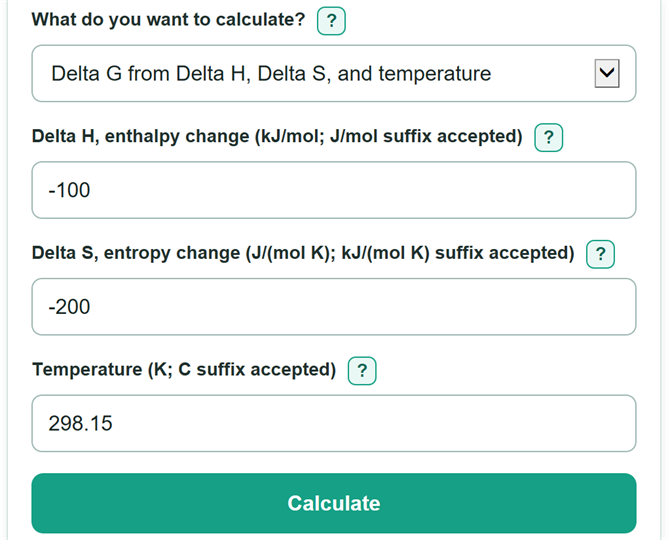
- Choose the quantity your problem asks for in "What do you want to calculate?" Use "Delta G from Delta H, Delta S, and temperature" for the usual Gibbs free-energy equation.
- Enter only the fields shown for that choice. A bare Delta H or Delta G value uses kJ/mol, a bare Delta S value uses J/(mol K), and a bare temperature uses K.
- Add a supported suffix when needed, such as "25 C", "-100000 J/mol", or "-0.2 kJ/(mol K)". For K and Q, enter a finite number greater than 0.
- Click "Calculate." Check that the displayed Kelvin temperature, signs, and units match your problem before using the answer.
Definitions
Gibbs free-energy change, Delta G: Energy change per mole for a reaction under stated conditions. Its sign describes thermodynamic favorability for the reaction direction as written.
Delta H: Enthalpy change, a heat-related energy change at constant pressure, usually reported in kJ/mol.
Delta S: Entropy change per mole per kelvin, usually reported in J/(mol K).
Absolute temperature: Temperature on the Kelvin scale. Gibbs free-energy equations require kelvins, not Celsius.
Standard Delta G: Gibbs free-energy change under the standard-state conditions used for the problem.
Equilibrium constant, K: A positive dimensionless quantity for a reaction at equilibrium.
Reaction quotient, Q: A positive dimensionless quantity that describes the current mixture using the same reaction definition as K.
Common mistakes and quick fixes
Mistake: Typing 25 for a temperature that was given as 25 C.
Fix: Type "25 C" so it converts to 298.15 K, or enter 298.15 directly.
Mistake: Mixing kJ/mol with J/(mol K).
Fix: Follow the units in each label. You can type a suffix such as J/mol or kJ/(mol K) instead of converting it yourself.
Mistake: Using K where the problem gives Q, or using Q where it gives K.
Fix: Choose "Standard Delta G from K" for an equilibrium constant and "Delta G from standard Delta G and Q" for current conditions.
Mistake: Entering 0 or a negative value for K or Q.
Fix: Use a finite value greater than 0 because the calculation takes the natural logarithm of K or Q.
Mistake: Treating a negative Delta G as proof that a reaction is fast.
Fix: A negative value means the forward direction is thermodynamically favorable under the stated conditions; reaction rate depends on kinetics.
Limitations & Key Assumptions / Boundary Conditions
- The result applies to the reaction direction, temperature, composition, and values entered.
- A negative Delta G means the forward reaction is thermodynamically favorable under the stated conditions; it does not predict reaction speed, mechanism, or completion time.
- The direct equation uses the entered Delta H and Delta S at the entered temperature. In real systems, these quantities can change with temperature or phase.
- K and Q must be positive, dimensionless values for the reaction as written. Replacing activities with uncorrected concentrations or pressures can change the result.
- The temperature-solving path is undefined when Delta S is zero and accepts only a calculated temperature above 0 K.
- Rounded worksheet or table values can make a result near zero appear slightly positive or negative.
Methodology
Equations used
The calculator converts Delta H and Delta G to kJ/mol, Delta S to kJ/(mol K), and temperature to K before using the Gibbs free-energy relationship. [1]
ΔG = ΔH - TΔS
Here, T is absolute temperature in K. The calculator also shows the signed T Delta S contribution so you can check the subtraction.
ΔH = ΔG + TΔS
ΔS = 1000 x (ΔH - ΔG) / T
T = (ΔH - ΔG) / ΔS
The factor 1000 in the Delta S equation changes kJ to J. Solving for temperature requires Delta S to be nonzero, and the result must be above 0 K.
K and Q calculations
For K and Q, the calculator uses the molar gas constant R = 8.31446261815324 J/(mol K). [2] ln means natural logarithm.
ΔG° = -RT ln(K) / 1000
ΔG = ΔG° + RT ln(Q) / 1000
Dividing by 1000 changes J/mol to kJ/mol. K and Q must both be greater than 0.
Worked example
For Delta H = -100 kJ/mol, Delta S = -200 J/(mol K), and 25 C, the calculator changes the temperature to 298.15 K and Delta S to -0.2 kJ/(mol K).
TΔS = 298.15 x -0.2 = -59.63 kJ/mol
ΔG = -100 - (-59.63) = -40.37 kJ/mol
The negative Delta G means the forward reaction is thermodynamically favorable for those entered conditions.