
Use this STP calculator to convert gas volume to standard conditions or find moles and volume at STP with the exact definition your class uses.
Advanced options
How to use our STP Calculator
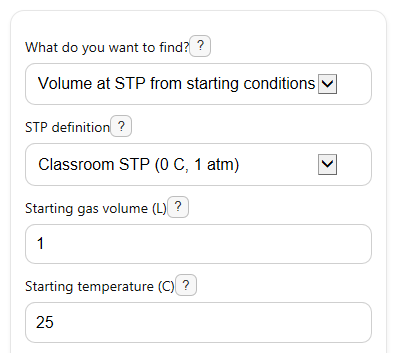
- Choose What do you want to find?, then pick the correct STP definition for your class: Classroom STP or IUPAC STP.
- Enter only the values for your task: use Starting gas volume (L), Starting temperature (C), Starting pressure, and Pressure unit for a conversion to STP; use Gas volume at STP (L) to find moles; or use Amount of gas (mol) to find volume.
- If needed, set Round answers to so your result matches your homework rounding style, then click Calculate.
- Read Answer first, then check STP conditions used and Molar volume at selected STP to make sure your teacher expects the same STP definition.
- Do a quick sanity check: at 25 C and the same pressure, volume at STP should usually be a little smaller because cooling a gas to 0 C lowers its volume.
Definitions
STP: Standard temperature and pressure. In this calculator, the temperature is 0 C and the pressure depends on the preset you choose.
Classroom STP: The common textbook version of STP: 0 C and 1 atm. This gives a molar volume near 22.4 L/mol.
IUPAC STP: A modern standard definition for gases: 0 C and 100 kPa [1]. This gives a slightly larger molar volume, about 22.71 L/mol.
Molar volume at selected STP: The volume taken up by 1 mole of an ideal gas at the chosen STP conditions.
Amount of gas (mol): The number of moles, or how much gas you have.
Combined gas law: A formula that connects pressure, volume, and temperature when the amount of gas stays the same.
Absolute temperature: Temperature measured in kelvins. For gas-law work, Celsius must be changed to kelvins first.
atm, kPa, mmHg, torr, bar: Different pressure units. The calculator converts them so the math stays consistent.
Common mistakes and quick fixes
Mistake: Leaving STP definition on the wrong preset and wondering why your answer is close but not exact.
Fix: Check STP conditions used . If your class uses 0 C and 1 atm, choose Classroom STP. If it uses 0 C and 100 kPa, choose IUPAC STP.
Mistake: Typing room temperature into Gas volume at STP (L) when the value is not actually at STP.
Fix: If the gas starts at some other temperature or pressure, switch What do you want to find? to the conversion mode and use the starting-condition fields instead.
Mistake: Entering Starting temperature (C) as a Kelvin value like 298.
Fix: This field is in C, not K. Enter 25 for 25 C. The calculator converts Celsius to Kelvin for the formula.
Mistake: Using the wrong Pressure unit for Starting pressure .
Fix: Match the number and unit exactly. For example, 760 should go with mmHg or torr, while 1 should go with atm.
Mistake: Entering 0 or a negative number for Starting gas volume (L) , Gas volume at STP (L) , Amount of gas (mol) , or Starting pressure .
Fix: Use values greater than 0. Gas amount, gas volume, and absolute pressure must all be positive in this calculator.
Mistake: Copying only Answer and ignoring Equation used and Note .
Fix: If your answer key disagrees, read those boxes. They usually show whether the difference comes from the STP definition, not from a math mistake.
Limitations & Key Assumptions / Boundary Conditions
- This calculator treats the gas as ideal, so real gases can differ, especially at high pressure or very low temperature.
- For the conversion mode, it assumes the amount of gas stays the same while conditions change.
- It uses only two STP presets: Classroom STP (0 C, 1 atm) and IUPAC STP (0 C, 100 kPa). If your class uses a different standard, results may not match.
- Starting temperature (C) must be above -273.15 C, and volume, pressure, and moles must all be greater than 0.
- The calculator treats torr and mmHg as equivalent at this intro-chemistry level.
- Rounded results depend on the Round answers to setting, so small differences from an answer key can come from rounding.
Methodology
How the calculator works
The calculator first sets the STP conditions from your chosen preset. Both presets use 273.15 K for temperature, but the pressure changes: Classroom STP uses 1 atm, while IUPAC STP uses 100 kPa [1]. That pressure change is why you may see about 22.4 L/mol in one class and about 22.71 L/mol in another.
Formulas used
P1*V1/T1 = Pstp*Vstp/Tstp
Vstp = V1*(P1/Pstp)*(Tstp/T1)
This is the combined gas law form used when you choose volume at STP from starting conditions. The calculator changes Starting temperature (C) into kelvins by adding 273.15, because gas-law temperature must be absolute [2].
n = Vstp / Vm,stp
This is used when you choose moles from a gas volume that is already at STP.
Vstp = n * Vm,stp
This is used when you choose volume from moles at STP.
Vm,stp = R*Tstp/Pstp
This gives the molar volume at the selected STP. Using the ideal gas law, 1 mole of an ideal gas at the same temperature and pressure has a constant volume-to-mole ratio [2][3].
Pressure conversions used
The calculator converts the entered pressure into the right standard unit before solving. It uses 1 atm = 101.325 kPa, 1 atm = 760 mmHg, treats torr as equal to mmHg for this level, and uses 1 bar = 100 kPa.
Mini example
Suppose you want to convert 1.00 L of gas at 25 C and 1.00 atm to Classroom STP.
T1 = 25 + 273.15 = 298.15 K
Vstp = 1.00*(1.00/1.00)*(273.15/298.15)
Vstp = 0.916 L
If you switch to IUPAC STP, the standard pressure becomes 100 kPa instead of 1 atm, so the answer changes slightly to about 0.928 L. The calculator also updates Molar volume at selected STP so you can see that difference right away.
Assumptions behind the result
The result is most reliable for homework and intro chemistry problems that use ideal-gas behavior. Real laboratory results can differ if the gas is not close to ideal or if your class uses a different STP definition than the selected preset.
Sources
- IUPAC Gold Book - standard conditions for gases - Iupac
- 9.2 Relating Pressure, Volume, Amount, and Temperature: The Ideal Gas Law - Chemistry 2e - Openstax
- Gas Stoichiometry at STP | Chemistry Tutorial on Gases - Physicsclassroom
- Standard Temperature and Pressure Explained: Definition, Examples, Practice & Video Lessons - Pearson