
Use this calculator to find a pure substance's vapor pressure or the temperature where it boils at a chosen pressure.
Advanced options
How to use our Vapor Pressure Calculator
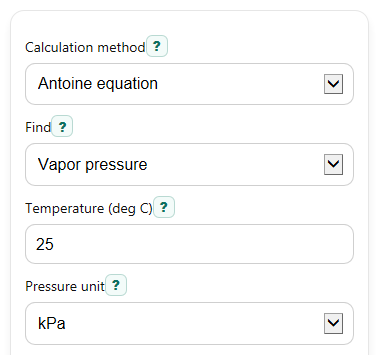
- Pick Calculation method: use Antoine equation when you have Antoine constant A, Antoine constant B, and Antoine constant C; use Clausius-Clapeyron estimate when you know one reference pressure-temperature point and Heat of vaporization (kJ/mol).
- Choose Find. Enter Temperature (deg C) to get vapor pressure, or enter Vapor pressure to match to get temperature. Keep all pressure entries in the selected Pressure unit.
- Fill in only the inputs for your chosen method. For Antoine, enter the constants and, if you know them, the Antoine valid from (deg C) and Antoine valid to (deg C) values in Advanced options. For Clausius-Clapeyron, enter Known temperature (deg C), Known vapor pressure, and Heat of vaporization (kJ/mol).
- Click Calculate, then read Calculated vapor pressure or temperature first. Check Method note, Validity check, and Units used so you know whether the answer is a fitted value or an estimate and whether your unit choice matches your source.
- Do a quick sanity check: if you solve for temperature at a higher pressure, the result should usually be a higher boiling temperature; if you solve for pressure at a higher temperature, the vapor pressure should usually be larger.
Definitions
Vapor pressure: The pressure made by a vapor above its liquid in a closed space. Higher vapor pressure usually means the liquid evaporates more easily.[3]
Boiling temperature: The temperature where a liquid's vapor pressure matches the surrounding pressure.
Antoine constants A, B, C: Numbers used in a fitted equation for one pure substance over a limited temperature range.
Antoine log base: Tells whether the Antoine equation uses base-10 logarithm or natural log. It must match your coefficient source.
Known temperature (deg C) and Known vapor pressure: The reference point used by the Clausius-Clapeyron method.
Heat of vaporization (kJ/mol): The energy needed to turn 1 mole of liquid into vapor.
Validity check: A message showing whether your Antoine calculation temperature is inside the entered coefficient range.
Common mistakes and quick fixes
Mistake: Entering Known vapor pressure in atm while Pressure unit is set to kPa.
Fix: Make Pressure unit match the units used for both Known vapor pressure and Vapor pressure to match .
Mistake: Using Antoine constant A , Antoine constant B , and Antoine constant C from a source that uses a different pressure convention than your selected Pressure unit .
Fix: Use constants and pressure units from the same source, then read Units used to confirm what the calculator assumed.
Mistake: Picking Clausius-Clapeyron estimate for a wide temperature jump and treating the result like exact data.
Fix: Read Method note . Clausius-Clapeyron is an estimate because Heat of vaporization (kJ/mol) is treated as constant.
Mistake: Leaving Heat of vaporization (kJ/mol) blank or entering 0.
Fix: Enter a positive value for Heat of vaporization (kJ/mol) ; otherwise the Clausius-Clapeyron logarithm step cannot give a physical answer.
Mistake: Entering a temperature that makes the Antoine denominator zero, such as Temperature (deg C) = negative Antoine constant C .
Fix: Change Temperature (deg C) or use a different coefficient set so Antoine constant C plus temperature is not 0.
Mistake: Ignoring the Validity check when the entered temperature is outside Antoine valid from (deg C) and Antoine valid to (deg C) .
Fix: Treat the answer as less reliable outside that range, or switch to coefficients that cover your temperature.
Limitations & Key Assumptions / Boundary Conditions
- This calculator is for a pure substance, not mixtures, solutions, humidity, or Raoult's law problems.
- Antoine results are only as good as the entered coefficient set and the pressure-unit convention that came with that set.
- Antoine constants usually work only over a limited temperature range. Outside that range, the calculator can still compute a number, but accuracy may drop.
- Clausius-Clapeyron is an estimate because it assumes heat of vaporization stays constant over the temperature interval and that the vapor behaves ideally.[1]
- All Clausius-Clapeyron temperatures are converted to kelvin internally, so inputs that would lead to 0 K or below are physically impossible and should be rejected.
- Pressure must be greater than 0 because the logarithm step in both methods cannot use zero or negative pressure.
- Real lab or plant values can differ because of impurity, measurement error, pressure-reference differences, or coefficient data taken from a different source.
Methodology
What the calculator does
The calculator solves one of two common pure-substance vapor-pressure relationships. It can find vapor pressure from temperature or find temperature from pressure, depending on your Find choice.
Antoine method
This method is usually the better choice when you already have a matching set of Antoine constants for your substance and temperature range.
log10(P) = A - B / (C + T)
T = B / (A - log10(P)) - C
ln(P) = A - B / (C + T)
T = B / (A - ln(P)) - C
Here, P is vapor pressure in the pressure unit tied to the coefficient source, and T is temperature in deg C. The calculator first evaluates the equation in the coefficient source pressure convention, then converts to your chosen Pressure unit for display.
Mini-example: with water-like constants A = 8.07131, B = 1730.63, C = 233.426, base-10 form, and T = 100 deg C, the calculator gives about P = 760.086 mmHg. That is essentially normal atmospheric pressure, so the result is consistent with boiling near 100 deg C.
Clausius-Clapeyron method
This method is best when you know one reference pressure-temperature point and want an estimate at another temperature or pressure.[1]
ln(P2 / P1) = -(DeltaHvap / R) * (1 / T2 - 1 / T1)
P2 = P1 * exp(-(DeltaHvap / R) * (1 / T2 - 1 / T1))
1 / T2 = 1 / T1 - (R / DeltaHvap) * ln(P2 / P1)
The calculator converts deg C to K with K = deg C + 273.15. It converts Heat of vaporization (kJ/mol) to J/mol, and uses the gas constant R = 8.314462618 J/mol/K.
Mini-example: if T1 = 100 deg C, P1 = 101.325 kPa, DeltaHvap = 40.65 kJ/mol, and you want pressure at T2 = 25 deg C, the calculator gives about P2 = 3.756 kPa.
How the suitability check is interpreted
Method note explains whether your answer comes from a fitted Antoine correlation or a Clausius-Clapeyron estimate. In plain language, Antoine is usually preferred when you have trustworthy constants for the right range, while Clausius-Clapeyron is more of a physics-based estimate between two states.
Validity check appears for Antoine when you enter Antoine valid from (deg C) and Antoine valid to (deg C). If your temperature is outside that range, the calculator still shows the math result but warns that accuracy may be poor.
Assumptions used
The calculator assumes a pure substance, consistent units, positive pressures, and valid numeric inputs. Antoine assumes your constants, pressure convention, and log base all match. Clausius-Clapeyron assumes nearly constant heat of vaporization over the interval and ideal-vapor behavior, so larger temperature jumps can increase error.[1]