
Choose your kinetics data to calculate the reaction rate constant k, its correct units, and the equation used.
Table of contents
How to use our Rate Constant Calculator
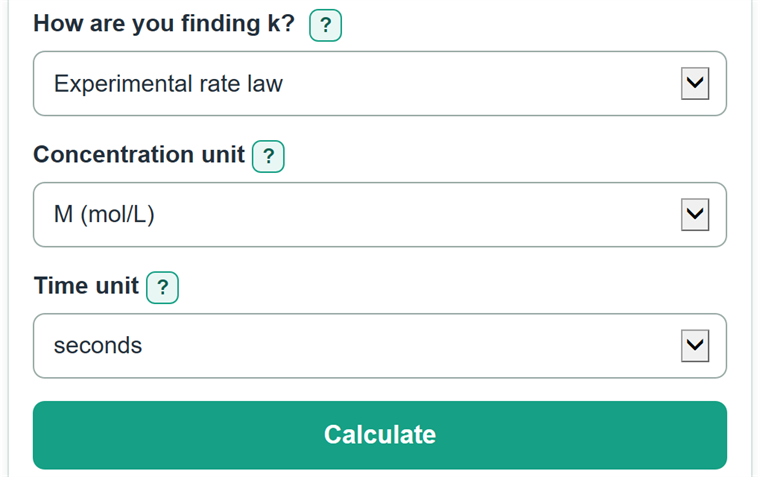
- Choose "How are you finding k?" based on the data in your problem, rate table, graph, or lab record.
- Choose the concentration unit and time unit that match the source values.
- Enter the fields shown for that method. For concentration vs. time, select the known reaction order before entering the two concentrations and elapsed time.
- Select "Calculate" to see k first, followed by its units and the substituted equation.
- Sanity-check that the displayed equation matches the stated reaction order and that the units for k use the same time basis as your source data.
Definitions
Rate constant (k): The proportionality constant in a rate law or integrated rate law. Its units depend on reaction order.
Reaction order: The exponent on a reactant concentration in a rate law. Overall order is the sum of the exponents for all included reactants.
Reaction rate: A concentration change per unit of time, such as M/s.
Integrated rate law: An equation that relates a reactant concentration to elapsed time for a known reaction order.
Half-life: The time for a reactant concentration to fall to one-half of its starting value. The half-life equation in this calculator applies only to first-order kinetics.
M: Molarity, or moles of substance per liter of solution. One M equals 1,000 mM.
Common mistakes and quick fixes
Mistake: Using the half-life method for a zero-order or second-order reaction.
Fix: Select "First-order half-life" only when the problem or experiment identifies first-order behavior.
Mistake: Entering a later concentration that is larger than the initial concentration.
Fix: Check the measurement order. The concentration vs. time path models reactant decay, so the later concentration must be less than or equal to the initial concentration.
Mistake: Entering reactant B concentration but no order for reactant B.
Fix: Enter both "Reactant B concentration (optional)" and "Order for reactant B (optional)," or leave both fields blank.
Mistake: Mixing seconds and minutes in values from the same calculation.
Fix: Convert source values to one time basis before entering them, then choose that shared unit.
Mistake: Copying k without its units.
Fix: Copy "Units for k" with the number. The concentration power in the units changes with overall reaction order.
Limitations & Key Assumptions / Boundary Conditions
- The concentration vs. time method supports only zero-, first-, and second-order integrated laws for one reactant.
- The concentration vs. time path is limited to reactant decay, so the later concentration cannot exceed the initial concentration.
- First- and second-order concentration calculations require both concentrations to be greater than zero because their equations use a logarithm or reciprocal.
- The half-life calculation uses k = ln(2) divided by half-life and applies only to first-order kinetics.
- All active concentration values must share the selected concentration unit, and all active time values must share the selected time unit.
- The calculator finds k from a supplied reaction order and measurements; it cannot determine reaction order from one concentration pair or one rate-table row.
Methodology
Equations used
The selected method determines the equation. Integrated rate laws relate concentration and elapsed time when reaction order is already known. [1]
Experimental rate law: k = rate / ([A]^m x [B]^n x [C]^p); omit factors for unused reactants
Zero order: k = ([A]0 - [A]t) / t
First order: k = ln([A]0 / [A]t) / t
Second order: k = (1 / [A]t - 1 / [A]0) / t
First-order half-life: k = ln(2) / half-life
Units for k
For an experimental rate law, overall order is m + n when reactant B is included, or m when it is blank. The units for k are concentration^(1 - overall order) per time. A first-order rate constant can therefore be written as s^-1, while a second-order rate constant can be written as M^-1 s^-1. The calculator keeps the selected M or mM and seconds, minutes, hours, or days in the displayed units.
Worked mini-example
For first-order data with [A]0 = 0.80 M, [A]t = 0.20 M, and t = 30 min, the concentration ratio is 4.
k = ln(0.80 / 0.20) / 30 = 0.0462098 min^-1
The positive value matches a concentration decrease over positive elapsed time. If the two concentrations are equal, the supported concentration-time calculation gives k = 0.