
Enter actual and theoretical product amounts to calculate percent yield, or choose a missing yield to solve for it.
Table of contents
How to use our Percent Yield Calculator
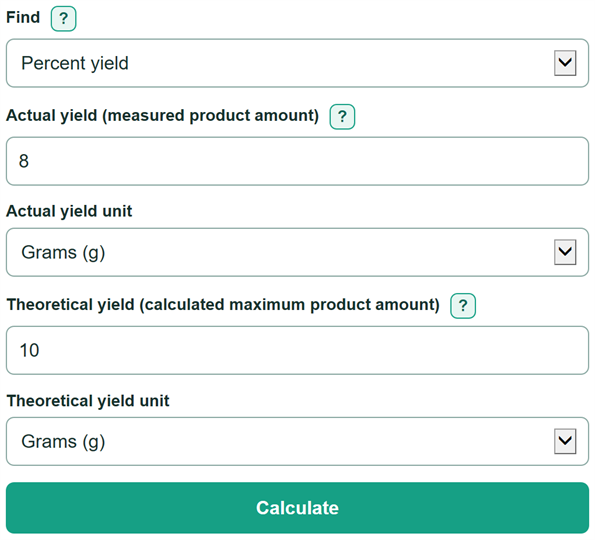
- Choose whether to find percent yield, actual yield, or theoretical yield.
- Enter the known product amount or amounts and select the unit shown in your lab record or problem.
- For a missing actual or theoretical yield, enter the stated percent as a whole number, such as 80 for 80%.
- Enter the product molar mass in g/mol if one yield is a mass and the other is in moles.
- Check that the answer has the unit you expected. A percent above 100% calls for a review of the measurements and theoretical-yield work.
Definitions
Actual yield: The amount of product actually recovered and measured after a reaction.
Theoretical yield: The greatest amount of product predicted from stoichiometry using the limiting reactant. [1]
Percent yield: Actual yield written as a percentage of theoretical yield.
Limiting reactant: The reactant used up first, which limits the amount of product that can form.
Molar mass: The mass of one mole of a substance, usually expressed in g/mol. It converts between a product mass and an amount in moles.
Common mistakes and quick fixes
Mistake: Reversing actual yield and theoretical yield.
Fix: Actual yield is the product recovered and measured. Theoretical yield is the calculated maximum amount of product.
Mistake: Entering the starting reactant mass as theoretical yield.
Fix: Enter the predicted amount of product from the balanced-equation and limiting-reactant calculation.
Mistake: Comparing grams with moles without a molar mass.
Fix: Enter the positive molar mass of the product in g/mol when one yield is mass and the other is moles.
Mistake: Typing 0.80 for an 80% target.
Fix: Enter 80 because the Percent yield (%) field expects a percent, not a decimal fraction.
Mistake: Accepting a result above 100% without checking it.
Fix: Check product drying, impurities, contamination, balance readings, units, and the theoretical-yield calculation.
Mistake: Using a theoretical yield of zero.
Fix: Percent yield is undefined when theoretical yield is zero. Recalculate the expected product amount first.
Limitations & Key Assumptions / Boundary Conditions
- The actual and theoretical values must describe the same product from the same reaction.
- The calculator does not perform the balanced-equation, stoichiometry, or limiting-reactant calculation needed to obtain theoretical yield.
- Mass units convert directly among mg, g, and kg. A mass-to-moles comparison requires a positive molar mass for that product.
- A theoretical yield of zero makes percent yield undefined. A target percent of zero is valid only when finding actual yield.
- A result above 100% is calculated normally, but moisture, impurities, contamination, incorrect units, weighing errors, or an incorrect theoretical yield can cause it.
- The calculation reports the relationship between entered amounts; it does not identify purity, contamination, or experimental error.
Methodology
Calculation
Percent yield compares the measured product amount with the calculated maximum product amount. The calculator converts mg, g, and kg to grams before comparing them. When one entered amount is mass and the other is moles, it uses the entered product molar mass to put both amounts on the same basis.
percent yield = (actual yield / theoretical yield) × 100
To find actual yield, the calculator multiplies theoretical yield by the entered percent divided by 100.
actual yield = theoretical yield × percent yield / 100
To find theoretical yield, it divides actual yield by the entered percent written as a decimal.
theoretical yield = actual yield / (percent yield / 100)
Worked example
If 8 g of product is recovered and the theoretical yield is 10 g, the percent yield is (8 / 10) × 100 = 80%. If the theoretical yield is 10 g and the stated percent yield is 80%, the calculated actual yield is 8 g. The theoretical yield comes from stoichiometry using the limiting reactant. [1]