
Enter molarity or solute mass and final volume to calculate solution normality in N for your reaction's n-factor.
Advanced options
Table of contents
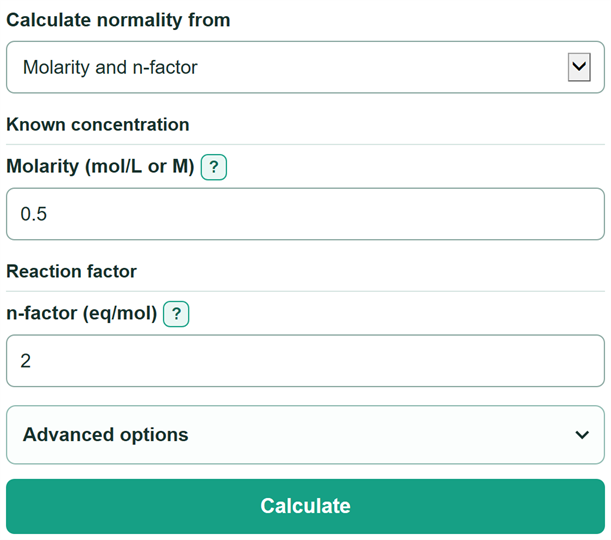
How to use our Normality Calculator
- Choose the method that matches your known data: molarity, or solute mass and final solution volume.
- Enter the n-factor from the balanced reaction, titration endpoint, or written laboratory method.
- For the mass method, enter the solute mass, the molar mass for the exact reagent form, and the finished solution volume; then choose mL or L.
- If you use the reaction helper, select a case only when its reagent and endpoint match your reaction, then confirm it before calculating.
- Check that the displayed n-factor basis and volume used match your intended reaction and units before using the normality.
Definitions
Normality (N): Reactive equivalents per liter of final solution. One N is one equivalent per liter (eq/L).
Molarity (M): Moles of solute per liter of solution. M and mol/L have the same numeric value.
n-factor: The number of reactive equivalents per mole for the stated reaction and endpoint.
Equivalent: A reaction-based amount. Multiplying moles by the n-factor gives equivalents.
Equivalent weight: Molar mass divided by the n-factor, measured in grams per equivalent (g/eq).
Final solution volume: The total volume after preparation. The calculator converts this value to liters for the mass method.
Common mistakes and quick fixes
Mistake: Treating molarity and normality as the same value in every problem.
Fix: Multiply molarity by the reaction-specific n-factor. They are equal only when the n-factor is 1.
Mistake: Choosing an n-factor from the formula alone without checking the reaction endpoint.
Fix: Use the balanced reaction or laboratory method. Phosphoric acid, for example, can have different factors at different neutralization endpoints.
Mistake: Entering 500 while L is selected for the final volume.
Fix: Enter 500 with mL selected, or enter 0.500 with L selected.
Mistake: Using the starting water amount instead of the final solution volume.
Fix: Use the total finished volume after the solute is dissolved and the solution reaches its final mark.
Mistake: Using a molar mass for a different reagent form.
Fix: Match the molar mass to the exact labeled substance, including any hydrate form.
Limitations & Key Assumptions / Boundary Conditions
- Normality depends on the reaction and endpoint, so one solution can have different normalities for different reactions.
- The optional reaction helper covers only its listed acid-base cases. For other reactions, determine the n-factor from the balanced equation or written method.
- Mass-based results assume the entered solute mass, molar mass, and final volume describe the same exact reagent preparation.
- The calculation does not adjust for reagent purity, dilution mistakes, temperature effects, incomplete dissolution, or titration endpoint error.
- Zero molarity or zero solute mass gives zero normality when the other required values are valid. The n-factor, molar mass, and final solution volume must be greater than zero.
Methodology
Calculation
Normality is a reaction-specific concentration measured as equivalents per liter. For a stated reaction, the calculator multiplies molarity by the entered n-factor. [1]
N (normality in eq/L) = M (molarity in mol/L) × n-factor (eq/mol)
For the mass method, the calculator finds moles from solute mass and molar mass, multiplies by the n-factor to find reactive equivalents, and divides by the final solution volume in liters.
moles = solute mass (g) / molar mass (g/mol)
equivalents = moles × n-factor
normality = equivalents / final solution volume (L)
equivalent weight (g/eq) = molar mass (g/mol) / n-factor
The calculator divides an entered mL volume by 1000 to convert it to liters.
Worked example
A solution contains 9.80 g of solute with a molar mass of 98.00 g/mol. It is prepared to 500 mL, and the reaction n-factor is 2 eq/mol. Moles are 9.80 / 98.00 = 0.100 mol. Reactive equivalents are 0.100 × 2 = 0.200 eq. The final volume is 0.500 L, so normality is 0.200 / 0.500 = 0.400 N. The equivalent weight is 98.00 / 2 = 49.00 g/eq.
Reaction helper
A helper selection proposes an n-factor only for its named reagent and endpoint. It must be confirmed, and the visible n-factor must match the proposal. If no helper case is selected, the calculator uses the manually entered n-factor.