
Enter three known solution values to calculate the missing dilution value, including the stock volume to measure and diluent needed to reach the final volume.
Advanced options
Table of contents
How to use our Solution Dilution Calculator
- Choose the value missing from your protocol, worksheet, or preparation plan.
- Enter the three known values and select the unit printed with each concentration or volume.
- Use concentration units from the same family, such as M and mM or g/L and mg/mL.
- Click Calculate. For a standard preparation, measure the stated stock volume and add diluent until the mixture reaches the requested final total volume.
- Check that the target is no stronger than the stock and that the stock transfer is large enough for your measuring tool.
Definitions
Stock concentration (C1): The concentration of the starting solution before diluent is added.
Target concentration (C2): The concentration wanted in the finished solution.
Stock solution volume (V1): The amount of stock solution placed into the mixture.
Final total volume (V2): The total volume after stock and diluent are combined. It is not the diluent amount by itself.
Diluent: The liquid added to lower concentration, often water or the solvent named in a protocol.
Dilution factor: Stock concentration divided by target concentration. A factor of 10 means the stock is 10 times as concentrated as the target.
Percent w/v: Grams of solute per 100 mL of final solution. For example, 1% w/v is 1 g per 100 mL.
X strength: A relative concentration label, such as 10X or 1X. Compare it only with another X-strength value.
Common mistakes and quick fixes
Mistake: Entering the amount of water or other diluent as the final total volume.
Fix: Enter the total volume after stock and diluent are combined. The calculator shows the diluent difference separately.
Mistake: Mixing molar units, such as M, with mass-per-volume units, such as mg/mL.
Fix: Choose stock and target units from the same concentration family. Converting between these families needs chemical-specific information that this calculator does not use.
Mistake: Trying to make a target concentration stronger than the stock by dilution.
Fix: Use a stronger stock, lower the target concentration, or use a different preparation method.
Mistake: Treating the stock volume as the final amount of prepared solution.
Fix: Measure the calculated stock volume first, then add diluent until the final total volume is reached.
Mistake: Ignoring a very small calculated stock transfer.
Fix: Enter a minimum reliable transfer volume if your procedure has one. If the result is smaller, make a larger batch, prepare an intermediate dilution, or use a suitable tool.
Limitations & Key Assumptions / Boundary Conditions
- Stock and target concentrations must be in the same family. The calculator cannot convert molarity to mass-per-volume without chemical-specific information such as molecular weight.
- The calculation applies to an ordinary dilution, where the stock is at least as concentrated as the target. Making a stronger solution requires another method.
- The diluent difference treats volumes as additive. For precise volumetric preparation, add diluent until the solution reaches the final-volume mark.
- The calculation does not account for chemical reactions, density changes, purity, active ingredient differences, temperature effects, sterile technique, or hazardous-material procedures.
- A very small calculated stock transfer can be mathematically correct but unreliable for a particular pipette or procedure. Use the optional minimum reliable transfer volume when it applies.
- A ratio instruction such as 1:10 does not always provide the stock and target concentrations required for this calculation. Follow the wording of the protocol.
Methodology
Calculation method
The calculator uses the standard dilution relationship. C means concentration, V means volume, and the dissolved material is treated as unchanged while diluent is added. [1]
C1 x V1 = C2 x V2
It first converts compatible concentration units to a shared base within their family. M, mM, uM, and nM are molar units. g/L, mg/mL, mg/L, and ug/mL are mass-per-volume units. Percent w/v and X strength remain separate families.
Volumes are converted to mL before solving.
1 uL = 0.001 mL; 1 L = 1000 mL
Missing-value formulas
V1 = C2 x V2 / C1
C2 = C1 x V1 / V2
V2 = C1 x V1 / C2
C1 = C2 x V2 / V1
After both volumes are known, the diluent difference is final total volume minus stock solution volume.
Diluent difference = V2 - V1
Worked example
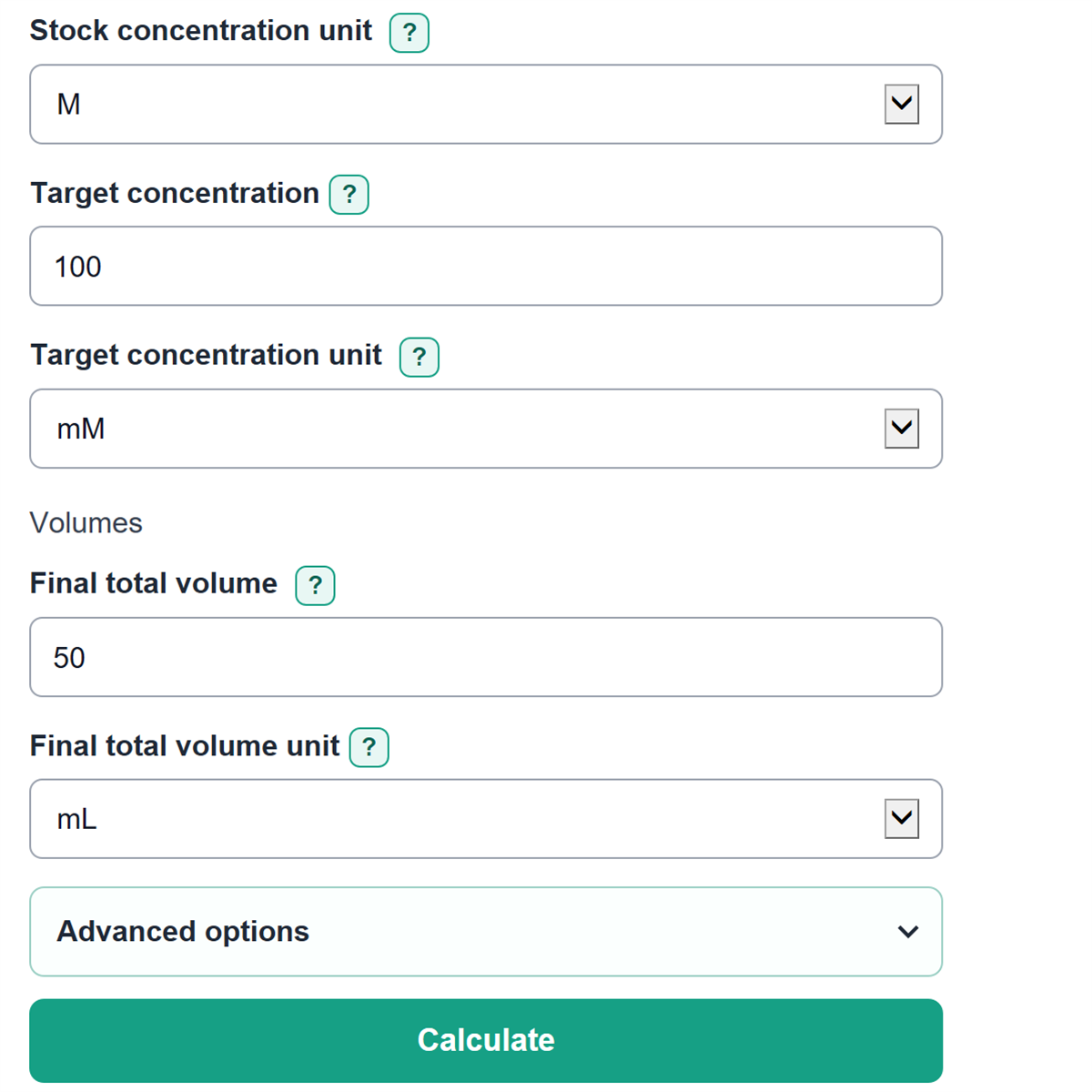
To make 50 mL of 100 mM solution from a 1 M stock, 100 mM equals 0.1 M. The stock volume is 0.1 x 50 / 1, or 5 mL. Measure 5 mL of stock, then add diluent until the total reaches 50 mL. The diluent difference is 45 mL, and the dilution factor is 10.
Displayed decimal places change only the formatting, not the underlying calculation. The calculator stops when a required value is zero or negative, concentration families do not match, or an ordinary dilution would require a target stronger than the stock.