
Estimate heating bill savings and payback from replacing windows using U-factor, window area, local heating degree days, fuel price, and project cost.
Table of contents
How to use our Window Replacement Energy Savings Calculator
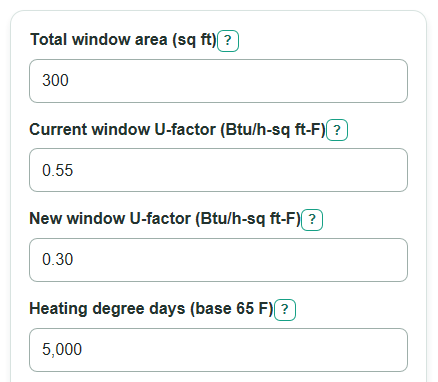
- Enter Total window area for all windows being replaced, not just one window.
- Enter Current window U-factor and New window U-factor from labels, quotes, or a careful estimate; lower U-factor means less heat loss.
- Enter Heating degree days, Heating energy price, and Installed project cost using the units shown in each label.
- Open Advanced options if you want to change Heating system efficiency or add an Energy price increase for future-year savings.
- Check the output: if First-year heating bill savings is tiny compared with Installed project cost, the Simple payback from heating savings will be long even when the U-factor improvement is real.
Definitions
Total window area: The combined area of the windows being replaced, in square feet.
U-factor: A window rating that tells how fast heat moves through the window. A lower U-factor means less heat loss.
Heating degree days: A yearly climate number that estimates how much heating a place needs compared with a 65 F base temperature [1].
MMBtu: One million Btu. A Btu is a unit of heat energy used for fuels and heating bills.
Heating system efficiency: The percent of fuel energy that becomes useful heat indoors.
Simple payback: Installed project cost divided by first-year savings. It shows how many years of heating savings would equal the cost.
Energy price increase: The assumed yearly percent rise in heating energy price used only for the 10-year and 25-year savings totals.
Yearly heat kept indoors: Useful heat that the new windows are estimated to stop from escaping during heating weather.
Common mistakes and quick fixes
Mistake: Entering the size of one window in Total window area.
Fix: Add the area of every replaced window, or multiply average width by height by the number of windows.
Mistake: Mixing Current window U-factor and New window U-factor values from different rating methods.
Fix: Use whole-window U-factor values for both when possible, so the comparison is fair.
Mistake: Using cooling degree days in Heating degree days.
Fix: Use base 65 F heating degree days for your area because this calculator estimates heating savings only.
Mistake: Entering $ per therm directly in Heating energy price.
Fix: Convert natural gas price to $ per MMBtu by multiplying $ per therm by about 10.
Mistake: Putting a yearly bill or monthly bill in Installed project cost.
Fix: Enter the total installed window project cost before comparing it with First-year heating bill savings.
Mistake: Leaving Heating system efficiency blank because it feels optional.
Fix: Use a reasonable percent, or use 100 for electric resistance heat; the calculator needs this to estimate fuel bought.
Limitations & Key Assumptions / Boundary Conditions
- This is a heating-only estimate. It does not calculate cooling savings, solar heat gain, shading, air leakage, comfort, tax credits, or resale value.
- The method estimates conductive heat loss through windows from U-factor, area, and heating degree days. Real homes can differ because of wind, thermostat settings, insulation, curtains, and window installation quality.
- Heating degree days should match your local climate. A nearby city can be a decent estimate, but microclimates and unusually warm or cold years can change savings.
- The fuel price input is $ per MMBtu bought. If your bill has fixed monthly charges, taxes, or tiered rates, actual bill savings can differ.
- Simple payback ignores financing, maintenance, rebates, future repair costs, window life, home value changes, and non-energy benefits.
- Negative savings are possible if the New window U-factor is higher than the Current window U-factor. That means the heating-only calculation estimates higher heating cost.
Methodology
How the heating savings are calculated
The calculator compares old and new window heat loss using U-factor, total window area, and heating degree days. Heating degree days turn a year of weather into a temperature difference over time [1]. The factor 24 converts days to hours.
annual_heat_kept_indoors_btu = (existing_u_factor - replacement_u_factor) * total_window_area_ft2 * heating_degree_days * 24
The saved useful heat is converted to fuel energy bought by dividing by heating system efficiency and by 1,000,000 Btu per MMBtu.
fuel_energy_saved_mmbtu = annual_heat_kept_indoors_btu / (heating_system_efficiency_percent / 100) / 1000000
First-year bill savings multiply saved fuel energy by the heating energy price.
annual_heating_bill_change = fuel_energy_saved_mmbtu * heating_energy_price_per_mmbtu
Simple payback divides project cost by first-year heating bill savings. Payback is shown as unavailable when first-year savings are zero or negative, or when project cost is not positive. Simple payback is a common screening measure, but it is not the same as a full life-cycle cost analysis [2].
simple_payback_years = project_cost / annual_heating_bill_change
Long-term savings keep the same physical heat savings each year. If the energy price increase is zero, the calculator multiplies first-year savings by the number of years. If the increase is not zero, it adds a growing yearly savings series.
n_year_savings = annual_heating_bill_change * (((1 + g)^n - 1) / g)
n_year_savings = annual_heating_bill_change * n when g = 0
The cut in window heat loss rate compares the U-factor change only.
window_heat_loss_cut_percent = ((existing_u_factor - replacement_u_factor) / existing_u_factor) * 100
Mini-example
With 300 sq ft of windows, a current U-factor of 0.55, a new U-factor of 0.30, 5,000 heating degree days, 90% heating system efficiency, and $18 per MMBtu, the useful heat kept indoors is 9.0 MMBtu per year. The fuel energy avoided is 10.0 MMBtu per year, so first-year heating bill savings are $180. If the installed project cost is $18,000, the simple payback from heating savings is 100 years. With no energy price increase, estimated 10-year heating savings are $1,800.
Sources
- Degree-days - U.S. Energy Information Administration (EIA) - EIA
- DOE/NREL Building America - Measure Guideline: Energy-Efficient Window Performance and Selection (includes simple payback discussion) - Energy
- ENERGY STAR - Draft Version 6.0 Criteria & Analysis Report for Windows, Doors, and Skylights (includes simple payback calculations) - Energystar
- ENERGY STAR - Characterization of Energy Savings and Thermal Comfort Improvements from Interior Storm Windows (payback example) - Energystar