
Compare duct leakage test ratios and model bill savings and payback using a separately entered energy-savings assumption.
Enter an energy-audit estimate or a scenario to test. This is separate from the duct leakage test; 10% is an illustrative starting assumption.
Table of contents
How to use our Duct Sealing Savings Calculator
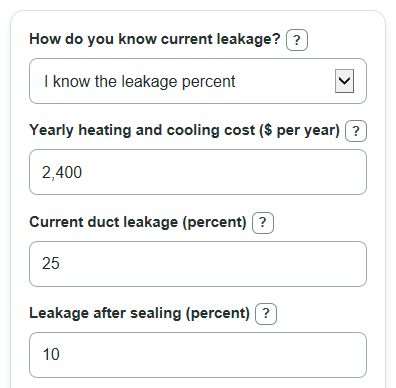
- Choose How do you know current leakage? Use percent if you already have a leakage rate, or choose the CFM25 test option if you have a duct test report.
- Enter Yearly heating and cooling cost. Use only the part of your utility bills tied to heating and cooling, not your full household energy bill unless that is all you have.
- Enter Current duct leakage, or enter Duct test reading and System airflow if you chose the CFM25 mode.
- Enter Leakage after sealing and Duct sealing cost, then select Calculate.
- Check the leakage test ratio separately from "Expected heating and cooling bill savings (%)". The test ratio is not an operating energy-loss percentage; changing it does not change the separately assumed bill saving.
Definitions
CFM25: Cubic feet per minute of air leakage measured while a duct system is held at 25 pascals of test pressure. It is a duct test reading, not a percent.
System airflow: The airflow, in cfm, that the tested HVAC system moves. The calculator compares CFM25 to this number to estimate leakage percent.
Current duct leakage: The entered leakage percentage, or CFM25 divided by the entered system airflow. A test-pressure ratio does not establish the fraction of airflow or energy lost during normal operation.
Leakage after sealing: The expected duct leakage percent after the sealing work is done.
Simple payback time: Duct sealing cost divided by estimated yearly savings. It is shown only when the estimated yearly bill change is positive.
Estimated 10-year money left after sealing cost: Ten years of modeled savings minus the duct sealing cost. A negative value means the modeled savings do not cover the cost within 10 years.
Common mistakes and quick fixes
Mistake: Using the whole utility bill as Yearly heating and cooling cost when much of the bill is for lights, appliances, or water heating.
Fix: Enter the best estimate of heating and cooling cost only; if you are not sure, treat the result as a rough project screen.
Mistake: Entering Duct test reading as a percent instead of the measured CFM25 number.
Fix: In CFM25 mode, enter the airflow leakage reading from the duct test report, such as 300 CFM25.
Mistake: Mixing up System airflow with house square footage or equipment size.
Fix: Enter system airflow in cfm for the tested HVAC system, not square feet, tons, or return grille size.
Mistake: Assuming a reduction in leakage percentage equals the reduction in energy bills. Fix: Enter "Expected heating and cooling bill savings (%)" from an applicable energy assessment or use it explicitly as a scenario.
Mistake: Typing a range such as 20-30 for Current duct leakage or Leakage after sealing.
Fix: Enter one number. If you want a range, calculate the low case and high case separately.
Mistake: Entering rebates or tax credits inside Duct sealing cost without deciding what cost you want to compare.
Fix: Use the out-of-pocket project cost after rebates if you want payback on what you actually pay.
Limitations & Key Assumptions / Boundary Conditions
- Bill savings use "Expected heating and cooling bill savings (%)", entered independently from the leakage test. Neither CFM25 nor a leakage-percentage reduction alone establishes energy savings.
- Real savings can differ because duct location, climate, equipment efficiency, run time, comfort settings, and repair quality affect actual energy use.
- CFM25 is measured at a fixed test pressure. Its ratio to system airflow is not the fraction of heat, cooling, or energy bills lost during normal operation.
- If Duct test reading is greater than System airflow, the calculator still computes a percent above 100, but that usually means the inputs or test context should be checked.
- The 10-year result does not include energy price inflation, maintenance changes, equipment replacement, financing cost, rebates, tax credits, or time value of money.
- A higher after-sealing leakage entry is flagged for review. It does not automatically change the separately entered bill-savings assumption.
Methodology
How the calculator turns inputs into savings
If you choose the percent mode, Current duct leakage is used directly. If you choose the CFM25 mode, the duct test reading is divided by System airflow and converted to a percent.
current_leakage_percent = measured_cfm25 / system_airflow_cfm * 100
The cost cards compare the whole entered heating and cooling bill before and after the separately assumed energy saving.
bill_before = annual_hvac_cost
bill_after = annual_hvac_cost * (1 - expected_bill_savings_percent / 100)
"Estimated yearly bill change after sealing" is the difference between the entered HVAC bill and the bill after applying the separate savings assumption.
estimated_annual_savings = bill_before - bill_after
Average monthly change uses 12 months per year.
estimated_monthly_savings = estimated_annual_savings / 12
Simple payback time is calculated only when yearly savings are positive.
simple_payback_years = sealing_cost / estimated_annual_savings
The 10-year net result keeps the sign, so a negative value means the entered savings do not cover the project cost over 10 years.
ten_year_net_savings = estimated_annual_savings * 10 - sealing_cost
The leakage removal percent compares the leakage drop with the starting leakage.
leakage_cut_percent = (current_leakage_percent - sealed_leakage_percent) / current_leakage_percent * 100
Worked mini-example
For a $2,400 annual HVAC bill and a separately assumed 10% bill saving, annual savings are $240. A $1,200 project has a 5-year simple payback and $1,200 net savings over 10 years. A 300 CFM25 test divided by 1,200 cfm is a 25% test ratio; it does not establish the 10% energy saving.
Calculation choices
The model is designed for quick project comparison, especially when a homeowner or contractor has a duct test report. ENERGY STAR describes duct sealing as a common way to reduce heating and cooling losses from leaky ducts [1]. This calculator does not model house load, duct location, weather, or fuel type separately; those practical limits are listed in the limitations section.